


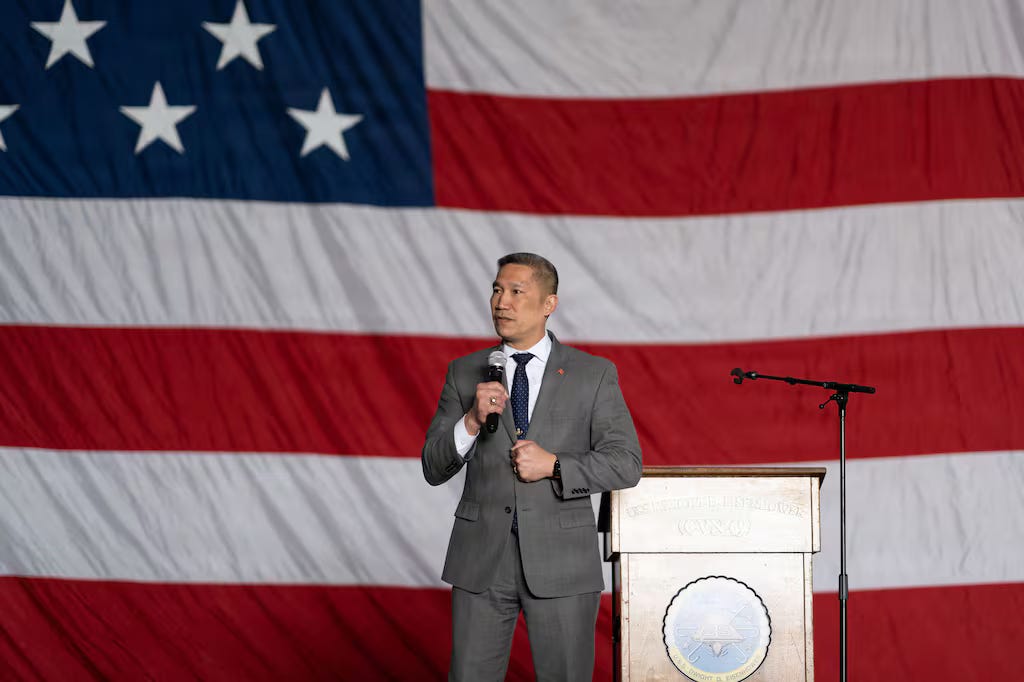
Acting Navy Secretary Hung Cao onboard the Nimitz-class aircraft carrier USS Dwight D. Eisenhower last April 7, 2026. Photo by MCS2 Miguel Santiago/U.S. Navy
Rodney J. Jaleco | September 16, 2026
WASHINGTON D.C. (Sept, 13, 2026) —When acting Navy Secretary Hung Cao admitted Iranian forces “blew the hell out” of a key US in Bahrain, he acknowledged for the first time the extent of damage inflicted by Iran — something the Pentagon downplays as it insists it’s a spent force — and now fuels internal discussion whether the US should pull back in Asia and build a defensive line out of range of Chinese missiles and suicide drones.
Cao’s statement was a rare rebuttal of Pres. Trump’s frequent boast the US has already defeated Iran, destroyed its air force and navy. Bahrain hosts the headquarters of the US 5th Fleet. Navy chief Adm. Daryk Caudle said they’re not going back to Bahrain “anytime soon” because of the damage. Significant damage was also reported on Al Udeid Air Base in Qatar and Camp Arifjan in Kuwait. The CIA’s outpost in Riyadh was effectively destroyed and other bases in Saudi Arabia and Kuwait also took hits from Iranian missiles and drones.
Reports by CNN, from the Washington Post and other news outlets say the Pentagon policy office, Joint Staff and CENTCOM, are quietly evaluating options for 2027, including re-aligning forces currently arrayed in the so-called First Island Chain in the western Pacific — a defensive line from Alaska running through Japan, Taiwan, the Philippines and Australia.
Instead, the US could strengthen a Second Island Chain running from Guam and Saipan, to Papua New Guinea and Australia. They are about 2,500-3,000 kilometers from China, outside most of China’s conventional ballistic missiles except for the Dongfeng-26 with a reduced payload.
The 2025 National Security Strategy reviews echo this priority for “long range crewed and uncrewed aircraft and weapons that effectively operate outside the range of China’s anti-access/area denial (A2/AD) systems.”
An analysis by the think tank RAND anticipates that “Washington is very likely to continue shoring up its defensive posture in the Second Island Chain to support joint operations in First Island Chain theaters, including in the Taiwan Strait, East China Sea and South China Sea.”
The Philippines is the heart of the First Island Chain, a critical deterrent to Chinese ambitions on Taiwan and the South China Sea. The Enhanced Defense Cooperation Agreement (EDCA), on paper, allows rotational access to nine Philippine military bases across the country but in reality, the US has forces in many other parts of the country — Special Operations, radar/ISR, logistics and prepositioned equipment.
Any strategic shift will have to be made after consultations with the Philippines and other allies in the region, principally Japan and Australia, with major stakes in preserving the integrity of vital sea lanes and island choke points. It will also likely run afoul with congressional initiatives aimed at stopping China in their own backyard, not closer to the US West Coast.
As part of a multi-year, $500 million military assistance package, the US will help expand port facilities in Buliluyan, Palawan, including a new assault boat service bay, and upgrade the Antonio Bautista Air Base, an EDCA facility, in Puerto Princesa city next year. (Also read: When the Hallowed Past is Desecrated at the Altar of Political and Material Expediency)
The port, currently a hub for Philippine Coast Guard (PCG) cutters operating in the West Philippine Sea, will undergo a $9 million upgrade to support not only the PCG’s existing 13-cutter fleet but also the 45 coming with help from Japan and France.
Projects along Palawan’s western coast will pave the way for the deployment of fast boats and unmanned surface vessels (USVs). The US has transferred at least nine USVs to the Philippine Navy since 2024 but the transfer of armed drones will accelerate next year. The US tested USVs, including the Triton and Ukraine’s Magura, during the Balikatan war games last April-May. Capitol Hill has allocated $100 million for military assistance to the Philippines in 2027.
US resolve — challenged by some because of decisions made in the Ukraine and Iran wars — is critical to deterring China, especially in Taiwan. Drones have become the weapon of choice for asymmetrical warfare and the US, just like Russia, have suffered serious setbacks from supposedly inferior military foes. The US has used up so much precision munitions and reportedly, a third of its Patriot missiles but it has not stopped Iran.
Any perceived doubt about where or whether the US would hold the line if a feared clash with China comes, does immense strategic damage to the multilateral approach to containing the threat. There may have been lessons learned in Iran that can be applied elsewhere and for some future conflict, but retreat cannot be part of them.
