


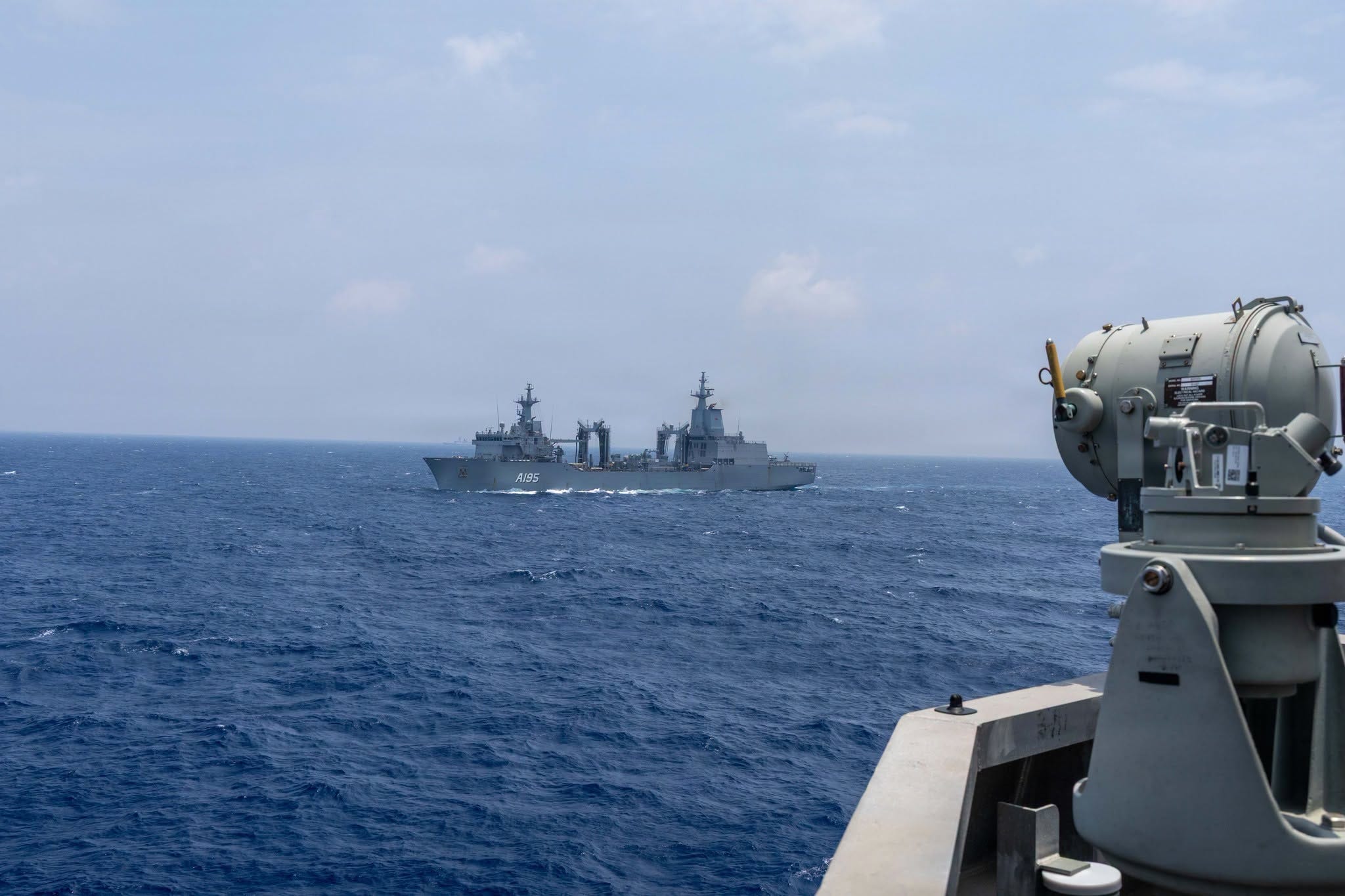
The Royal Australian Navy supply ship HMAS Supply (A195) participated in the 19th multilateral maritime cooperative activity last August 19-25, 2026 within the Philippine Exclusive Economic Zone. Photo from US Pacific Command.
Manuel Mogato | August 26, 2026
MANILA — The United States Pacific Command (USPACOM) and the Australian Defence Force (ADF) joined the Philippine Navy in another multilateral maritime cooperative activity (MMCA) in the West Philippine Sea, the 19th iteration since 2024.
A military spokesman, Colonel Xerxes Trinidad, said the one-week activity enhanced maritime interoperability and operational coordination among the participating forces through a series of complex maritime and air operations designed to strengthen their capability to operate seamlessly together in support for a free, open, and secure Indo-Pacific. (Also read: No scaling down in joint exercises with the US — Philippines)
He sad the Philippines deployed the BRP Diego Silang (FFG7), a Philippine Navy AW109 helicopter, Philippine Air Force FA-50 fighter aircrafts, C-208B aircraft, and Sokol Search and Rescue (SAR) helicopter.
The Philippine Coast Guard also participated through the deployment of BRP Teresa Magbanua (MRRV-9701), he added.
For the United States, it sent USS Santa Barbara (LCS-32) and P-8A Poseidon aircraft, while Australia deployed HMAS Supply (A-195), along with MH-60R helicopter and P-8A aircraft. (Also read: What’s the reason behind US expansion of military engagements in the Philippines?)
Throughout the activity, participating the three navies conducted advanced maritime interoperability exercises, including Communications Exercises (COMMEX), Maritime Domain Awareness (MDA), Anti-Submarine Warfare (ASW), Replenishment at Sea (RAS), Division Tactics (DIVTACS) / Officer of the Watch (OOW) Maneuvers, Photo Exercise (PHOTOEX) and fly-by operations.
“The successful completion of the 19th MMCA underscores the enduring commitment of the Philippines, the United States, and Australia to strengthening defense cooperation, enhancing interoperability, and promoting peace, stability, and security in the Indo-Pacific region,” Trinidad said.