

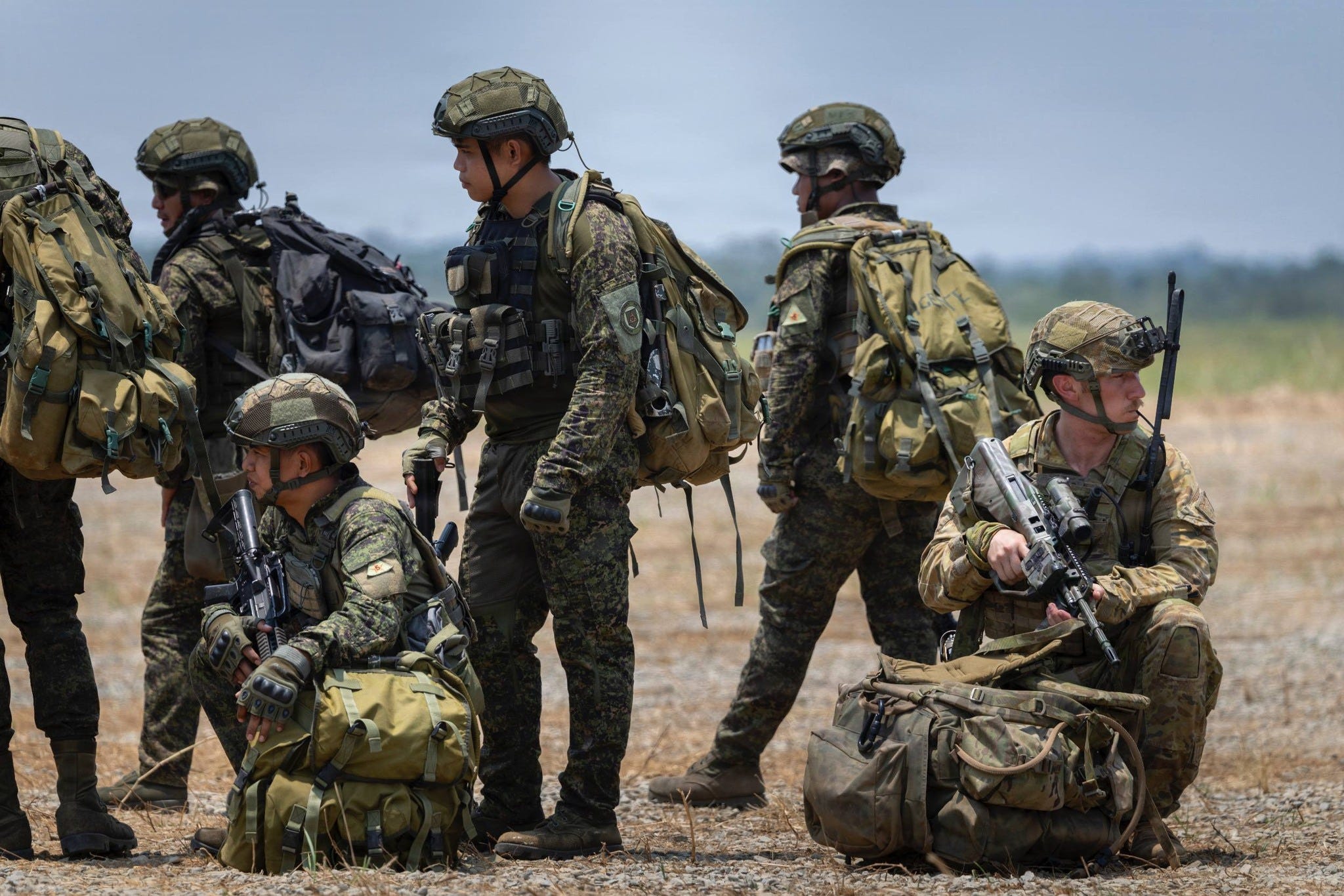
Military personnel from the US Army, Australian Army, and the Armed Forces of the Philippines conducted CH-47 Chinook cold-load training in Lal-lo, Cagayan Province last April 2022. Photo by U.S. Army Sgt. Olivia Cowart
Rommel C. Banlaoi | May 13, 2026
After a 19-day “largest-ever” multinational military drill, the 41st Iteration of Exercise Balikatan concluded on May 8, 2026. The drill coincided with the historic commemoration of the 75 years of the Mutual Defense Treaty, the legal anchor of Philippine-American security alliance.
From a usual military exercise, Balikatan 2026 was a game changer as it became a great geopolitical event reflecting the Philippines’ growing strategic role in the Indo-Pacific. Manila is now faced with the enormous challenge on how to strengthen its military alliance with the United States and its regional security partners while sustaining on-going bilateral dialogue for a reset of relations with China, a permanent neighbor next door with whom it shares highly contested waters and deep economic ties. (Also read: The Philippines as ASEAN Chair Should Build Bridges of Cooperation Through a Code of Conduct in the South China Sea)
This year’s Balikatan exercises were the largest in history, so far, involving Filipino and American forces alongside contingents from Japan, Australia, Canada, France, and New Zealand with a total of 17,000 troops participating. These exercises demonstrated that the Philippines was no longer confined to a bilateral alliance with the US but is now part of a broader military coalition of likeminded states in Asia seeking to deter coercive activities in the South China Sea.
While the Balikatan aims to enhance Manila’s defense posture, Beijing regards it as a strong provocation being part of Washington’s containment strategy. (Also read: Chinese vessels observe Philippine maritime drills with allies)

Japan’s participation is of particular security concern. With more than 1,000 Ground Self-Defense Force troops deployed, Tokyo took a groundbreaking step toward a greater, yet highly controversial, security role. For Manila, this development raises sensitive questions. The Philippines must avoid becoming a problematic platform for Japan’s rearmament agenda, mindful of painful historical memories and wary of being drawn into Tokyo’s new strategic ambitions. (Also read: Japan may transfer lethal weapons to the Philippines)
There are security risks associated with the recently concluded military drills. Japan’s deeper involvement could entangle the Philippines in broader Indo-Pacific rivalries as China could respond with stronger actions in the South China Sea. This can raise the danger of miscalculation and unintended violent encounter at sea. Over-reliance on U.S. security guarantees, on the other hand, may also prevent Manila to achieve strategic autonomy as constitutionally mandated.
Thus, the Philippines cannot afford to exclude China. The Balikatan must be framed as a military activity aiming to strengthen interoperability on maritime domain awareness, humanitarian assistance and disaster response, and external defense. While doing the Balikatan, dialogue with Beijing must continue whether through joint oil and gas exploration, fisheries cooperation, or maritime safety protocols. These initiatives show that Manila can pursue security with one hand and diplomacy with the other.
Balikatan 2026 is both a triumph and a test of its security strategy. It can demonstrate the Philippines’ ability to mobilize a defense ally and security partners in order to project military strength. But it can also highlight the fragility of its strategic position caught between the gravitational pull of Washington and the economic magnetism of Beijing.
Manila, therefore, needs to walk the tightrope without falling by striking the balance: strengthening alliance with the U.S. while sustaining dialogue with China, building the appropriate deterrence while avoiding provocation, and embracing security partners without undermining strategic autonomy. (Also read: Friends to all, enemies to no one)
If Manila fails to maintain the delicate strategic balance between asserting sovereignty and managing external alliances, the annual Balikatan exercises could shift from being a symbol of resilience to a reminder of its strategic vulnerability. Instead of showcasing the Philippines’ ability to strengthen its defense posture and regional partnerships, the drills might highlight its exposure to the pressures of growing great power rivalry. In such a scenario, the Philippines will be perceived not as a proactive actor shaping its security environment, but as a pawn or proxy caught between competing interests of larger powers.
Moreover, the transformation of Balikatan into a symbol of vulnerability would have profound implications for regional stability. It could reinforce the narrative that the Philippines is the frontline state in great powers’ geopolitical contest in Asia, making it a focal point for military competition and diplomatic maneuvering. Such a role would increase the risks of escalation in the South China Sea and beyond, while also straining domestic politics as leaders grapple with the consequences of heightened exposure.
Ultimately, the failure to strike this strategic balance could undermine Manila’s long-term goal of securing peace and prosperity, leaving the country vulnerable to external shocks and internal political divisions. (Also read: Take-aways from Balikatan 2026)
To avoid this tragic fate, the Philippines must continue to pursue confidence-building measure and development diplomacy with China to stabilize ties, deepen regional cooperation beyond military drills, and assert its strategic autonomy in shaping its national and regional security agenda.
Rommel C. Banlaoi, PhD, is the President of Philippine Society for International Security Studies and Director of Philippines-China Studies Center at Diliman College.