


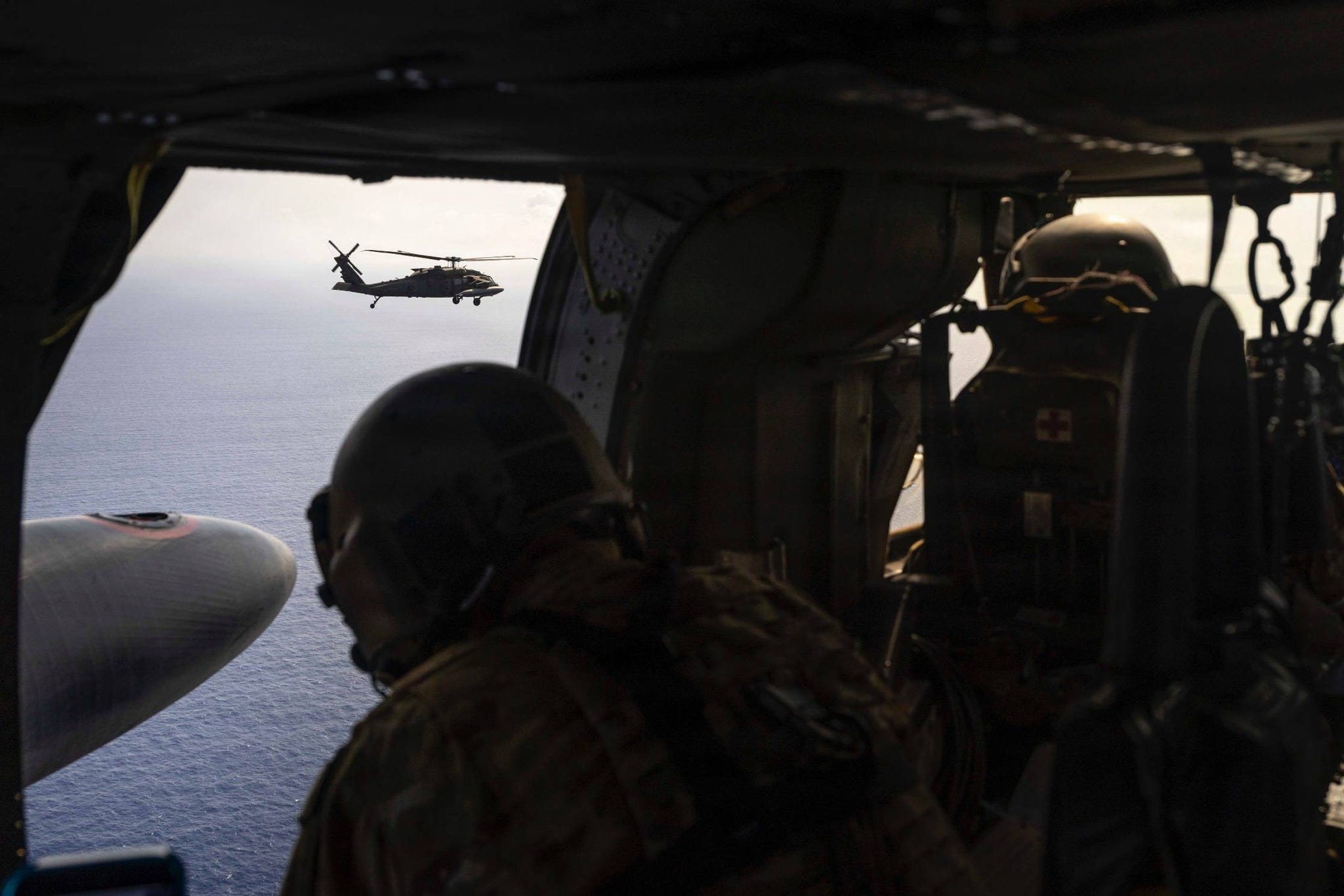
American soldiers deployed Sofar Ocean Spotters, ocean buoys used to provide real-time environmental data, in the Luzon Strait last April 28. Photo by U.S. Army Sgt. Olivia Cowart
Rodney J. Jaleco | May 12, 2026
WASHINGTON D.C. — As the 41st iteration of the Balikatan joint training exercise came to a close last week, there was little doubt about the vital role of the Philippines and the international resolve to help it hold the line against Chinese adventurism, particularly in neighboring Taiwan. Tactics were validated, logistics tested and learnings shared among this year’s seven-nation coalition — Japanese troops were back in the Philippines for the first time since the end of the Pacific War.

Balikatan has evolved from anti-insurgency to global security mission
The Balikatan joint training exercise was an offshoot of the 75-year-old Mutual Defense Treaty (MDT) between the Philippines and United States, initially to help the Armed Forces of the Philippines (AFP) wage counter-insurgency warfare against both the Maoist New People’s Army and secessionist Muslim militants, and after the 9/11 attacks in the US, the Abu Sayyaf terror group.
The rise of China from regional to global threat prompted the AFP to refocus on its traditional role of external defense. Japan first joined the annual exercise as an observer in 2016 but did not become a full-fledged participant until nine years later, even as NATO members Netherlands, Lithuania, Czech Republic and Poland were accepted as observers. The Philippines has Visiting Forces Agreements with the US (since 1998), Australia (2007), Japan (2024), New Zealand and Canada (2025), and France earlier this year.
In addition, the Philippines has an Enhanced Defense Cooperation Agreement (EDCA) that allows the US to “rotate” combat forces in AFP camps, naval and air bases, as well as stockpile equipment and supplies for troop mobility and sustainment, logistics, and humanitarian and disaster relief (HADR). There are nine EDCA sites that run the length of the archipelago although the US is reportedly looking into additional sites. (Also read: US plans to set up fuel storage facilities in Mindanao)
Adm. Samuel Paparo, US INDOPACOM chief, characterized the latest iterations of the Balikatan as “rehearsal for the defense of the Philippines.”
All the preparations are directed against China — though everyone is careful not to mention it by name — that has embarked on a massive militarization with an avowed goal to grab Taiwan and stop anyone who might try to stand in their way, especially the US.
Japan was the one Xi didn’t see coming
The over 1,400 troops Japan deployed for the Balikatan rivaled that from the US and host Philippines which some analysts saw as a clear indication of their commitment to the defense of the Philippines.
The Philippines has long been considered the “weakest link” in a chain that stretches from the Aleutians south to South Korea and Japan, the Philippines, Indonesia, down Papua New Guinea to northern Australia.
It is also the most proximate to Taiwan, aside of course from China and Japan’s southern frontier islands. Chinese president Xi Jinping erased any ambiguity about Taiwan in a 2019 speech, declaring reunification as an “unstoppable” part of the “Chinese Dream” and refused to rule out force. They’re amid a long-term military modernization that aims to turn the People’s Liberation Army (PLA) as a “world class force” by 2049. Xi’s speech however predated a fundamental shift in strategy and policy from a rival neighbor.
Japan has only recently shifted from its passive, defensive posture to a proactive deterrence strategy — defense spending spiked by 21 percent in 2024 alone, to over $55 billion and is on course to raise its share of GDP to two percent by 2027. Prime Minister Sanae Takaichi, emboldened by a strong electoral mandate, is accelerating the modernization and working with allies like the US, Philippines and Australia to strengthen their ability to tame China’s adventurism.
Japan did make a splash in the Balikatan 00 deploying the Hyuga-class helicopter destroyer JS Ise 00 in reality, an aircraft carrier but because Japan vowed not to build any more aircraft carriers after WWII, is classified as a “helicopter destroyer”. They also fired a salvo from the J-88 anti-ship mobile missile, destroying an old minesweeper.
How Japan’s military resurgence, including its expanded involvement in regional security, will sway Xi Jinping’s calculations on Taiwan is still subject to conjecture, but it’s not something the Chinese can easily dismiss.
Littoral Deep Battle: Applying lessons from Ukraine
This year’s Balikatan was not only the biggest but also the most complex so far. There were two counter-invasion exercises hundreds of miles apart, in Sandy Dunes, Ilocos Norte, near the northernmost point of the Philippines, and in Balabac Island, on the southwestern pole of the archipelago.
The US tried out its “Littoral Deep Battle” strategy that was developed from lessons of the Ukrainian assault on the Russian Black Sea Fleet. Using a combination of indigenous marine and aerial drones, and US and NATO-supplied cruise missiles, Ukraine forced Russia to withdraw its surface ships and submarines from their Crimea bases even without a navy of its own.
The US used Ghost X drones to detect a simulated invasion force off the Ilocos coastline where US, Philippine, Japan, Australia and New Zealand troops — formed as “Task Force Lightning” — used machine guns, artillery, drones and J-88 ship killers to repulse the “Red Force” that were using amphibious vehicles interestingly enough, painted in PLA camouflage patterns. In an added layer of complexity, the allied defense was orchestrated by the Marine Expeditionary Force (MEF) from the AFP headquarters hundreds of kilometers away.
In Balabac Island, US Marines from Rotational Force Darwin and 25th Infantry Division, 5/7 Australian Battalion and 61st Philippine Marine Reconnaissance Company dropped off by V-22 Ospreys, helicopters and amphibious vehicles departing from Puerto Princesa — 200 miles away — captured the small airport and paved the way for deploying HIMARS launchers from the US Multi-Domain Command’s 7th Infantry Division. (Also read: US reaffirms ironclad commitment to the Philippines)
It’s evident Balikatan has become a laboratory for the US and an opportunity for partner militaries to work in combined arms fashion — incorporating the latest drone technology — under centralized command and control. These lessons are portable and with some tweaking can be used equally well in the Philippines as in, say, Taiwan.
A new confidence with help from friends
When asked to comment on Chinese criticism against Balikatan, Defense Secretary Gilberto Teodoro’s pointed retort was for them to mind their own business. He accused China of engaging in espionage, cybercrime, human trafficking and industrial espionage all across Southeast Asia. China, Teodoro averred, is “a dictatorship and whose military suppresses its own people.” (Also read: Chinese vessels observe Philippine maritime drills with allies)
AFP chief Gen. Romeo Brawner Jr. expressed a desire to expand the Balikatan even more, eyeing some Southeast Asian neighbors who’ve recently clashed with Chinese maritime forces. “We welcome as many countries as possible,” he said.
Philippine leaders have stressed that the annual joint training exercise forms part of a deterrence strategy against foreign aggressors. For the first time, the US used the Typhon medium-range system — the weapon that China appears to fear most — to fire off an unarmed Tomahawk cruise missile from the Tacloban airport in Central Philippines to a bogey about 600 kilometers away in Fort Magsaysay on Luzon Island.
The Philippines, US and Japan have apparently used Balikatan to deliver a message to China. It fulfills the last and perhaps most important leg of the “3 C’s” of deterrence — capability, credibility and communication. The show of force by the Philippines’ friends has afforded it with new-found confidence even as the defense and security establishment continue to face perils and powerful headwinds in and outside the country.