


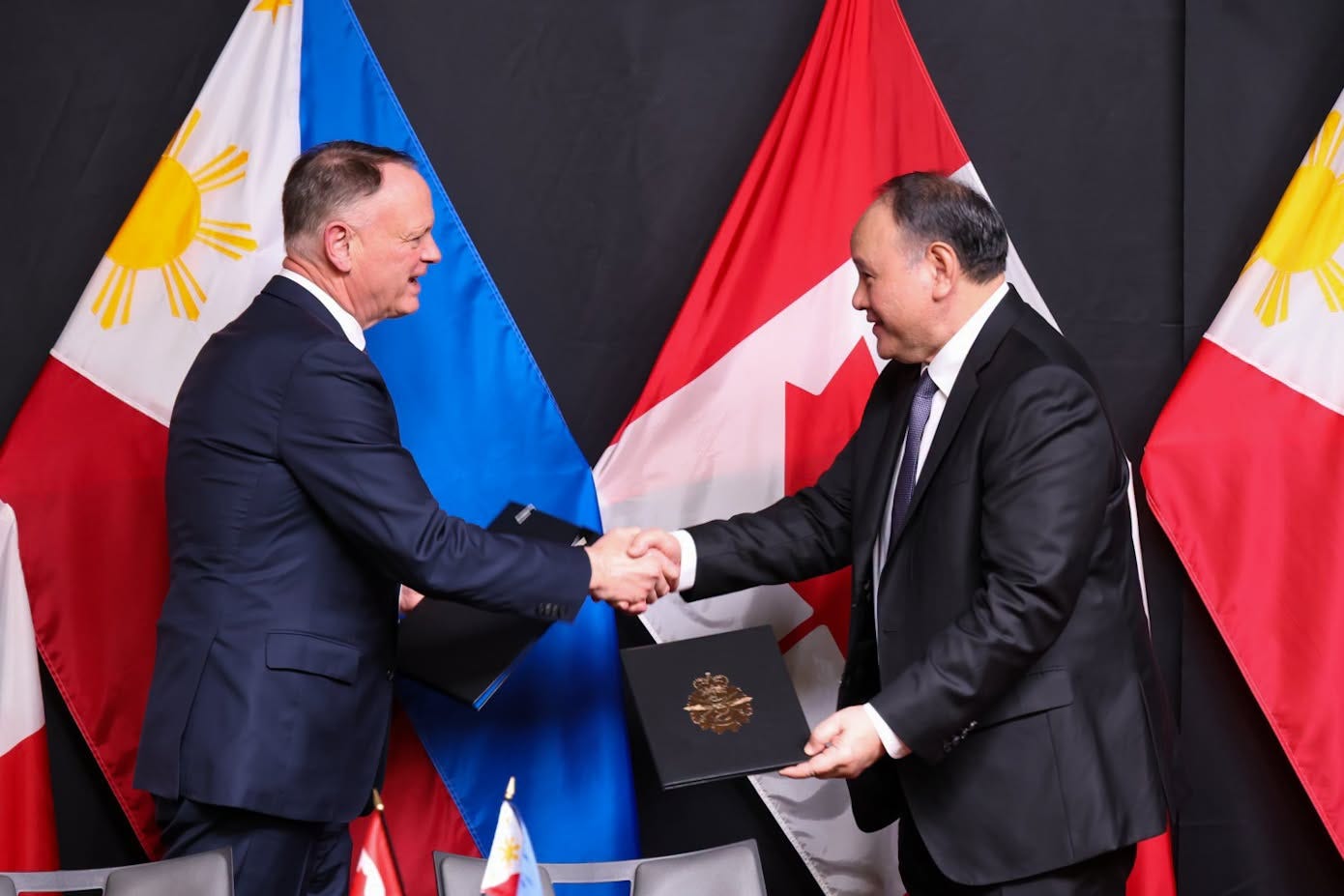
Secretary of National Defense Gilberto C. Teodoro, Jr. met with Canada’s Minister of National Defence David McGuinty for the Defense Ministers’ Meeting (DMM) in Ottawa last June 11. Official handout.
Manuel Mogato | June 15, 2026
MANILA — Canada has signed a second military-to-military agreement with the Philippines, a clear intention to expand its presence and activities in the world’s emerging volatile region.
After entering into a Status of Forces Agreement (SOFA) with the Philippines in November, Canada signed a second agreement last week, a mutual logistics deal that would ensure its troops, taking part in military training and exercises thousands of miles from home in a tropical archipelago, have ample fuel, food, and other essentials.
Canada’s Defense Minister David McGuinty hosted Philippine Defense Secretary Gilberto Teodoro Jr, who made a watershed visit to Canada to sign the “Intent on Strengthening Defense Cooperation”, which includes the military logistics deal.
It was a strategic move as Ottawa plans to deploy a guided-missile frigate in the region every year, a symbolic presence that signals a shift from Europe to the Indo-Pacific.
Canada also plans to open a regional military office in Manila, headed by a senior general, to coordinate military cooperative activities in the region.
Why in Manila?
The Philippines is the only country in the region that has a Status of Visiting Forces Agreement (SOVFA) and a Mutual Logistics and Service Agreement (MLSA).
Canada is one of six countries with which the Philippines has a SOVFA. It also has similar arrangements with the United States, Australia, France, Japan, and New Zealand.

It also has an MLSA, the third country after the United States and Japan.
Canada was among the first countries to provide “real-time” information on vessel movements and positions in the South China Sea through its satellite-based dark vessel detection system.
Although the program focuses on illegal, unreported, and unregulated (IUU) fishing that contributes to global destruction of marine habitat and depletion of fish stocks, it also has a security dimension as it tracks Chinese militia vessels that switch off location identification devices, called automatic identification system (AIS), to evade monitoring, control, and surveillance.
Ottawa has also assisted the Philippine Navy in training to operate and maintain conventional submarines, even though it doesn’t offer to sell such vessels, unlike South Korea and France.
Even before Canada formalized its military deals with the Philippines, it has joined maritime security drills, such as the “Sama-Sama” exercises in the central Philippines and the Maritime Cooperative Activities with other like-minded countries, such as Australia, France, Germany, Japan, New Zealand, the United Kingdom, and the United States.
Incidentally, Germany’s leader will visit Manila this week to cement security and economic ties with the Philippines.
Germany, France, and Canada are among the North Atlantic Treaty Organization (NATO) members that have shown keen interest in ensuring the Indo-Pacific region is open and free.
Europe and Canada’s economic interests are tied to the region, ensuring the flow of goods remains unhampered as China asserts control over the South China Sea. (Also read: The Dutch are back in Manila after 400 years, not for the spices, but to protect trade routes)
About $3 trillion of seaborne goods pass annually through the strategic sea lanes in the South China Sea, one of the most important trade routes other than the Strait of Hormuz.
Global trade would be disrupted if China controls the South China Sea, choking maritime routes from the narrow Strait of Malacca to Northeast Asia and the Pacific, and finally to Canada’s western frontiers.
That is how important Indo-Pacific security is to Canada as trade with the region accelerates and investments in the region grow, especially in agriculture, mining, and technology.
Canada has also been helping train the Philippines to improve its cybersecurity, hardening its networks to repel constant attacks that may compromise its national security.
It would not be a surprise if Canada’s next step is to enter into a General Security of Military Information Agreement (GSOMIA) with the Philippines to provide more valuable “real-time” information. (Also read: Teodoro expresses concern about espionage case in defense department)
As uncertainties about the United States’ “ironclad” commitment to the region hang, the Philippines should welcome Canada’s interest in trade, investment, and security cooperation.
Like Japan and other like-minded countries in the region and elsewhere, Canada is concerned with China’s expansion and security intentions, particularly in Taiwan, a major global source of semiconductors.
Manila should take advantage of Ottawa’s keen interest in the region, forging closer economic and security ties.
Manila would gain valuable experience not only in cybersecurity but also in advanced military technology.
Canada may have smaller military capabilities than the United States and even Japan. However, the Philippines needs all the cooperation of like-minded nations, no matter how small, to counter China’s creeping influence in the region.
Remember, the rice stalks that are bound together are much stronger than one in facing an adversary.
