


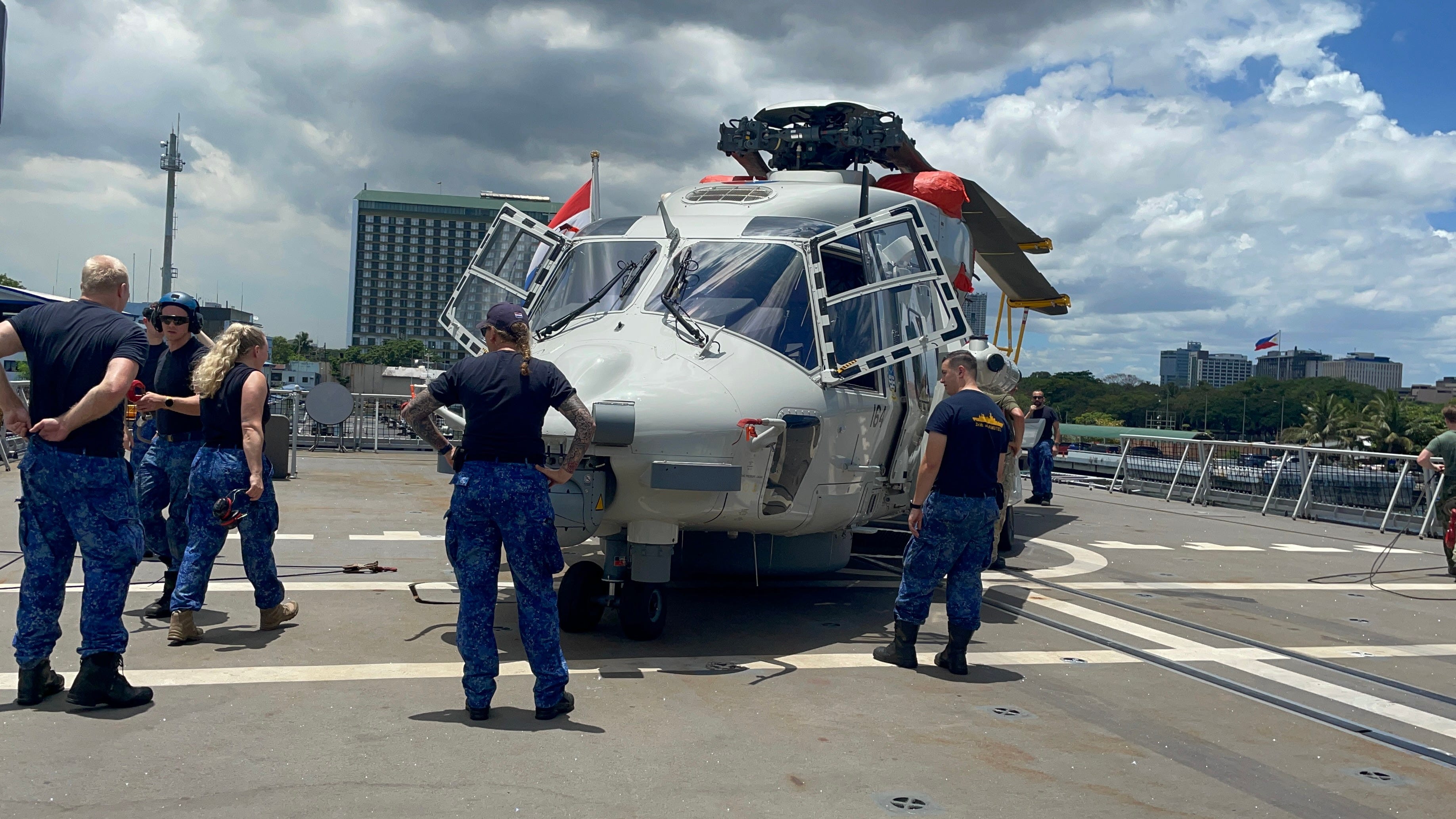
Crew of HNLMS De Ruyter reposition the NH-90 helicopter aboard the ship on Friday, May 22, during their port call in Manila. Photo by Anna Mogato.
Manuel Mogato | May 25, 2026
MANILA — In the 16th century, European powers raced against each other to secure trade routes and control the spice trade in Southeast Asia.
The Portuguese, Spanish, Dutch, and English seized territories in this part of the world in search of riches: raw materials and minerals to fuel their engines of growth.
Most countries in the region remained exploited colonies of waning European powers until the second half of the 20th century.
The rise of new world superpowers — the United States and the former Soviet Union — forced the European powers to retreat, giving up their colonies in this part of the world.
The French lost Indo-China, the English gave up Brunei, Malaysia, and Singapore, the Spanish ceded the Philippines, and the Dutch freed Indonesia.
However, in the 21st century, there was a sudden interest in Western Europe to return to Southeast Asia.
Europe said it is back, not for the spices and other riches, but to secure trade routes that may affect its economic lifeblood.
Invoking the rules-based global order and freedom of navigation, France, Germany, Great Britain, and now the Netherlands have sent warships to the South China Sea, where about $3 trillion worth of trade passes annually.
The commanding officer of a Dutch guided-missile frigate, HNLMS De Ruyter, Commander Rodger de Wit, articulated European’s renewed interest in the region.
“The Indo-Pacific region, and especially Southeast Asia, is really important for Europe and the Netherlands, because a huge chunk of its trade goes by sea, from here to Europe, and keeping stability and freedom of navigation, in this area, is a vital role for us to keep the trade flowing towards Europe,” de Wit said, as the Dutch warship made a brief port call to Manila.
“We are strong supporters of freedom of navigation, and the UN Security Council for the resolution of the law of the sea. It doesn’t matter if that’s the North Sea, the South China Sea, or wherever […] and that’s the reason why we’re here to promise that freedom of navigation and keep the seas open and to keep the trade going.”
Is Europe only interested in securing global trade routes? Or does Europe’s interest lie beyond freedom of navigation and the rule of law?
Did the United States ask its European allies to help police one of the world’s most volatile sea lanes as Washington’s dominance wanes and countries in the region begin to doubt its “ironclad” commitment to deter a rising China?
But what can Europe and the North Atlantic Treaty Organization do to stop China when they struggle in their own backyard against threats from Russia after it crossed into Ukraine in early 2022?
Washington has pulled out some troops in Berlin and redeployed them to the Middle East as conflict with Tehran has dragged on for months.
Europe and NATO were forced to increase defense spending to 5 percent of their GDP and strengthen their deterrence capabilities.
Germany, for instance, set aside $100 billion to rebuild its army, recruit more soldiers, and upgrade capabilities to contain Russia. (Also read: Germany seeking closer defense ties with Philippines)
However, Europe and NATO have to spend more to help the United States counter China’s creeping influence, not only in the Indo-Pacific region, but in other parts of the world — the Pacific, South America, Africa, and the Middle East.
Europe and NATO’s discomfort with China surfaced after it joined Russian military drills along their eastern borders.
Chinese vessels have also started showing up in the Arctic Ocean, posing a direct threat to Europe and NATO.
With limited capabilities and a smaller fleet, it is highly doubtful if European powers, including NATO, can make a difference in the Indo-Pacific’s security architecture.
Commander De Wit’s big words should be matched with actions. However, the Netherlands has only four guided-missile frigates, and can commit only one vessel in the region every two years.
The Philippines, the weakest among Washington’s allies in the first island chain, similarly has four missile-guided frigates.
It was puzzling why Europe is suddenly interested in this region when it has to remain focused on its own region, with the four-year conflict in Ukraine.
France signed a status-of-forces arrangement with the Philippines. The United Kingdom, Germany, and the Netherlands have expressed similar defense arrangements with the Philippines.
What can these military-to-military activities contribute to the Philippines’ increased deterrence capabilities?
Or are these arrangements part of a sales pitch to offer European and NATO armaments to an emerging weapons-systems market in the region?
The exercises and training exchanges are a way to introduce European defense equipment that could enhance interoperability, a cheaper alternative to US defense equipment.
European defense manufacturers had sold naval guns on vessels, anti-submarine warfare (ASW) helicopters, trainer planes, armored vehicles, and combat utility helicopters.
They are also offering conventional submarines, multi-role fighters, and trainer jets.
Southeast Asia, particularly the Philippines, must be wary of Europe’s real intentions in the region. (Also read: Why countries in Southeast Asia should not fear Japan?)
In the end, it boils down to business interests.
Europe is back, not to take the spices, but to offer weapon systems and, at the same time, help contain China, which has started to show on its own borders.