


Manuel Mogato | April 20, 2026
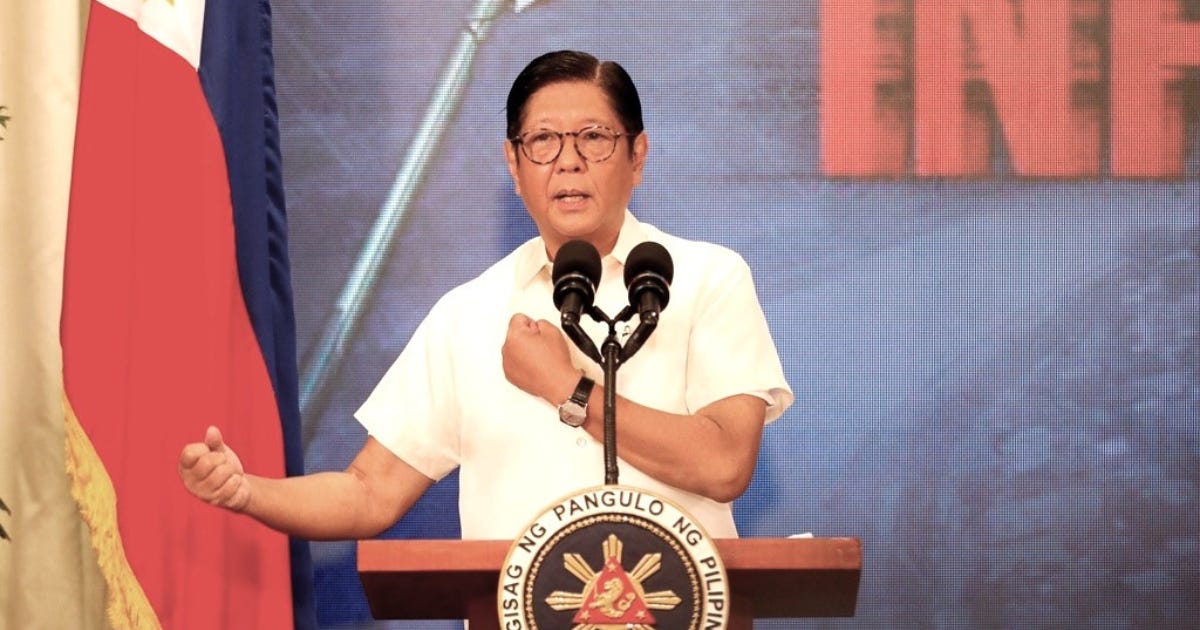
MANILA — When Ferdinand Marcos Jr assumed the presidency in July 2022, he pursued an independent foreign policy, saying the Philippines would be a “friend to all and an enemy to one.”
But the West Philippine Sea issue prevented him from warming relations with China, and his government slid closer to the United States and other Western allies.
After four years in office, Marcos expanded security and economic relations with the United States, Japan, Australia, New Zealand, Canada, and some European powers, forging status-of-forces agreements to allow these states to exercise and train in the country.
The annual joint and combined “Balikatan” drills have evolved into a multilateral exercise, separate from the multilateral maritime cooperative activities, which steadily grew from 2024 to about 16 iterations.
Apart from a trilateral deal with the US and Japan, and with the US and Australia, the Philippines also had the SQUAD arrangement with Australia, Japan, and the United States.
The Philippines moved farther from Russia and China, which intensified its bullying tactics in the West Philippine Sea, ignoring international laws, particularly the 2016 decision made by the Permanent Court of Arbitration in The Hague.
But the conflict in the Middle East could change the equation. The Philippines was forced to deal with Russia, China, and Iran to ensure a steady supply of petroleum products. (Also read: Thinking out of the box)
The Quad security dialogue among Australia, India, Japan, and the United States, and the AUKUS arrangement among Australia, the United Kingdom, and the United States don’t matter anymore to assure countries in the region of a stable supply of oil.
Suddenly, a rival organization, the Shanghai Cooperation Organization (SCO), based in Beijing, rose to prominence due to the global oil shock.
For instance, Pakistan, one of the 10 SCO member-states, was instrumental in brokering talks to end the conflict between Iran and the United States.
Although no agreement was reached after the initial 21-hour negotiations in Islamabad, there were still hopes that the two sides would reach a deal.
Most of the Arab states — Bahrain, Kuwait, Qatar, Saudi Arabia, and the United Arab Emirates — were also SCO partners, making it important during these times of crisis.
Formed in 2001 as a security, political, economic, and counter-terrorism organization among 10 Euroasian countries, the SCO covers 24 percent of the world’s land area and 42 percent of the global population.
It rose to prominence when the North Atlantic Treaty Organization (NATO) and the QUAD security dialogue distanced themselves from the Middle East conflict.
The fact that most of the Arab states affected by the Iran conflict were part of the 17 SCO partner-states makes it hard for the world to ignore such an organization.
The Iran conflict has thrust the SCO as one of the main centers of the new multi-polar world, capable of countering all present-day threats and challenges.
The Philippines has opened negotiations with Russia for an oil supply deal and with Iran to allow vessels bound to the Philippines safe passage in the Strait of Hormuz.
Marcos said his government is now open to dealing with China for joint oil and gas exploration in the West Philippine Sea, despite protests from some sectors worried about Beijing’s sincerity.
Perhaps, it would help the Philippines if it became an observer or a SCO partner-state, like two other Southeast Asian countries, Cambodia and Myanmar, two of the closest Chinese allies in the region.
Geography binds the Association of Southeast Asian Nations (ASEAN) and the SCO to cooperate and foster closer relations.
Both organizations share the goal of providing security and stability in the region, as well as promoting trade and investments, economic and development assistance, culture, and tourism.
Tighter coordination and cooperation between ASEAN and SCO would better address regional threats and challenges, like food and energy security, terrorism, and international crime, such as drug, arms, and human trafficking.
As ASEAN chair, the Philippines can enhance the cooperation and coordination between the bloc and the SCO.
ASEAN should resist efforts by the US and its allies to discredit the SCO and bring the bloc behind the Western alliance, defeating its goal as a bridge between NATO and the US on one side, and the SCO on the other.
The SCO has moved from a purely military-focused organization compared to QUAD and AUKUS
By joining the SCO, the Philippines will diversify its relations, balancing its foreign policy with China, India, Pakistan, Russia, Central Asian, and Middle Eastern countries, and its Western allies.
President Marcos would leave behind a legacy of an independent foreign policy by bridging relations with the US-led alliance and the SCO states.
By then, the Philippines can crow about that it is a friend to all and enemy to no one.