


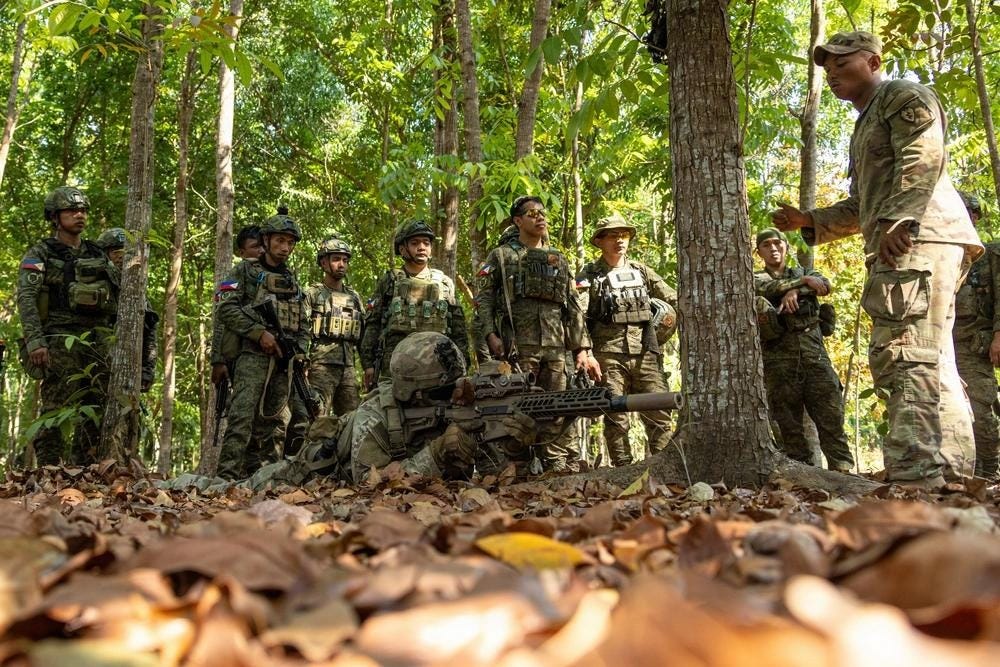
Philippine Army and US Army Pacific 25th Infantry Division troops conduct a bilateral squad live-fire during Exercise Salaknib 2026 in Fort Magsaysay, Nueva Ecija. Photo taken from Philippine Army Facebook page.
Manuel Mogato | April 24, 2026
The Armed Forces of the Philippines (AFP) is not equipped, trained, or tasked to fight external threats.
Since the country’s independence from the United States in July 1946, its military has been trained, equipped, and oriented for pacification missions — quelling agrarian unrest in the countryside.
During the war, pro-American guerrillas were sabotaging and fighting Japanese occupation forces alongside Communist-inspired HUKBALAP fighters in central Luzon.
But, after the war, the HUKs continued to fight the government, demanding distribution of farms to landless peasants nationwide.
In the late 1960s, the HUKs and the Soviet-backed Partido Komunista ng Pilipinas (PK) were replaced by the Maoist-led Communist Party of the Philippines (CPP) and its armed wing, the New People’s Army (NPA).
Although Filipinos fought gallantly in Korea in the 1950s, the country did not have experience in fighting conventional warfare in the succeeding years until today.
Filipino soldiers were only sent on peacekeeping duties from the 1960s in Congo to the most recent in monitoring the ceasefire between Cambodia and Thailand.
The Philippines has always depended on the United States for external defense, as Washington maintained two large overseas bases in Clark and Subic until the Philippine Senate voted to end the bases agreement in September 1991.
When the last American sailor left in November 1992, the Philippines learned the truth — it has zero external defense capability.
The air force has limited radar coverage and no fighters to interdict intruders. Its navy has no submarines, no minesweepers, no credible surface combatants. The Air Force and Navy had no missiles.
Most of the assets were World War II-vintage and Vietnam War era helicopters.
The ground forces grew, expanding the number of infantry battalions, but were structured to fight an insurgency.
When the modernization program was introduced in 1995, the Army was supposed to be trimmed to three infantry divisions and eight separate infantry brigades.
The military was supposed to invest in defense systems for the air force and the navy, reducing manpower to save on costs.
A generation later, the Philippines had failed to implement these reforms. Worse, the Army grew fatter to 11 infantry divisions as internal threats worsened in the early 2000s - the resurgence of the NPAs and the emergence of Islamist militants with links to international terrorist groups.
With both Islamist militants and Communist rebels reduced to almost insignificant threats, President Ferdinand Marcos Jr. has ordered the military to shift to external defense.
But there have been no significant changes in the armed forces’ structure, organization, equipage, and training.
Although Defense Secretary Gilberto Teodoro Jr has unveiled the Comprehensive Archipelagic Defense Concept (CADC), the Armed Forces still have to implement its transformation into an external defense force.
The Army is still configured as a territorial force spread across the archipelago, and neither the Air Force nor the Navy has expanded their personnel to reflect the increasing number of vessels and aircraft.
In other countries, such as Germany and Japan, the armed forces have been downsized due to fewer recruits joining the military.
In the Philippines, the number of people joining the military continued to increase. However, these recruits should be trained in new combat skills and technical expertise, such as operating, maintaining, and sustaining modern vessels, aircraft, drones, and missile systems.
Reducing the number of infantry divisions would also lessen the budget for personnel services, freeing money to acquire, maintain, and sustain new combat equipment and systems.
It’s about time the Philippines pays attention to maritime operations, creating commands to deter threats from the sea and strengthen its anti-access and area denial (A2AD) capabilities.
Both the Navy and Air Force must invest in cheaper unmanned sea and air platforms and cyber warfare systems to develop not only conventional but also asymmetrical capabilities.
The Armed Forces need to train with like-minded countries, including Australia, Canada, France, Japan, New Zealand, and the United States, to familiarize themselves with new doctrines, strategies, and tactics in fighting modern warfare.
Of course, the age of counterinsurgency and counterterrorism should not be completely forgotten. A new set of warfighting skills could further enhance the old and familiar way of dealing with internal security problems.
The internal threat can now be better handled by the National Police, whose manpower has grown more than that of the Armed Forces.
The Western Command and the Northern Command must be expanded and commanded by a competent Air Force general or a Navy flag officer to defend and protect the Kalayaan Island Group and Bajo de Masinloc, respectively.
It is not important to only reorient and retrain, but to instill a new external defense doctrine, a mindset that would prepare for future warfare.
Future military leaders must think outward, more regionally and internationally than the usual counterinsurgency.
Most importantly, the Armed Forces must be trained, equipped, and prepared to confront and defeat the emerging security threats in the region and beyond.
Modernizing the Armed Forces is not only about upgrading soldiers’ skills and their equipment and facilities, but also changing mindsets.
Thus, the Armed Forces must now think, prepare, and train to defend not only the country but also how to preserve regional peace, stability, and prosperity.
The Philippines, after all, is a responsible member of the international community.