


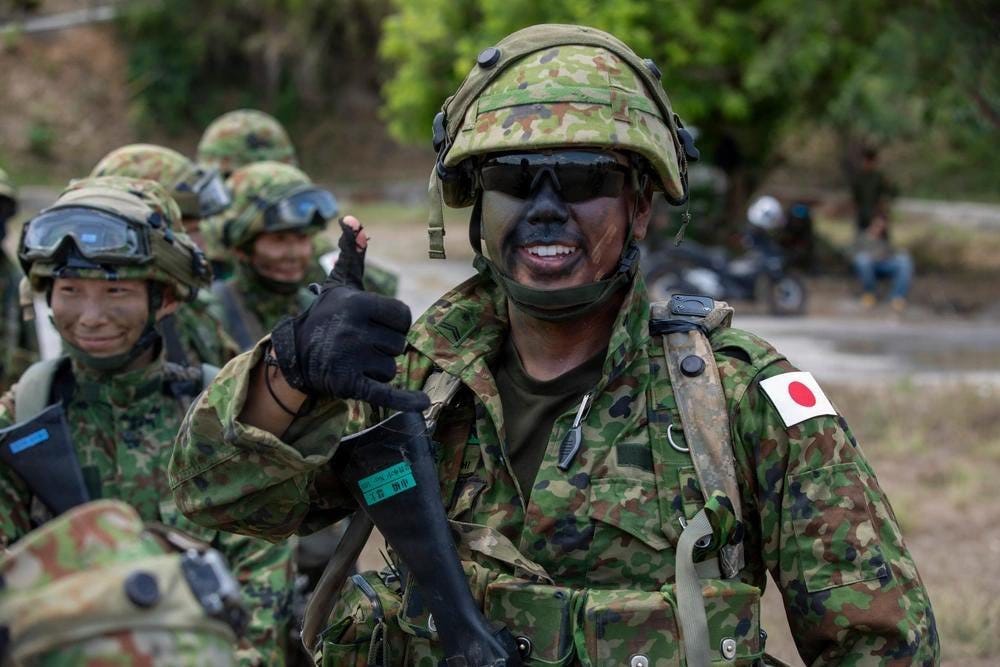
Japan Ground Self-Defense Force troops joined an air assault drill held at Colonel Ernesto Ravina Air Base (CERAB) in Capas, Tarlac to Fort Magsaysay, Nueva Ecija on May 17, 2026. Photo from Philippine Army
Manuel Mogato | May 22, 2026
When the United States pulled out its Terminal High-Altitude Area Defense (THAAD) from the Korean peninsula, it was an indication that Washington is not serious enough to defend the Indo-Pacific region from any threats.
It was also a clear message that even if the United States promised an “ironclad” commitment to the region, it cannot afford to engage in a two-front war.
In Ukraine, the United States has left it to the North Atlantic Treaty Organization (NATO) and European powers to help Kyiv repulse Moscow’s aggression.
In the Indo-Pacific region, is Washington confident it could leave the defense of the region, in the first island chain, to emerging powers Australia, Japan, and South Korea?
The three countries have stepped up their deterrence capabilities, increasing defense spending and defense industries to produce missiles, surface combatant vessels, and other military equipment.
While Australia and South Korea focused on their own defense industries, Japan has cracked its shell to expand its influence in the region and is openly challenging China’s dominance as the United States’ power starts to decline.
Last month, Japanese Prime Minister Sanae Takaichi’s government dramatically changed the Pacifist Constitution to allow Japan to export legal weapon systems to neighboring states.
For instance, Tokyo will soon transfer six of its aging Abukuma-class destroyer escorts to Southeast Asian countries, including the Philippines. (Also read: Why countries in Southeast Asia should not fear Japan?)
It has deployed maneuvered armored vehicles, artillery pieces, and its Type 88 surface-to-ship truck-mounted missile system to the northern Philippines.
Then, it had made a live demonstration when Type 88 fired two missiles to destroy a decommissioned Philippine Navy minesweeper in disputed waters off the coast of Ilocos Norte.
There are indications Japan would not remove the Type 88 from the Philippines to work alongside US high-tech equipment, such as the High Mobility Artillery Rocket Systems (HIMARS), the Navy-Marine Expeditionary Ship Interdiction Systems (NMESIS), Marine Air Defense Integrated Systems (MADIS), and the mid-range capability Typhon launcher. (Also read: Learning to fight future wars in Balikatan drills)
Incidentally, the US Army, for the first time, demonstrated Typhon’s capability when it fired a Tomahawk missile from an airport in the Visayas to hit a target inside a jungle base in northern Luzon, travelling more than 600 kilometers for almost an hour to destroy a target.
The American and Japanese missile systems are mobile and agile, representing a new defense strategy from maintaining large military bases, which are vulnerable to medium-range ballistic and cruise missiles.
Japan’s recent participation in the Philippines’ large-scale military exercise showed that Tokyo was not only sharing the load of defending the region, but could be replacing the United States.
Is Japan abandoning its Pacifist Constitution and rearming itself? Does a militarized Japan pose a new threat to the region? Will an armed Japan reopen the wounds of World War II when China, South Korea, and most Southeast Asian countries suffered from brutal atrocities?
After the Second World War, Japan was considered a war criminal and was stripped of all its offensive military capabilities, such as aircraft carriers, nuclear-powered submarines, and medium-range ballistic missiles.
However, many conservatives in Japan have been calling for rearmament to counter nuclear threats from North Korea and China.
They are also calling for the expansion of Japan’s self-defense forces beyond its borders, including the space domain, to acquire the capability to launch a preemptive strike from outer space.
A recent decision to expand the “space operations” within Japan’s special operations forces, with more funding, transformed the unit into an offensive force.
Since coming to power in October 2025, Prime Minister Takaichi, a protege of the late Prime Minister Shinzo Abe, started transforming Japan’s Self-Defense Forces into a lethal offensive force, throwing away the Paficist Constitution.
Outside Japan, many see the revival of Japanese militarization as dangerous and a serious threat to regional peace and stability.
China, South Korea, and some Southeast Asian states would not like to see a rearmed Japan, fearing a repeat of the atrocities during World War II.
Some do not trust a militarized Japan, as Prime Minister Takaichi and some Liberal Democratic Party officials went to the Japanese military memorial at Yasukuni Shrine to offer ritual offerings.
They see the visit as another demonstration of Tokyo’s unwillingness to acknowledge the brutal crimes of the last war.
The Philippines may see it differently, but most of its neighbors might be worried about a militarized Japan. They also condemned Tokyo’s attempts at historical revisionism to prevent a repeat of Japanese aggression against its neighbors.
They warned Tokyo to remember the lessons of history and honor its international obligations enshrined in the Japanese Instrument of Surrender in 1945, the Potsdam Declaration, and other documents, helping prevent the revival of militarism in the country.
Should the Philippines align itself with its Asian neighbors in expressing fears about Japan’s rise as a regional power?
Or should it welcome because Japan was willing to transfer old weapon systems?
In the last century, Japan invaded but failed to hold on to the Philippines as a colony. Now, without firing a shot, it has gained a territory where it could launch attacks on its enemies.