


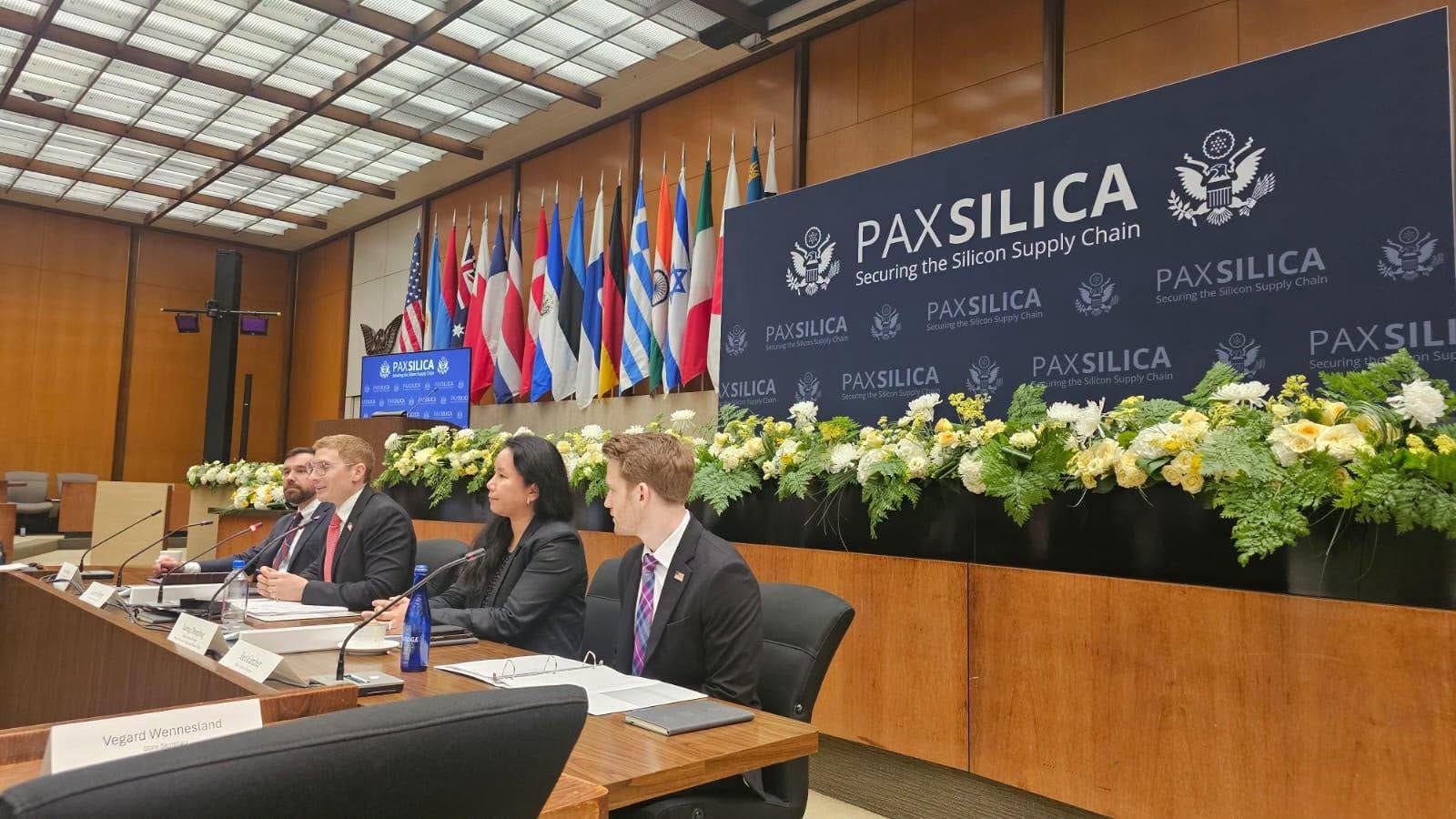
The Pax Silica Summit held earlier this month in Washington, D.C., attended by the Philippine delegation. The Philippines is the 13th partner economy of the United States-led international coalition. Photo from BCDA.
Rodney J. Jaleco | July 28, 2026
WASHINGTON D.C. (July 27) — Driving through the Washington suburbs of Northern Virginia, you can’t miss the low, sprawling box-like clusters, AI data centers that’ve become a focal point of debate which could soon be reach the Philippines.
Northern Virginia is home to over 600 data centers — representing about 13 percent of the world’s operational capacity — earning it the monicker “Data Center Alley.” Over 70 more data centers are either being built or envisioned for the Commonwealth. This has triggered loud and at times, vociferous opposition.
The Philippines formally joined a US-led initiative dubbed Pax Silica last April 16, becoming the 14th country to join the now 23-member aggrupation aiming “to secure the entire AI stack — from critical minerals to semiconductors, data centers, fiber, and AI models — among partner states.”
Members commit to reducing excessive dependence on concentrated supply chains, coordinating investment, and building trusted digital ecosystems. Analysts say it’s part of blunting China’s domination in chips and AI development. (Also read: Security-linked investments — aimed at taming China — spurs PH economy)
The first phase in the Philippines is the construction of a 1600-hectare “economic security zone” at Clark City in Capas, Tarlac. The US State Department has described the facility as “an investment acceleration hub where the specific industrial activities are shaped by market demand.”
Philippine Ambassador to the US Jose Manuel Romualdez estimated Pax Silica will generate up to 300,000 jobs from the new facility and the influx of tech companies. It’s also projected to add P180 billion (almost $3 billion) a year to government coffers. (Also read: Pax Silica: Is the Philippines willing to give up its sovereignty in Clark?)
Despite the rosy projections, there has been a building crescendo of voices in Manila urging caution — worries spawned by a lack of knowledge about the mechanics, commitments and targets of Pax Silica, concerns over its environmental impact and the domestic resistance to AI data centers in the US itself.
US data centers use about 2 percent of the nation’s electricity, projected to hit 8 percent by 2030. As utilities scramble to build new transmission to serve them, residents have seen prices skyrocket. The concern is that regular households end up paying for the grid upgrades that AI needs. Virginia Gov. Spanberger campaigned on making data centers “pay their fair share.”
A single large facility can use up to 2 million gallons of water a day for cooling. In areas dependent on limited groundwater, that’s become a major environmental concern, plus concerns about wastewater discharge and pollution.
The most immediate complaint is the noise. As centers have cropped up alongside residential developments, they’ve become synonymous with round-the-clock noise from cooling systems and on-site generators.
Northern Virginia communities have also bewailed the failure to deliver promised jobs after the data centers are constructed. They contribute $5.5 billion annually and 74,000 jobs statewide, but locally after they’re built they employ very few people, so neighbors see the costs without day-to-day benefit.
The Philippines — Luzon in particular — suffer from a chronic lack of both electricity and potable water, especially during the dry season. In addition, Pax Silica aims to tap into the country’s rare metals — the Philippines is the world’s top exporter of nickel ore — critical for the production of batteries and chips. Electronics and semi-conductors are over half of Philippine exports — $39.1 billion in 2024 alone.
Pax Silica is still at its very early stage in the Philippines. Defense Secretary Gilberto Teodoro Jr. said “there are no firm documents yet” and details are still being worked out. Actual construction is not expected to start until 2028 at the earliest.
Pax Silica could thrust the Philippines high up the AI supply chain but it’s ultimate benefits for the country are still up in the air, waiting to be understood, weighed carefully, defined and eventually pursued. The proverbial devil is in the details and Pax Silica can be a bagful of demons.