


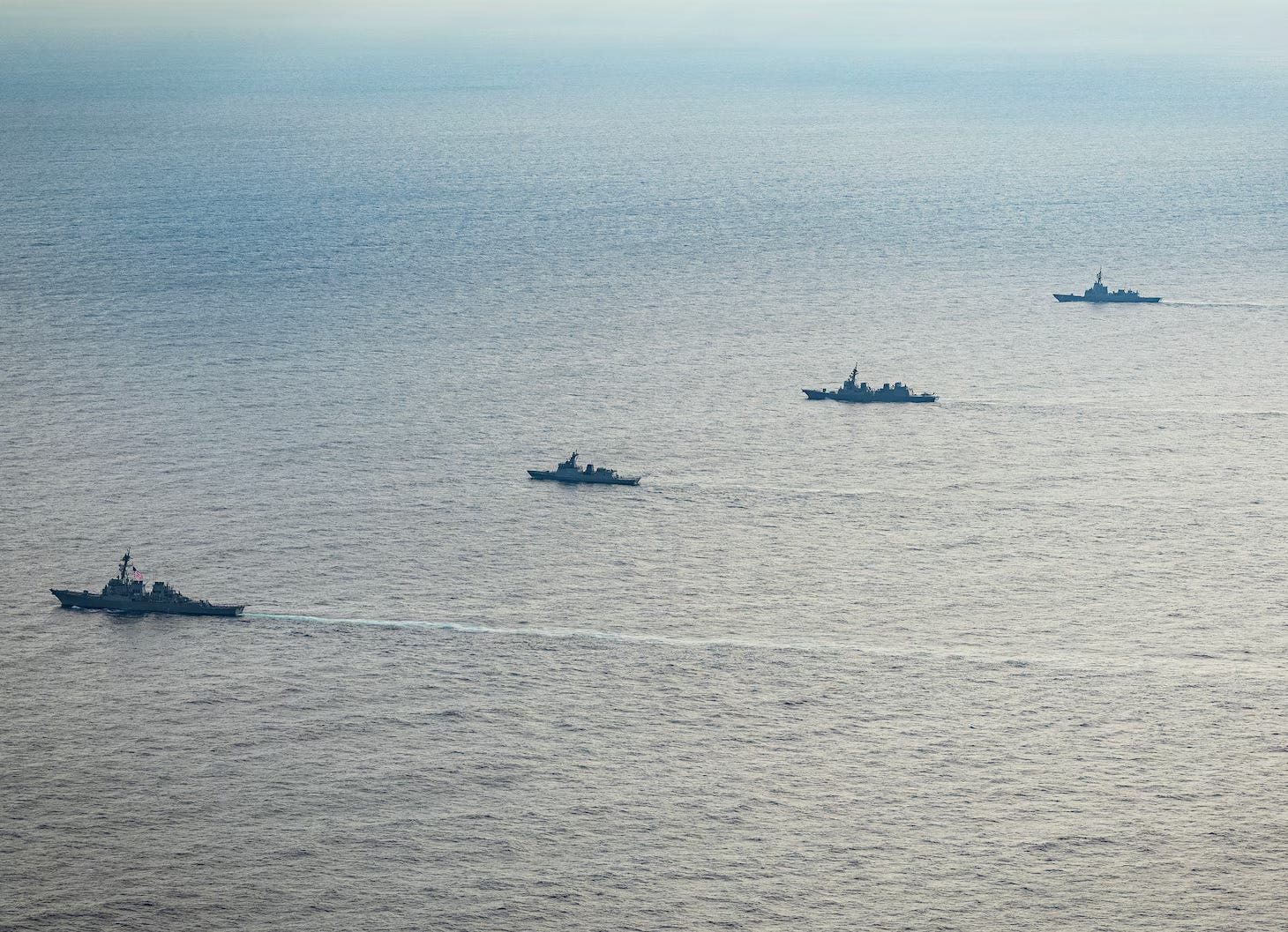
Naval and air force units from Australia, Japan, the Philippines and the United States, conducted a multilateral Maritime Cooperative Activity (MMCA) within the Philippine Exclusive Economic Zone last 5 February 2025. Photo from the U.S. Indo-Pacific Command
Manuel Mogato | August 29, 2026
MANILA —As the United States becomes an unpredictable and unreliable security partner in the Indo-Pacific region, middle powers are stepping up to help deter a growing China.
For decades, these middle powers have been reluctant to step onto the batting plate, relying on the United States to lift the heavy load, whether in the South China Sea, the Korean Peninsula, or the Taiwan Strait.
These middle powers were not necessarily doing nothing to help the United States. They were picking up the slack when the US slowed down. (Also read: “Middle Powers” rise as doubts of US reliability deepen)

For instance, when Washington reduces funding support for international military education and training programs (IMETP) for the Philippines, Australia increases funding for technical and higher military education for Filipinos.
There were instances when Australia exceeded the US financial assistance for education and training.
On the other hand, Japan has become a source for used or second-hand military platforms, such as surface combatant vessels and surveillance aircraft, as the United States has shifted from mothballed to brand-new platforms under purely commercial deals.
Australia and Japan have become more reliable security partners for the Philippines than the United States. The two countries have also increased their presence and activities in the Philippines, including periodic multilateral maritime cooperative activities (MMCA).
Since MMCA started in 2024, there have been 19 iterations involving Australia, Canada, France, Japan, New Zealand, and the United States.
For the Philippines, these military activities boosted Manila’s deterrence. It also enhanced presence in disputed waters in the West Philippine Sea, particularly around Bajo de Masinloc, Ayungin Shoal, and other Philippine-occupied features. (Also read: Teodoro calls on a coalition to resist China)
Defense Secretary Gilberto Teodoro Jr visited Darwin while the Philippine Air Force takes part in the Pitch Black exercise to forge closer cooperation with Canberra.
The two countries are close to concluding a Defense Cooperation Agreement (DCA) that would further expand existing military training and exercises, such as Alon and Kasangga in the Philippines.
The DCA could also enhance Australia and the Philippines’ arrangement under the so-called Squad — Australia, Japan, the Philippines, and the United States.
But there could be a downside, as other middle powers’ presence and activities in disputed areas heighten tension and increase miscalculation and accidents that could lead to confrontations.
Security experts have observed that Australia and Japan are now playing key roles in the military and political plans of the Western alliance, including the US, India, and the North Atlantic Treaty Organization (NATO) in the Indo-Pacific area. (Also read: Reviving SEATO or building an Asian NATO?)
These countries have intensified efforts to form and strengthen an anti-China bloc. Beijing can also create its own counter-bloc, making the volatile region more dangerous.
These developments threaten to escalate an arms race, provoke tension, and increase the chances of conflicts in the region.
For one, Australia planned to build nuclear-powered submarines under the Australia-United Kingdom-United States (AUKUS) alliance.
Delays in the building of nuclear-powered submarines did not deter Australia from partnering with Japan to build 11 Mogami-class frigates for $6.5 billion.
Canberra and Tokyo also planned closer cooperation to produce other munitions and other materials, creating a strategic partnership that could reduce the risk of attacks from China on industrial military bases and build a so-called strategic depth.
At the same time, granting access to Tokyo’s naval forces at Canberra’s port facilities could increase Japan’s operational reach and expand maritime security missions beyond the East and South China Seas.
Australia and Japan’s partnership strengthens the Quadrilateral arrangement, including India and the United States.
The two countries’ partnership fills the potential vacuum when the US focuses more on the Middle East, but nothing will change in the Indo-Pacific area.
The dominant United States will be replaced by several middle power states, fueling a more dangerous arms race.
The bigger danger would be an ambition by these states to acquire nuclear weapons, threatening the non-proliferation regime as well as Southeast Asia’s nuclear-weapons-free zone area.
If that happens, the region’s security architecture may change, making the region dangerous.