


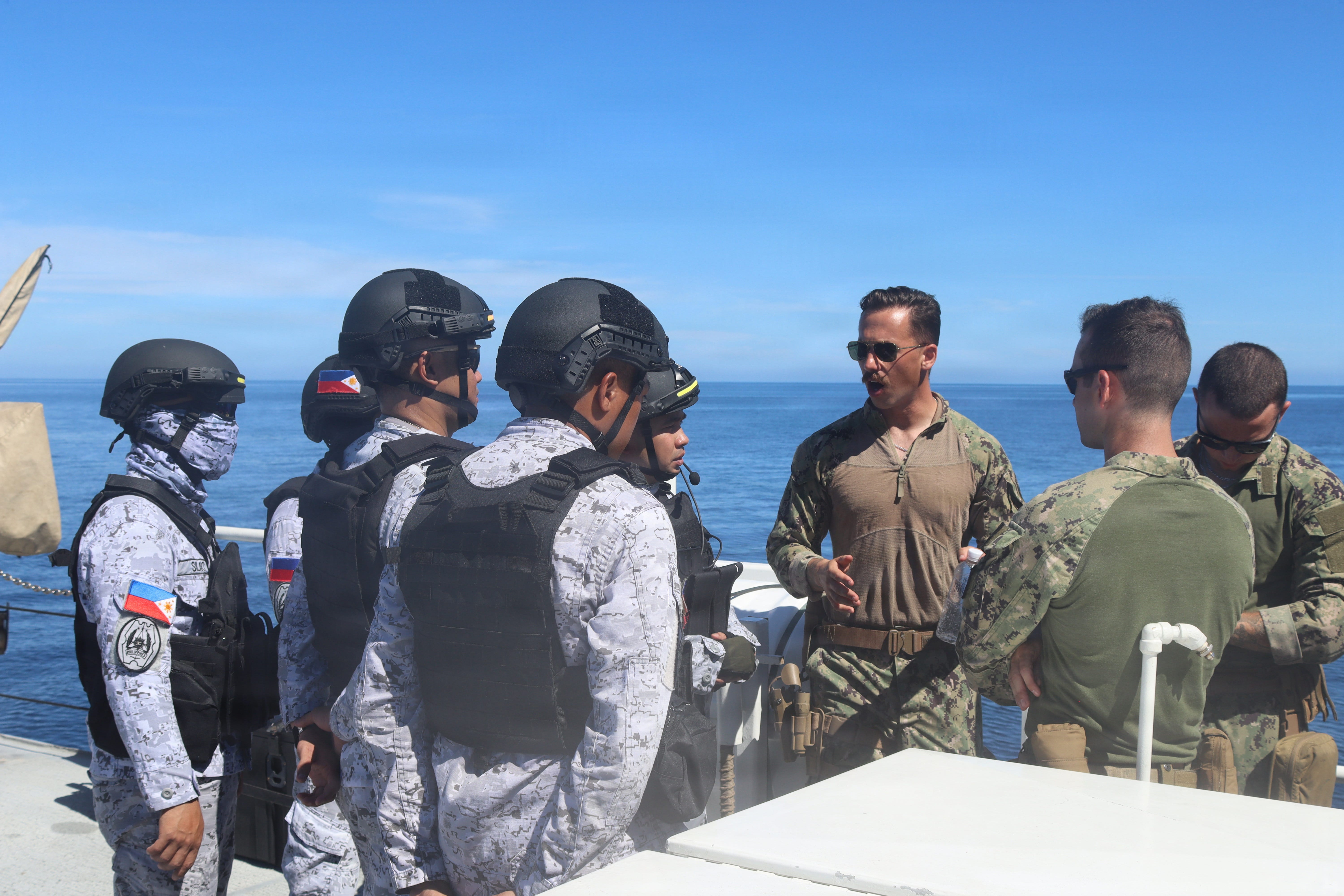
Members of the Armed Forces of the Philippines and U.S. Coast Guardsmen conduct small-boat training aboard Sentinel-class fast response cutter USCGC Charles Moulthrope (WPC 1141) during a Maritime Cooperative Activity. Photo from U.S. Coast Guard
Rodney J. Jaleco | August 24, 2026
WASHINGTON D.C. (Aug. 22) — Growing questions about the reliability of the United States as a security partner have driven the rise of a “middle powers” coalition that’s filling gaps left by a distracted America.
US dependability is a sensitive subject in the Philippines which relies on a decades-old mutual defense pact to help deter Chinese encroachment in its exclusive economic zone. Top US officials have repeatedly assuaged that concern with Pres. Marcos Jr., whose most prominent rival maintains close ties with Beijing.
Manila has crafted a defense coalition beyond treaty ally US, signing status of visiting forces agreements with Australia, Japan, Canada, New Zealand and France.
The Philippines continues to be America’s staunchest ally in the region even as doubts about US resolve have never been stronger.
When the Trump administration unveiled its national defense strategy earlier this year, it envisioned a shift toward homeland defense, prioritizing the Western Hemisphere, while treating China as a secondary regional priority. Then the US was drawn into a protracted, costly but indecisive war with Iran.
Pres. Trump has vacillated with allowing Ukraine to produce Patriot missiles for its own defense after promising to do so earlier. Then he unexpectedly ordered scaling down US participation in joint military exercises with South Korea.
As the Trump administration becomes increasingly distracted with Iran and the congressional elections around the corner, and the president’s seemingly erratic decision-making, geopolitical fragmentation is leading to the rise of middle powers building smaller, overlapping coalitions.

Under the second Trump administration, partnerships have been described as “by invitation only and principally transactional” with repeated statements about leaving NATO and Europe, and using tariffs even against allies, including the Philippines.
In his Manila sortie earlier this month, US Undersecretary for Policy Elbridge Colby alluded to a more transactional security framework with the Philippines. “We are looking for partners, not protectorates,” he stressed as he urged the Philippines to do more for its own defense. (Also read: Washington assures allies it will remain a reliable security partner in the region)
At Davos last January, Canadian Prime Minister Mark Carney warned of a “rupture in the world order” and that the US was no longer a reliable ally, while French President Emmanuel Macron described a “world without rules”. Similar concerns have been voiced in Europe about whether the NATO alliance will survive an “America First” approach. (also read: Reviving SEATO or building an Asian NATO?)
The term “middle powers” lacks a firm definition, but generally refers to states with substantial economic, human and military resources that are not “great powers” — in Asia this includes Japan, South Korea, Australia, India, Indonesia, and beyond that Canada, the UK and the 27-nation European Union. The “great powers”, the world’s two Superpowers Russia and US, weighed down by war, haven’t been looking too super lately.
The emerging “middle powers” coalition is being manifested in different forms. Perhaps most noticeable is the diversification of defense procurement and doctrine. (Also read: Teodoro calls on a coalition to resist China)
Canada announced it will prioritize domestic arms purchases and is reconsidering its 2023 order for 88 US F-35s. They recently selected Sweden’s GlobalEye airborne early warning and control fleet over Boeing’s E-7 Wedgetails.
Portugal earlier ruled out F-35s over American industry reliability concerns.
Australia has modified its original plans to acquire three brand new Virginia-class nuclear powered submarines to buying used vessels over doubts US shipyards can meet Australia’s deadlines.
Europe is working to revitalize its defense industrial base and joint purchases, with discussion of a shared nuclear umbrella to supplement the US guarantee, and even open discussion in Poland about its own nuclear option. France is expected to update its nuclear doctrine to outline what Paris can offer allies worried about the US umbrella.
Taiwan is still waiting on about $21 billion worth of US-made weaponry from F-16s to Harpoon and Patriot missiles to Altius drones that have been paid for, but still to be delivered.
How the world, particularly Asia-Pacific nations, perceive US reliability has been undermined not only by the discord coming out of Washington but also by what China has been doing. A Pew Research survey in 36 countries last May showed that for the first time in over two decades, China was viewed more positively than the US.
A separate poll by Singapore-based Yusof Ushak Institute in the 11-nation ASEAN revealed more than half saw US global leadership as unpredictable, and a narrow majority leaned towards China. (Also read: Frustrations over US unpredictability lure Thailand closer to “big brother” China)
The emergence of the middle powers coalition is reaction to the void created by an erratic and thus unreliable America.