


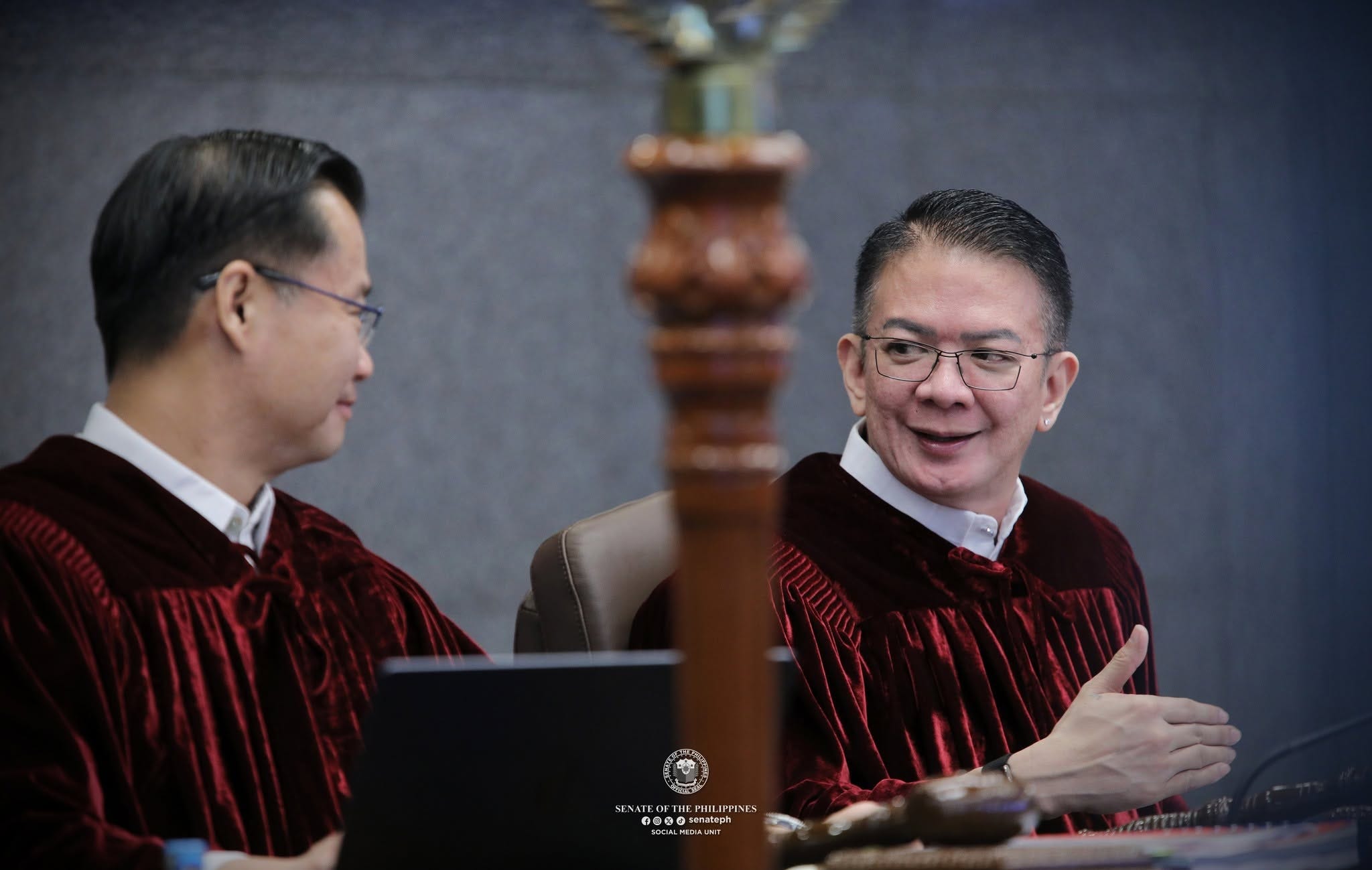
Senate President Sherwin “Win” Gatchalian and Impeachment Court Presiding Officer Francis “Chiz” Escudero during the third day of Vice President Sara Duterte’s impeachment trial. Photo by Wendell D. Alinea / Senate Social Media Unit.
COL Dencio S Acop (Ret), PhD, CPP | July 9, 2026
BOSTON, MASSACHUSETTS — Things are unraveling fast in the Philippines! It is almost as if there is a timeline that is being followed by the enemies of the state. Perhaps there is. First, there was the infamous caper of a senator being served a warrant of arrest to answer for crimes against humanity and his subsequent escape right within the Philippine Senate.
Then, there was the illegitimate stay of a senate president holding on to an office as if it was proprietary to him and not the people. It was quickly followed by the pending arrest of another senator for plunder who used his religious group to stage a spectacle in Manila’s main thoroughfare as if the public display of arrogance would exonerate him and make the law enforcers change their minds.
Of course, the staged “people power” was also meant to incite the military to intervene and turn its back on its commander-in-chief. While all of these were going on, China was “business as usual” in the West Philippine Sea acting as if that part of Philippine territory and exclusive economic zone was proprietary to it, driving away its actual owners. (Also read: PH assails China’s “wolf warrior diplomacy”)
Finally, at least for now, Filipinos are glued to their television sets watching the latest ongoing spectacle which is the impeachment trial of the accused vice president.
Meanwhile, another “Chinador” senator is courting the support of Overseas Filipino Workers on the issue of sending support to the victims of the recent calamities in Venezuela on the heels of his pending arrest by the International Criminal Court also for crimes against humanity like that faced by his former patron languishing in jail at The Hague. The domestic troubles described all favor China but none of it is good for the Philippines, not even for the Filipinos who’ve turned traitors to their own country.
Given this background, this piece intends to shed some light upon two main issues: the scourge of military adventurism and the need for a two-party system only in the Philippines. The former is useless and unneeded by the Philippines. But the latter, if it is truly implemented, would be a cure whose effects for the country would be positive and long-term.
The truth of the matter is that military intervention carries with it serious political, economic, and institutional costs outweighing the temporal gain of removing an unwanted national leader. Naturally, the intervention of armed power, if led by moral leaders, has its apparent advantages too. These advantages may include the immediate removal of a bad national leader, the rapid resolution of a national crisis, and the possible alignment with a desired foreign power.
Armed intervention or the withdrawal of military support, like the 1986 EDSA People Power Revolt, has at times succeeded in toppling entrenched dictatorships or illegitimate leaders thereby allowing a more citizen-friendly leader to take over. In other cases where civilian institutions are completely paralyzed by overwhelming public problems, swift and decisive military action has been used to restore a baseline of relative order.
Further, as in the 1989 coup attempt, U.S. military support helped prevent the violent overthrow of a democratically elected leader allowing the first Aquino administration to sustain the Philippines’ bilateral defense relationship with her long-time ally vital to national security and regional stability.
While military interventionism has had its positive outcomes in specific cases, it cannot be a blueprint for long-term national progress and stability. This is because of the chronic problems its acute problem-solving creates. First, and in the case of the Philippines, the martial law regime deployed by Ferdinand Marcos Sr. to extend his term of office led to thousands of deaths, tortures, and widespread suppression of civil liberties.
The repression, in turn, led to the growth of local rebellions chiefly epitomized by the Communist Party of the Philippines-New People’s Army whose presence is still felt up to now.
Second, the reliance upon the military to effect political change or governance militarizes the civic space marginalizing the public will and interest and generally undermines the stability and long-term viability of democratic institutions.
Third, if civilians believed military leaders could eradicate the usual problems of corruption, history reveals that this is not the case. Military regime changes and martial law have also enabled systemic corruption, massive external debt, and economic instability.
Fourth, military interventionism may even empower external threats. Academic literature on regime change operations highlights that forceful overthrows rarely result in long-term internal security. Further, internal destabilization of the Armed Forces of the Philippines has been exploited by opposing political groups to sow division, potentially leaving the country vulnerable to external aggression.
We are seeing this situation today in our row with China exploited by some of us who see nothing wrong with surrendering our sovereignty and territorial integrity to the Chinese. Historically, our constitutionally enshrined values are closer to America’s than China’s. While the aberrant Duterte regime pivoted to the Communist power, our joint values with our former colonizer have lived longer tested by blood during World War II.
The AFP is more a son of the US Armed Forces than it is a son of the People’s Liberation Army. The current administration has merely brought us home to where we rightfully belong as a nation. My personal knowledge and involvement with coups and counter coups during years of active-duty service compel me to side with the wisdom argued in these passages. (Also read: Security-linked investments — aimed at taming China — spurs PH economy)
Lastly, more than looking to the military to solve our political problems, strategic resolution (if we’re truly serious about it) lies in fixing the document that bears the answer to the dilemma and foreboding just articulated. I have long had reservations about the foundational laws we revised in 1987.
My exhortations are of course not those of a constitutional lawyer, but just the same logic compels me to argue that, among other provisions, ours should be a two-party political system. I think that a two-party system has more advantages for us than our present multi-party system.
First, it is simpler. People do not get confused. Voters only get to choose one of two parties. Second, why is there a need for so many political parties when there are (really) only two distinct positions to take on every issue? One is either liberal or a conservative.
So, if you advocate for radical change then you go liberal and if you prefer incremental change (only) then you vote conservative (one who sticks more to tradition cautiously endorsing new ideas).
Third, it is more organized. Nuisance candidates are eliminated. Fourth, we will always have a majority president. No candidate will claim that he / she has been cheated out since it will be more difficult to cheat given a two-candidate choice than having to choose from a lineup of so many. Fifth, it is more effective for us Filipinos with our history of not so honest elections, traditional politics, and other cultural peculiarities and dysfunctions.
If we do not move towards a two-party system, this current trend of just about anyone wanting to be president, senator, congressman, etc. will continue. A two-party system essentially screens candidates, particularly each candidate’s stance on any public issue (liberal or conservative).
This is almost impossible to do with a multi-party system wherein the number of candidates running, despite their differing parties, echo other candidates’ positions making the duty of suffrage confusing and exploitable. And in a society like ours, these possibilities occurring are a given. We all should give it a thought. A serious one at that.