


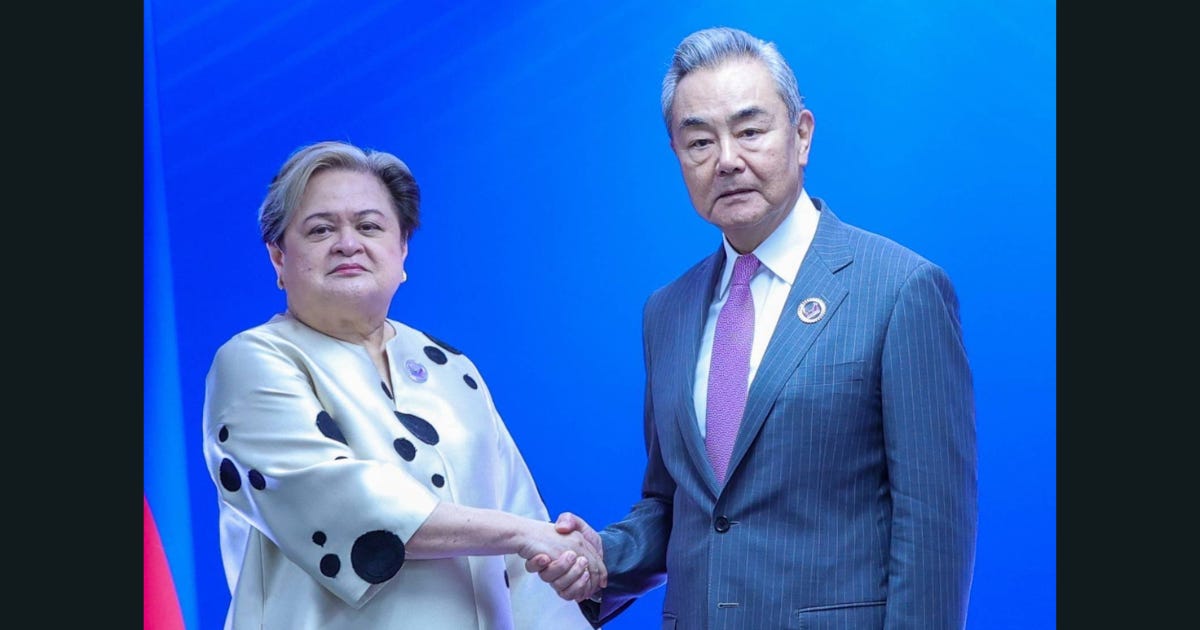
ASEAN Chair and Foreign Secretary Ma. Theresa Lazaro and China’s Foreign Minister Wang Yi meeting at the sidelines of the 59th ASEAN FOreign Ministers Meeting in Manila last July 22. Official handout.
COL Dencio S Acop (Ret), PhD, CPP | July 28, 2026
BOSTON, MASSACHUSETTS — The region and the world have just celebrated the 10th year anniversary of the 2016 Arbitral Award upholding the Philippines’ maritime claims over those of the People’s Republic of China in the West Philippine Sea. While the celebration was ongoing, Chinese scholars came out with a study claiming the northernmost Philippine islands of Batanes as part of China.
A few days later, the Chinese Coast Guard managed to strike a member of the Philippine Navy on the head with a wooden baton off Ayungin Shoal in the Spratly Islands right within the Philippines’ Exclusive Economic Zone. And the 59th meeting of foreign ministers of the Association of Southeast Asian (ASEAN) nations just concluded. In line with this meeting, US State Secretary Marco Rubio came to Manila for high-level talks with President Ferdinand Marcos Jr. and counterparts in the East Asia Summit and ASEAN Regional Forum.
In his meeting with the Philippine leader, Rubio reaffirmed America’s commitment to the bilateral alliance as well as to a free and open Indo-Pacific Region. To further this commitment, he announced over $100 million in new foreign assistance to upgrade infrastructure, logistics, and energy projects in Subic via the Luzon Economic Corridor. Rubio echoed along with the Free World that the 2016 Arbitral Ruling against China’s maritime claims is final and binding, emphasizing freedom of navigation for all.
Reacting to the recent striking incident off the grounded BRP Sierra Madre in the Ayungin Shoal, he called China’s actions “disturbing” and “escalatory”, adding that the U.S. will not abandon allies in the region and that it remains committed in honoring its obligations under the RP-US Mutual Defense Treaty. Rubio’s recent statement was meant to reassure Manila that Washington’s cooperation with Beijing will not come at the expense of its regional partner as US President Donald Trump is scheduled to have another meeting with Chinese leader Xi Jinping in September.
Firstly, thanks to the Aquino administration, the 2016 Arbitral Award remains the enduring and effective strategy of the Philippines to any challenge against its territorial and maritime interests. As President Marcos articulated, it is the cornerstone of the country’s maritime policy. And this win is also beneficial to all other maritime interests throughout the world.
Its authority and legitimacy emanate from the United Nations Convention on the Law of the Sea (UNCLOS) signed on by most nations of the globe including and especially China, which has challenged it nonetheless insisting upon its self-proclaimed Nine Dash Line protocol. (Also read: PH arbitral win gives legal framework for more PH, US, allied enforcement in South China Sea)
Commemorated last July 12 this year, the 10th year anniversary of the landmark award was visibly celebrated by 13 other nations including the US and European Union (EU). The award is the center of gravity in the Philippines’ efforts to protect its maritime rights, particularly in the face of China’s open aggression and continuing coercion. The strategy has been effective because it is legally binding and aligns with international order and the rule of law advanced by the UN Charter through UNCLOS. And the BRP Sierra Madre — that old war-boat aground in the middle of the Philippine Sea — remains the concrete symbol of Filipino defense and defiance against the unabashed, arrogant, and thieving ambitions of China in the South China Sea. In Idealist International Relations Theory, China has already lost because of the 2016 Ruling. But in Realist Theory, the fight is still on.
However, the Philippines has managed to back up its lack in Idealist IR through its alliances with other regional and global powers thereby propping up its limited IR capabilities in Realist terms.
What has resulted is a more equated balance of power which China is seeing to grow more each day. Thus, Beijing’s disrupted timeline relative to its ambitions in Taiwan and the rest of the South China Sea has it resorting to knee-jerk reactions through undiplomatic utterances and violent behavior increasing odds against it even from friendlier allies now coming to the side of bullied Filipinos and to the fold of the Western Alliances in the region.
Meanwhile, the claim of Beijing scientists that Batanes in the northern Philippines is part of China has effectively been dismantled by the Philippines point by point. On the Chinese claim that Batanes was administered from Taiwan during the Ming and Qing dynasties, the Philippine Department of Foreign Affairs rebutted that the Spanish Empire formally claimed Batanes as part of Cagayan province in 1783 and that the islands have been under continuous and undisputed governance ever since.
On the claim that the 1898 Treaty of Paris placed the Philippines’ northern boundary at 20 degrees north latitude, leaving Batanes outside Philippine borders, the DFA countered that that perceived boundary line error in the Treaty of Paris was corrected long ago, as the clear intent of the signatories was to place the line between Batanes and Taiwan.
Next, on the claim that post World War II treaties requiring Japan to return seized territories to China should have included Batanes as an extended sub-territory of Taiwan, the Philippine National Historical Commission (NHCP) explained that the Ivatan people in Batanes liberated themselves from Japanese forces in early 1945 before the end of WWII, proving that Japan could never “return” Batanes to China because it already belonged to the Philippines.
Finally, on the Chinese academics’ claim that historical navigation records, Qing dynasty fishing activities, and indigenous links between Taiwan’s Tao people and Batanes’ Ivatan community proved to justify a shared connection, again the DFA rebutted that the people of Batanes took part in the 1896 Philippine Revolution against Spain and were represented in the Malolos Congress and all subsequent iterations of the Philippine legislature. To which the Chinese academics rested their case and the CCP disavowed their claims.
A third point is that in the latest violence committed by the Chinese Coast Guard against the Philippine Navy, two differing arguments present plausible outcomes already foreseen by those who micro-manage what goes on through the chain of command from macro but invisible perspectives.
With everything that has been going on in the West Philippine Sea between Chinese and Philippine forces, it seems logical to think that those who see the big picture would continue to assume that assertive actions, including violence apparently, justify China’s position while passivity confirms weakness and lack of commitment on the part of the Philippines. In the face of the Philippines’ victory from the 2016 Arbitral Ruling and adherence to the international rule of law, what could China do that would still seem legal and legitimate even if its position is contrary to the ruling?
Thus, China has resorted to “gray zone” narratives warfare and strategic “lawfare” tactics to advance its position, nonetheless. It would be this type of mindset on the part of those who call the shots in the CCP hierarchy which would allow for calculated law enforcement violence by a domestic agency like the Coast Guard to assert Chinese “legal” authority in a space it deems its own despite its being internationally contested.
That authority might even think that the Philippines’ lack of wherewithal to use legal force is a public admission of illegitimacy in its claims. It might also be just fear on the part of the Filipino sailors intimidated to counteract against a powerful opponent. But in this last episode, it is a civilian, domestic agency that is being pitted against a military unit, with all the legal authority to meet unlawful force committed against it by a foreign trespasser.
While trespassing into another country’s exclusive economic zone is not normally met with military force, actual violence committed against the person of a Filipino sailor by a Chinese Coast Guard member within a maritime space which grants sovereign economic rights to the Philippines could constitute an act of war. The use of deadly force by the foreign trespasser invites justified defense from the attacked defending his country’s exclusive economic rights.
On the part of the Philippines at this point, it may not be enough anymore for its soldiers to just take it. Soldiers have the dignity to fight back. A defensive action by a soldier is a Just War. A soldier is not there to talk, be cute, or run. Not fighting back is what the enemy expects and wants. It reaffirms their assumption that might is right. But fighting back scares them too. It humiliates them like how David stood up to Goliath. It, therefore, is also an effective strategy by itself.
What are the facts and rules of international law and order, including domestic ones? (1) The AFP does its job by enforcing RP rights through its territory and EEZ. (2) The AFP is not AFP without the A in the acronym. Deploying the AFP means the Philippines is ready to use force if provoked because it has every right to do so. (3) Fear? Possibly paying the ultimate sacrifice in battle with the enemy is part of a soldier’s job and if they’re not willing to do that, then they shouldn’t be soldiers at all. Soldiers may be outnumbered but they are not necessarily outfought. (4) Escalation? That is not the problem of soldiers if violence erupts and even escalates at some point. Such is the concern of government leaders but not soldiers. A soldier’s job is to effectively react and treat every violent attack suffered as an act of war. And (5) By not doing the above, the Philippines loses the gray war.
Fourthly, Philippine chairmanship of the ASEAN this year has its strategic advantages and benefits if local leaders play the game right. Thus far, the Philippines is navigating through skillfully given its strengths and weaknesses continually tested by threats as well as opportunities in the region and the world.
Nevertheless, and while DFA Secretary Maria Theresa Lazaro and the rest of the ASEAN Ministerial Team are quite optimistic about crafting a Code of Conduct with China in the South China Sea overnight, the COC is merely a stalling document. The merits and demerits of the case with China on the South China Sea are clearly black and white than they are gray. Any mechanisms grounded on the international rule of law and order already fail the first test as far as the CCP is concerned even if it won’t say it outright. But any alternative which sets these conditions aside is welcomed by China’s leaders. Thus, the proposed COC is merely working to manage the ongoing friction and prevent total escalation rather than be a definitive solution to regional claims.
Finally, in terms of the ASEAN ministerial leaders’ efforts to talk some democratic sense into the heads of the governing generals in Myanmar who have long imprisoned democratic leader Aung San Suu Kyi, the prevailing character of both the autocratic leaders in Myanmar as well as ASEAN itself points to a historical record marked by non-interference in each member’s internal affairs. Secretary Lazaro, who is also the ASEAN Special Envoy on Myanmar, stated that the Myanmar leadership’s returning to the top-level ASEAN meetings is “still far off.”
Unless Myanmar strictly complies with the Five-Point Consensus Agenda issued to it by ASEAN in April 2021, its readmission into the regional bloc meetings hangs in the balance. (Also read: ASEAN makes headway in Myanmar, Code of Conduct negotiations)
Noting ongoing concerns over the military government’s actions after the 2021 coup, ASEAN has since demanded (1) An immediate cessation of violence in Myanmar, with all sides exercising maximum restraint; (2) Constructive dialogue among all concerned parties to seek a peaceful solution in the interests of the people; (3) Mediation of the dialogue process facilitated by an ASEAN Special Envoy assisted by the ASEAN Secretary-General; (4) Provision of humanitarian assistance through the ASEAN Center; and (5) A visit to Myanmar by the Special Envoy and relevant delegations. Most of these five points have not been met to date.
While there has been some humanitarian aid allowed in by the Myanmar Junta, along with the appointment of a Special Envoy and her subsequent visits, the key consensus points have only been partially or minimally met due to the Myanmar government’s non-cooperation.