


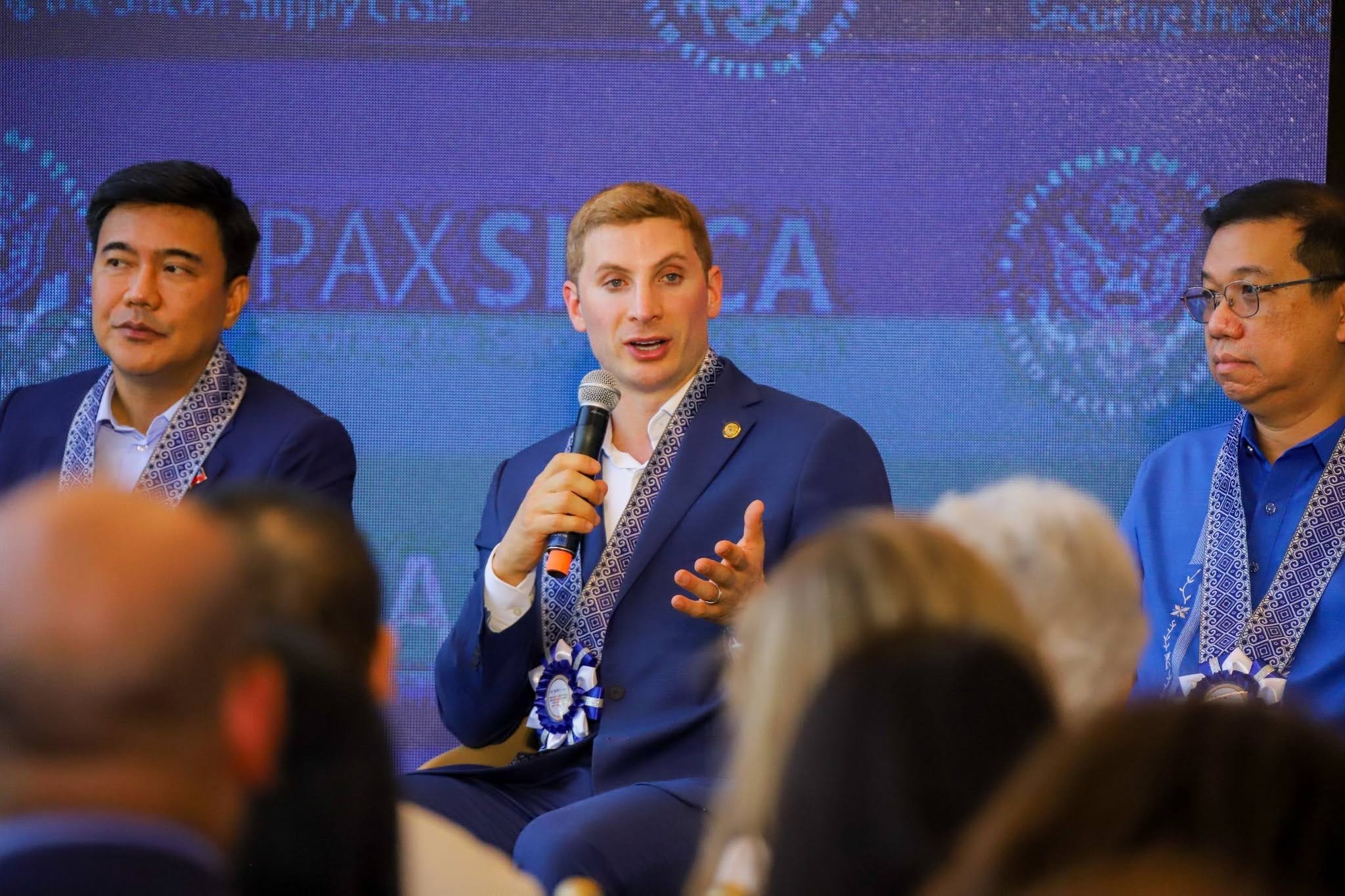
(L-R) Bases Conversion and Development Authority President and CEO Joshua Bingcang, United States Under Secretary of State for Economic Affairs Jacob Helberg, and Department of Trade and Industry Undersecretary and Board of Investments Managing Head Ceferino "Perry" Rodolfo during the site inspection of the proposed Pax Silica development in New Clark City last May 18, 2026. Photo from BCDA Group.
Manuel Mogato | June 21, 2026
MANILA — Does Washington want to colonize the Philippines anew by asking that a piece of property in the northern Luzon region be placed under its laws in exchange for high-technology investments?
If Manila agrees, it will surrender its sovereignty over an economic security zone where the United States’ companies will invest in advanced Artificial Intelligence (AI) operations, critical minerals, semiconductors, advanced manufacturing, and digital infrastructure — the future drivers of global economic growth.
Washington wants American companies investing in the special economic security zone and their workers not covered by local laws and regulations. They also cannot be sued for violating domestic laws.
This is grossly unfair to the Philippines. It is illegal and a clear violation of the 1987 Constitution.
The Philippines is no longer a colony of the United States.
Even after it won its independence in 1946, the Philippines remained at the mercy of Washington’s economic and security interests.
For instance, it has been the graveyard of obsolete military equipment, transferred under the Excess Defense Articles (EDA) program and the Foreign Military Sales (FMS) credit program, supervised by the US State Department.
The United States also has its “own bases within Philippine military bases” where it co-locates military assets, equipment, and personnel through the Enhanced Defense Cooperation Agreement (EDCA) facilities.
The US also planned to build a munitions factory in a former US naval base in Subic, where an American investment company took over the management of a bankrupt South Korean shipyard.
However, the US company that took over Hanjin’s shipyard was also charging the Philippine Navy a rental of 1 billion pesos for use of a portion of the shipyard as a naval operations base — a strange arrangement, which the Philippines pays rent for a piece of land it owns.
The so-called special military and economic relations between the United States and the Philippines have always been in Washington’s favor, a form of neocolonialism.
Now, the US wants a piece of territory in Clark to be placed under its own laws and under its full control. That should never happen.
The United States used to have a sprawling military base at Clark in Pampanga, the home of the 13th United States Air Force, until the Philippine Senate abrogated the military bases agreement in September 1991.
The late President Corazon Aquino created the Bases Conversion and Development Authority (BCDA) to transform the former US military bases into commercial and industrial estates, generating investment and creating jobs for Filipinos.
Fast forward to three decades later, Clark has become a thriving business and industrial center.
However, parts of the former US military base remain a Philippine military facility, allowing the United States to continue landing and taking off advanced fighters, surveillance planes, and other types of aircraft.
The two former US bases — Subic and Clark — are not part of EDCA locations, but American ships dock and planes land and take off from these areas, which were converted to economic zones.
When the Philippines joined the US-led Pax Silica initiative as the 13th member in April, the BCDA set aside a 1,600-hectare area in Clark as an Artificial Intelligence (AI) native industrial acceleration hub.
The Philippines needed to attract high-technology investments from advanced countries, such as Japan, Singapore, South Korea, the United Kingdom, and the United States, despite several constraints, including connectivity issues and a reliable and steady power supply. (Also read: Marcos places the country under an energy emergency)
The United States spearheaded the creation of Pax Silica, an international initiative focused on securing the supply chain for advanced technologies, such as semiconductors, artificial intelligence (AI), and rare earth elements.
It also intended to reduce “coercive dependencies” and improve resilience across the full technology stack, from mineral extraction and processing through chip manufacturing and computing infrastructure.
In short, the US sought to create a rival supply chain that can challenge China’s global dominance in the rare earth and critical minerals industries. (Also read: Hegseth’s Burden-Sharing and Manila’s Balancing Act with Washington and Beijing)
Moreover, China has tightened export controls on rare earths and critical minerals, triggering prices to soar six times outside China.
A Griffith Asia Institute study in 2026 showed China dominated the rare earth mining and processing, controlling about 70% of global rare earth mining and 90% of refining and processing capacity.
The study said Beijing has invested billions since the 1980s to build an integrated supply chain spanning mining, separation, refining, and permanent magnet production.
China now controls 94% of global output, and the monopoly it has gave China unparalleled leverage over industries critical to defense, electric vehicles, renewable energy, and advanced electronics.
Last year, China imposed export controls on rare earth licensing, strangling supplies to Western markets.
For instance, the same study said neodymium-praseodymium (NdPr) oxide, a benchmark material, surged from around $80 per kilogram in 2024 to over $480 per kilogram in early 2026 — a sixfold increase.
The rare earth and critical mineral supply chain has a direct impact on industrial and commercial uses, such as electric vehicles and renewable energy. It also has a direct effect on national security, particularly in advanced military systems, including missile guidance, radar, and night vision equipment.
For instance, the Pentagon has identified rare earth supply as a critical vulnerability, with the National Defense Stockpile receiving 2 billion dollars in new funding under the Trump administration.
That’s how important Pax Silica is to the United States as it plays catch-up with China in rare earth and critical minerals industries.
For the Philippines, there’s really no problem in helping its oldest security ally counter China’s global dominance in securing the rare earth supply chain.
But, at what expense? Is the Philippines willing to surrender its sovereignty in exchange for US high-technology investments?
