


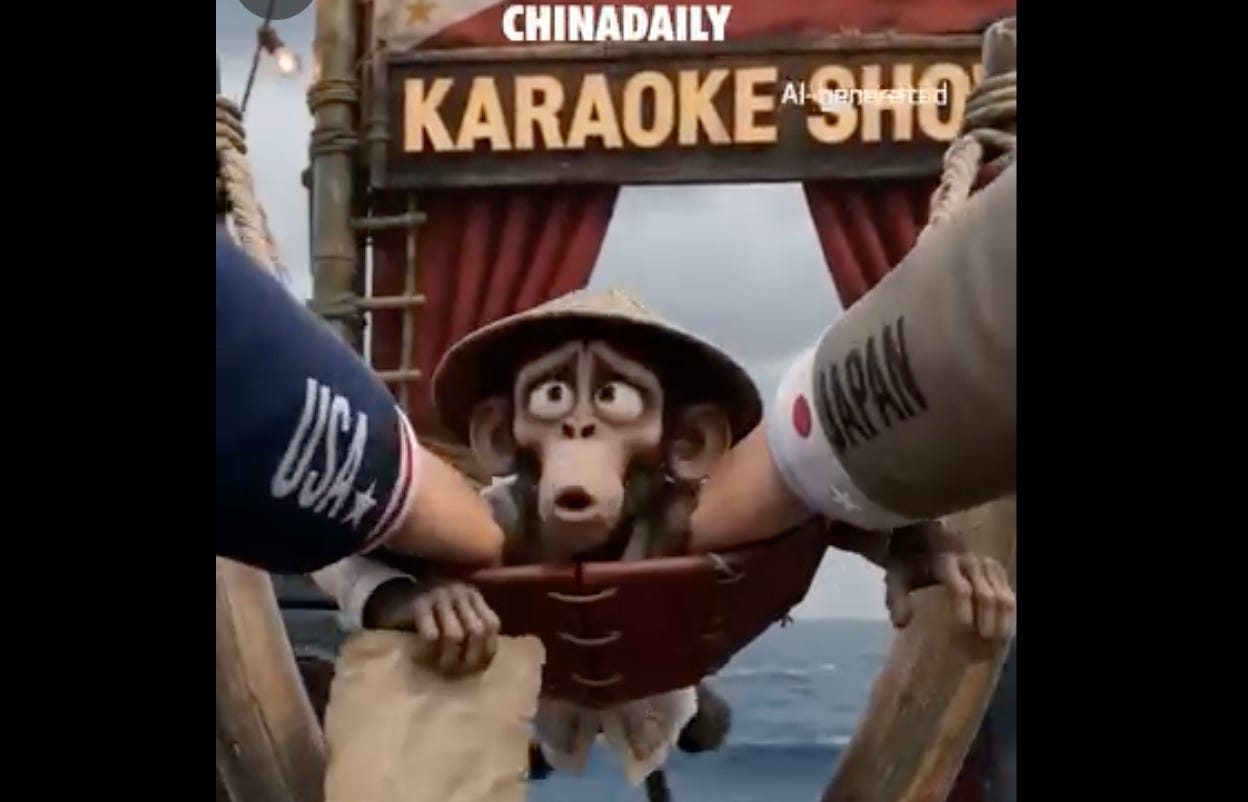
Screenshot of China Daily’s AI-generated video which portrayed the Philippines as a monkey. As of July 20, the video is still posted on China Daily’s Facebook page.
Rodney Jaleco | July 20, 2026
WASHINGTON, D.C. (July 19, 2026) — A racist depiction of Filipinos in China’s controlled press underscored the Asian superpower’s growing frustration over the way the Philippines has successfully countered much of China’s “gray zone” tactics, expanding an international coalition of nations supporting the 2016 UNCLOS arbitral ruling on South China Sea maritime disputes.
On July 10, the state-run China Daily posted an AI-generated video to its Facebook account that depicted Filipinos as monkeys. The video showed a monkey dressed in a “barong Tagalog” being directed on what to sing by arms representing the US and Japan.
After being called “stupid,” the monkey grabs a sheet of lyrics bearing the words “South China Sea arbitration award” before being thrown into the sea and blasted by a vessel’s water cannon.
The Philippines condemned it as “racist” and “contemptible propaganda,” saying it had lodged a diplomatic protest and that “disagreement over legal and political issues does not justify resorting to imagery that has no place in the public discourse of responsible states.”
China’s foreign ministry disavowed any involvement with the video and refused further comment.
The Philippines celebrated the landmark international decision on July 12, 2016, in which a tribunal established at The Hague under the UN Convention on the Law of the Sea (UNCLOS) ruled overwhelmingly in favor of the Philippines in a dispute against China.
China refused to participate in the arbitration and immediately rejected the ruling as “null and void,” continuing to assert its expansive maritime claims. The Philippines and numerous international allies—including the US, UK, Japan, Australia, and the EU—have declared the tribunal’s decision final and legally binding.

The Philippines has elevated the dispute from a bilateral confrontation into an issue of wider international concern. It has invoked the arbitral ruling—shunned during the previous Duterte administration but now embraced by the administration of Pres. Ferdinand Marcos Jr.—to provide a legal framework for allies and partners to reinforce freedom of navigation and the rules-based maritime order.
The think tank Asia Maritime Transparency Initiative counted 27 nations that have publicly called for the ruling to be respected, 17 that have issued generally positive statements noting the verdict but have stopped short of calling for the parties to abide by it, and eight that have publicly rejected it.
The Philippines continues to work to operationalize and enforce the arbitral ruling by conducting joint patrols with the US, Japan, Australia, Canada, India, France and the UK, among others.
In a surprise move, the US formed an Expeditionary Cutter Squadron for the Western Pacific, redeploying six Sentinel-class Coast Guard cutters from Bahrain to rotate between Singapore and the old Vietnam-era US naval base at Subic Bay.
While the US has previously deployed large national security cutters to the region, this marks the first time these smaller, highly agile, fast-response cutters are operating out of Subic Bay. They are approved to remain in the theater through at least September.
More significantly, the US expedtionary force may be relying on the 2016 arbitral ruling to lend legal framework legally for law enforcement activities in the South China Sea and the West Philippine Sea.
The US is not a claimant in the South China Sea and is not a party to UNCLOS, but it has consistently said the 2016 arbitral award is final and binding and should be used as the legal baseline for what counts as lawful activity.
The award — which invalidated China’s sweeping claim under the nine-dash line and ruled that features like Mischief Reef and Second Thomas Shoal are within the Philippines’ EEZ — gives the US and Philippines a framework to characterize Philippine law enforcement actions as routine EEZ enforcement, and Chinese interference as unlawful.
The US and Philippine Coast Guards have worked together in the West Philippine Sea, where Chinese “white hulls” and maritime militia have figured in clashes with Philippine vessels that have been subjected to water cannons and blinding lasers. A more robust US Coast Guard presence in the South China and West Philippines seas is expected to add a layer of risk and complication to China’s “gray zone.”
There is also little doubt it will leave some measure of deterrence as well as escalation in an already precarious South China Sea.