

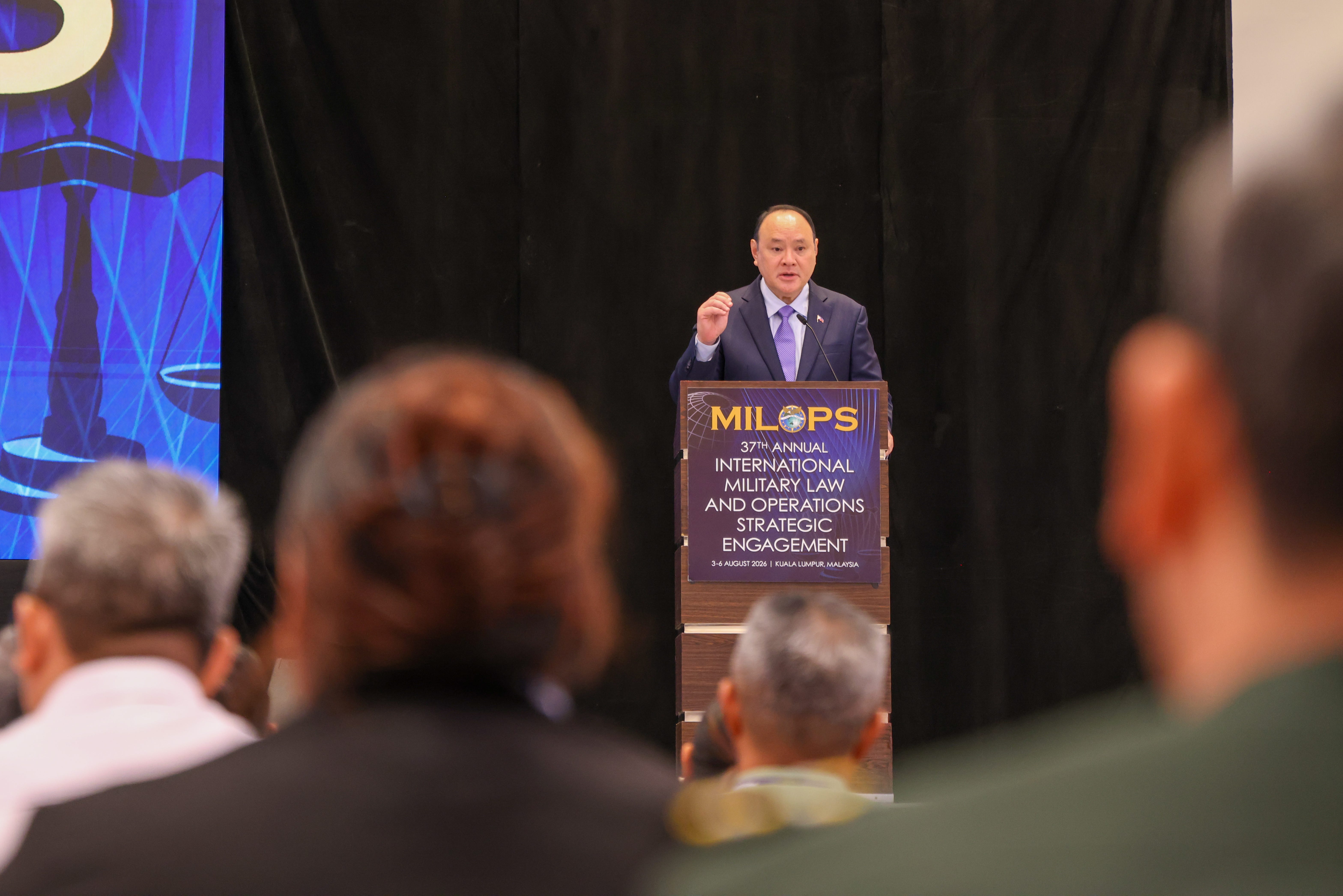
Defense Secretary Gilberto Teodoro Jr. speaking at the United States Pacific Command’s annual international Military Law and Operations Strategic Engagement (MILOPS) in Kuala Lumpur, Malaysia. Official handout.
Anna Mogato | August 5, 2026
MANILA — Defense Secretary Gilberto Teodoro Jr. has called on “like-minded allies” in Southeast Asia to band together in ensuring a free and open Indo-Pacific.
During the United States Pacific Command’s annual international Military Law and Operations Strategic Engagement (MILOPS) in Kuala Lumpur, Malaysia, Teodoro called for neighbors to “converge in the Philippines.”
“We have the uniqueness of having several convergence partners with fundamental disagreements,” Teodoro said.
“We are blessed with the fact that for the Philippine interests, everybody converges. Probably they would not have done that if not for the open and inclusive narrative and a trusted narrative on the part of the Philippines that […] also goes to show to our ASEAN neighbors that the Philippines only has their best interests in mind.”
Teodoro also said that he is confident that in the case of overlapping boundaries in the contested waters of the South China Sea, the Philippines will resort to “peaceful, legal and transparent means to resolve these overlapping lines. It’s different with China.”
Teodoro’s speech comes weeks after the Philippines celebrated its 10th anniversary of the UNCLOS arbitral ruling, which rejected China’s nine-dash line claim over the South China Sea, which would have covered over 90% of the waters.

However, the Chinese Coast Guard (CCG) harassed the Philippine Navy, Coast Guard, and Fisheries and Aquatic Resources repeatedly last month.
On July 20, Chinese Coast Guard personnel, on a rigid-hulled rubber boat, approached a rusting naval transport, BRP Sierra Madre, on Ayungin Shoal, prompting the Philippine Navy to drive them away.
In a brief scuffle, two Filipino sailors were injured; one was struck in the head by a wooden baton.
Days later, in another part of the West Philippine Sea, CCG vessels conducted dangerous maneuvers and fired water cannons at Philippine vessels delivering food and fuel to local fishermen.
Teodoro said that the Philippines’ strategic location, straddling the South China Sea and the Pacific Ocean, plays an important role in ensuring its ASEAN neighbors have unimpeded access to maritime trade routes.
“Therefore, it follows that if ASEAN wants unimpeded access to the Pacific under a regime of UNCLOS, ensuring Philippine entitlements as a whole under UNCLOS and the Arbitral Award is in ASEAN’s interest,” he added.
The Philippines, which hosts this year’s Association of Southeast Asian Nations, is attempting to conclude the Code of Conduct (COC) on the South China Sea with China.
However, it’s not clear whether the COC would be legally binding between China and the ASEAN member states. (Also read: ASEAN makes headway in Myanmar, Code of Conduct negotiations)