

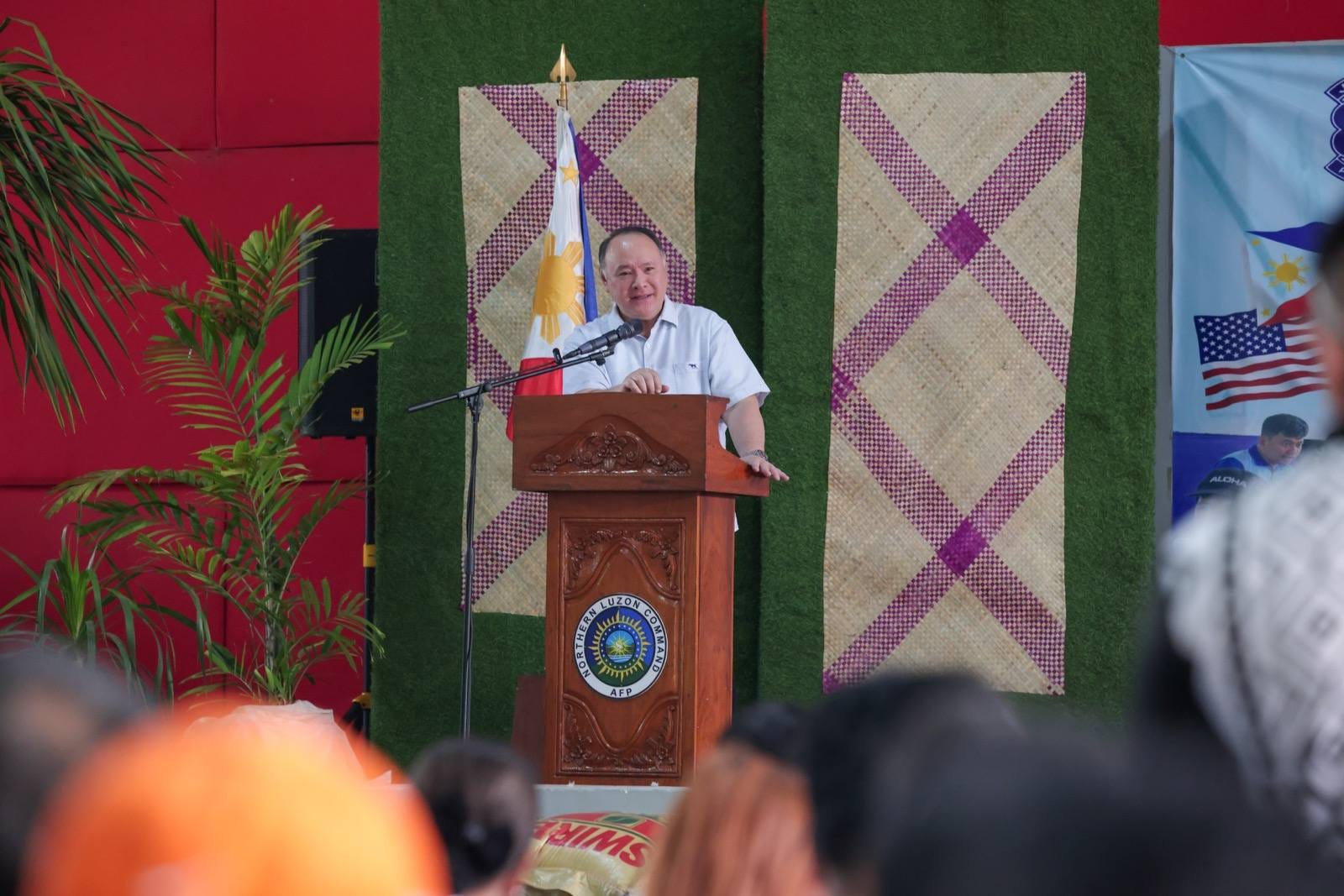
Defense Secrtary Gilberto C. Teodoro Jr. at an inter-agency community outreach program at Laoac, Pangasinan on March 18, 2026. Photo from Department of National Defense.
Manuel Mogato | March 18, 2026
Manila — Watching closely the ongoing conflict in the Middle East closely, the Philippines has drawn some valuable lessons from the experience, Defense Secretary Gilberto Teodoro Jr. said, particularly on the sustainability of military logistics.
Teodoro said that a more reliable and sustainable supply chain is important for a country to last through a conflict for a longer period, particularly for the necessary platforms needed for a conflict.
These are necessary for aircraft, vessels, and other war machines to operate unhampered during a conflict, Teodoro said.
“We need a source that can supply us even under tight conditions,” said Teodoro, emphasizing the importance of the supply chain.
The Philippine Air Force was forced to ground its fleet of FA-50 light fighters from South Korea due to the unavailability of spares a few years ago.
It had to wait for two years for the spares to be delivered.
It was the fault of the defense department, which signed the deal with South Korea more than a decade ago. It did not include spare parts in the original deal and was negotiated separately.
Teodoro said there was also a need to stockpile fuel reserves, as the world experienced soaring prices due to a tight supply after Iran threatened tankers passing through the narrow Strait of Hormuz. (Also read: ASEAN calls for cessation of hostilities in the Middle East)
A number of vessels were hit by Iranian missiles while attempting to pass through the strait in “We need huge reserve,” Teodoro said, adding the reserve must be more than what the oil companies keep for commercial and industrial use.
The Philippines has an oil stockpile of only up to 60 days, importing nearly 98 percent of its requirements from the Middle East. It consumed roughly 480,000 barrels per day.
“I will not say the amounts, but we need not only the amounts but the facilities.”
The Philippines can also avail of a military logistics agreement with the United States, the Mutual Logistics and Service Agreement (MLSA) signed during the Bush administration.
The Philippines can request fuel for its ships and planes during exercises and training activities from the United States and Japan.
Finally, Teodoro said the Philippines must stockpile missile interceptors after Iran targeted airports, oil refineries, and other critical infrastructure in Israel and Arab states in the Persian Gulf.
“We need additional anti-missile systems. It’s all a question of national resilience and national defense,” Teodoro said.