

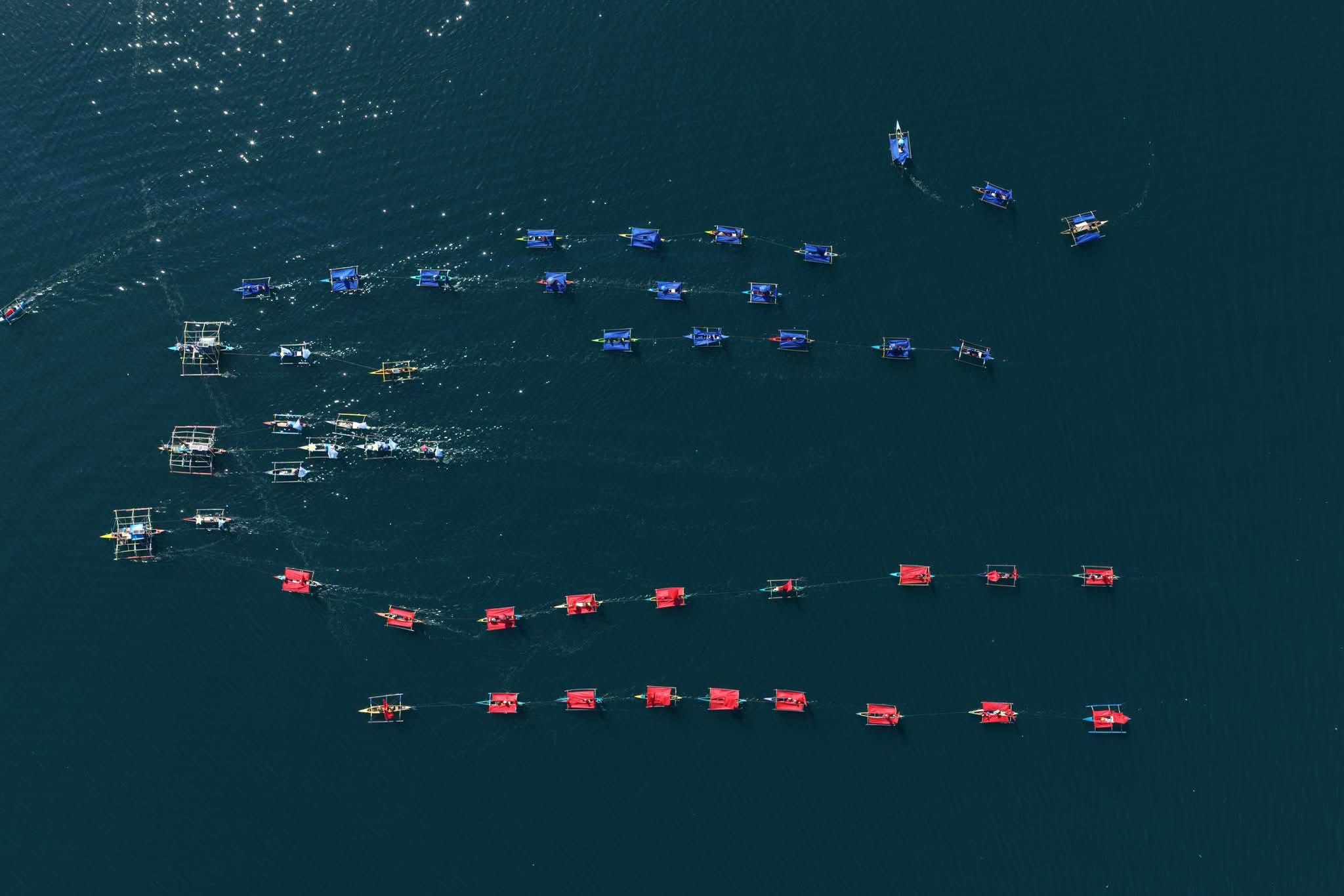
The Atin Ito Coalition and hundreds of fisherfolk from Zambales, in partneship with New Masinloc Fishermen Association, the Subic Commercial Fishers Association, and the Samahan ng Cabangaan-3 Fishermen’s Unity, conducted a symbolic sea action to form a Philippine flag ahead of the 10th anniversary of the arbitral ruling last July 5, 2026. Photo from Atin Ito Coalition.
Anna Mogato | August 5, 2026
MANILA — The Philippines’ foreign ministry remained confident that a rules-based order can be achieved in the South China Sea despite the China Coast Guard’s (CCG) repeated illegal, coercive, aggressive, and deceptive (ICAD) tactics over Bajo de Masinloc and Ayungin Shoal.
Rogelio Villanueva Jr., DFA Spokesperson on Maritime Affairs on West Philippine Sea Issues, said they’re still optimistic that the Code of Conduct (COC) on the South China Sea between the Association of Southeast Asian Nations (ASEAN) and China will be concluded this year.
“We remain optimistic that we’re able to conclude an effective, substantive, and legally binding COC by this year, and we are of course encouraged by the political will, the enthusiasm, the commitment of the ASEAN member states during the negotiations, including China,” Villanueva said. (Also read: Philippine Defense Secretary calls on ASEAN to support a rules-based order in the South China Sea)
“There has been considerable progress in the discussions, especially on those that are about the [definition of] self-restraint. Now the Philippines is working very hard to arrive at the consensus of the ASEAN member states, especially as to the other milestone issues, particularly on the legal nature of the COC.”
Last month, the Philippines celebrated the 10th anniversary of the Arbitral Award, which recognized the country’s entitlements over some part of the resource-rich South China Sea.

The Arbitral Award also rejected China’s historical nine-dash line claim, which would have covered over 90% of the waters.
Chinese vessels harassed the Philippine Navy, the Fisheries and Aquatic Resources Bureau, and the Philippine Coast Guard, coinciding with the ASEAN Ministers’ Meeting, attended by China’s Foreign Minister Wang Yi.
An altercation last July 20, which led to a head injury on a Philippine Navy serviceman, led to President Ferdinand Marcos Jr. summoning Beijing’s envoy, Jing Quan, to Malacañang.
The Chinese ambassador later hinted that they are considering reviewing the Provisional Understanding between the two countries on Ayungin Shoal.
The Chinese embassy has yet to inform the Philippines of a proposal to review the Provisional Understanding (PU), which was enforced in July 2024 following an incident at Ayungin Shoal that caused a Philippine personnel to lose a finger.
“The Provisional Understanding is a means for conflict prevention and to avoid misunderstandings and miscalculations at sea, particularly in respect to our rotation and resupply (RORE) missions,” Villanueva said.
Under the PU, the Philippines is not required to seek permission from China to conduct its RORE missions, and China is also not allowed to board and inspect Philippine vessels.
The PU also does not prohibit the Philippines from exercising its sovereign rights.
“It has worked for two years already, since July 2024. We have had 15 incident-free RORE missions just to show that PU has worked,” Villanueva said.
“And we’re able to arrive with the necessities and to undertake the rotation of our personnel, servicemen assigned in the BRP Sierra Madre.”