


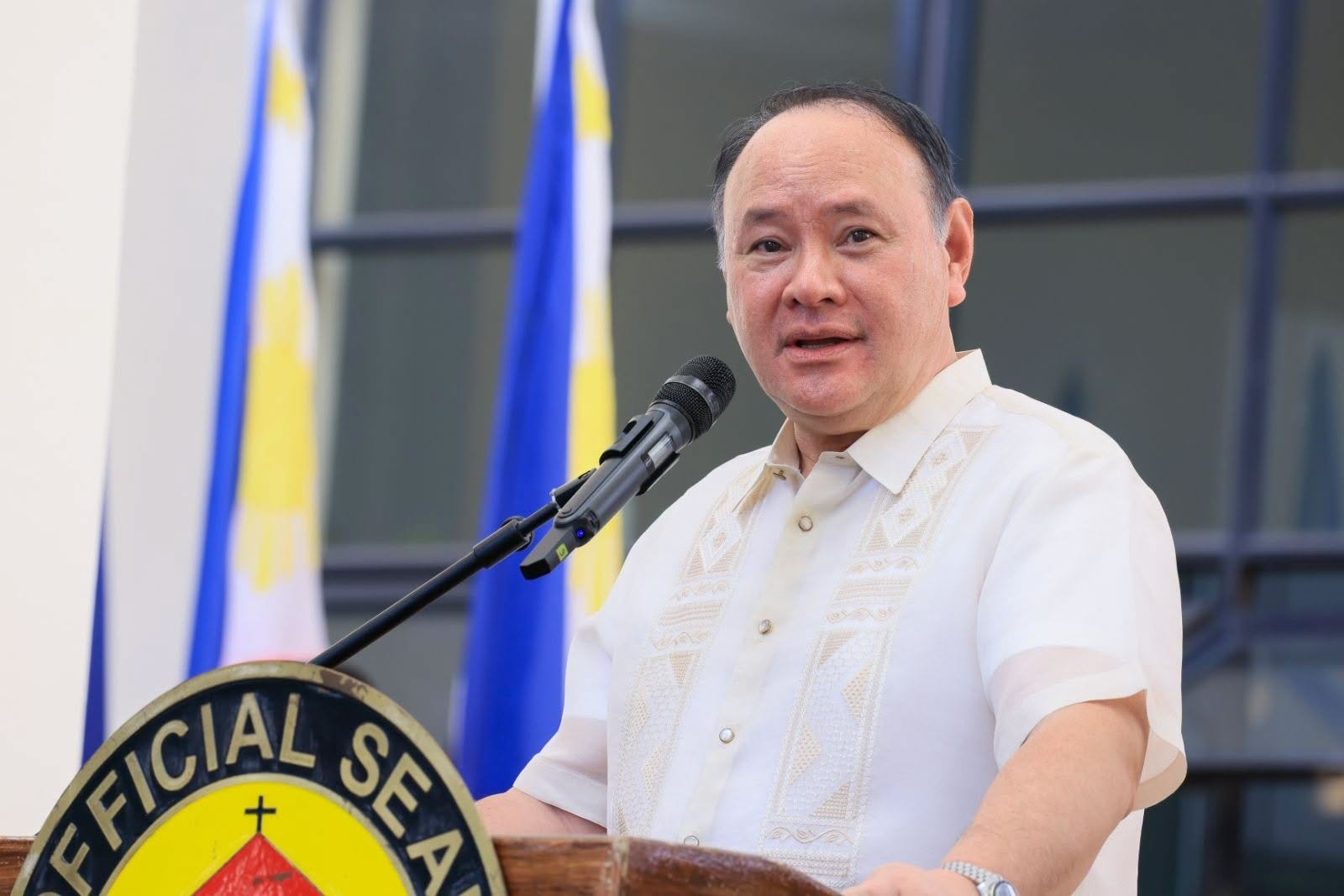
Department of National Defense (DND) Secretary Gilberto C. Teodoro, Jr. at Cebu City Hall for the West Philippine Sea (WPS) Victory Day at Cebu City Hall last July 13, 2026. Official handout.
Manuel Mogato | September 6, 2026
MANILA — Defense Secretary Gilberto Teodoro Jr has set two important requirements for the Philippines to enter into deals with defense contractors for military platforms, parts, and critical supplies.
Appearing before the House Appropriations Committee to justify the Department of Defense’s 324.6 billion pesos spending for 2027, Teodoro said his office will prudently allocate the meager budget to upgrade deterrent capability to protect national interests.
Sustainment and infrastructure support are essential in acquiring vessels, aircraft, armored vehicles, drones, and missile systems, he told lawmakers, pleading for a higher budget as regional tensions rise and greater uncertainty looms. (Also read: The military modernization fund faces big challenges)
When asked by lawmakers what the department’s priority concerns are, Teodoro pointed out two things before a government-to-government (G-to-G) deal will be awarded to a contractor for military equipment and weaponry.
First, the contractor and the country that will supply critical equipment, defense technology, or weapons systems must be aligned with the Philippines’ position on the West Philippine Sea issue.
Thus, like-minded countries have a clear edge in winning big-ticket contracts for vessels, aircraft, and other military equipment, parts, and accessories. (Also read: Philippines gets $100 million from the United States in 2027)
The Philippines has listed the following as among its major defense suppliers for brand-new or second-hand platforms or equipment: Australia, Brazil, the United States, the United Kingdom, the Netherlands, Poland, Turkey, Israel, India, South Korea, Japan, and Indonesia.
These countries are among staunch supporters of the Philippines’ position in territorial claims in the South China Sea. A few of them have even entered into deeper and broader defense cooperation, including status-of-forces agreements (SOFA).
Other like-minded states, such as Canada, France, and Germany, are among those offering assistance to the Philippines, such as training, exercises, and other forms of defense cooperation.
Teodoro said the Philippines will not accept any country that may wish to provide material or financial assistance and any other forms of engagement if these states support China’s excessive and illegal claims in the South China Sea.
He said the Philippines would not want to share a table with any country that also deals with military equipment, technology, or logistics with China. (Also read: Teodoro calls on a coalition to resist China)
Second, the Philippines will not make deals with states at war with another state because there could be a potential disruption in the supply chain, particularly for spares, parts, and other components.
For instance, the Philippines has halted entering into deals with Israel due to the ongoing conflict with Iran and other non-state actors, like Hamas and Hezbollah.
Teodoro said the only contract with Israel involved the restocking of short-range Strike ER missile systems after some were used for the Navy’s training purposes.
A Polish company had completed delivery of 48 S-70i Black Hawk helicopters, and a South Korean shipyard delivered two of four Offshore Patrol Vessels (OPVs). The other four vessels will be constructed in a shipyard in Subic.
Indonesia is also set to deliver two Landing Platform Docks (LPDs), the largest naval vessel in the Philippines’ inventory.
A South Korean shipyard could be awarded a large logistics vessel, and a South Korean aircraft maker won a contract for a squadron of FA-50s to be delivered starting in 2028.
Brazil won a second contract for six A-29 Super Tucano to complete a squadron of 12 turboprop close air support aircraft.
Teodoro said the Armed Forces has 10 ongoing projects under the three-phase, 15-year revised modernization program, originally set at 300 billion pesos.
However, only two phases were funded under the Aquino and Duterte administrations. President Ferdinand Marcos Jr. has revised the third horizon program several times, now costing the government over 1 trillion pesos.
For 2027, Congress has allocated 50 billion pesos for the military’s modernization program.
However, almost 80 to 90 percent of the fund will go to paying for the amortization of equipment acquired in the last two administrations.
Less than 10 billion pesos would be left to fund new acquisitions.
Teodoro has limited options to fast-track the military upgrade program, including taking out loans and selling military properties.
Defense spending hovers a little over 1 percent of GDP, far from 3 percent, which the US has been pushing its allies and partners in the Asia-Pacific region to share the burden in countering China’s rise.