


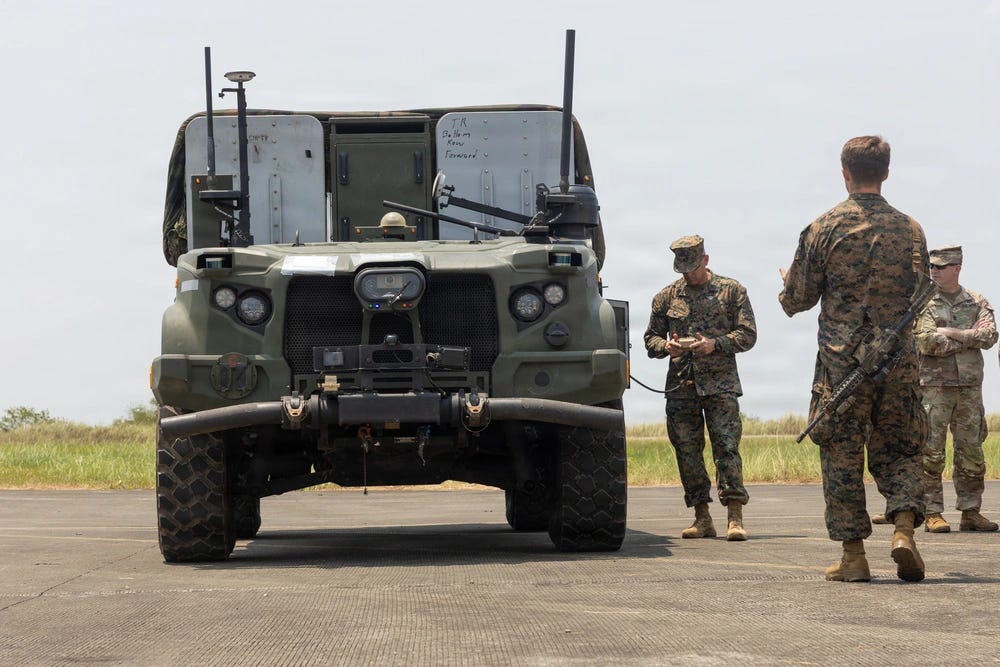
US Soldiers at the Cagayan North International Airport, or Lal-lo Airport, during the annual Balikatan exercises last April 22, 2026. Lal-lo Airport is one of the nine EDCA sites. Photo by Sgt. Jonathan Beauchamp, 3rd Marine Division.
Rommel C. Banlaoi | October 28, 2026
Although the Enhanced Defense Cooperation Agreement (EDCA) between the Philippines and the United States has become a focal point of debate in our national security discourse, it is paramount to critically examine studies that claim to assess its implications. (Also read: What’s the reason behind US expansion of military engagements in the Philippines?)
A recent Tearline report, “An Examination of US and PRC Influence at the EDCA Sites in the Philippines” (2026), produced under National Geospatial-Intelligence Agency (NGA)-reviewed methodology, offers descriptive mapping of EDCA facilities. But it regrettably suffers from methodological and evidentiary gaps that limit its policy relevance.
Strengths and Weaknesses
The study’s strength lies in its compilation of open-source materials and its attempt to visualize influence dynamics around EDCA sites. Maps and geospatial overlays provide a useful starting point for analysts.
However, the methodological framework, the grounded theory, is not strictly applied. Grounded theory, based on my limited knowledge, requires systematic coding of fieldwork or interviews. Yet the study fails to show if such fieldwork has been rigorously conducted. Instead, the report presents heavy sources on English-language news, social media posts, and advocacy statements. For a study claiming to assess “mechanisms of influence” at the community level, the absence of Filipino-language sources and household-level data is also a serious methodological flaw.
The evidentiary base is in fact uneven. The Fraym.io survey snapshot from late 2024 is the only original quantitative input. But its methodology is undisclosed, making sentiment figures unverifiable.
Other data points conflate disparate sources: remittance figures from 2016 are used to explain recruitment claims in 2024, while tabloid reports substitute for official records on land acquisition, crime, and student enrollment. This weakens the credibility of the findings and its conclusions.
Analytical Balance
The report’s treatment of the China threat is apparently overstated. Correlation is often presented as causation, with Philippine Offshore Gaming Operator (POGO) operations, land fraud, and student enrollment near EDCA sites framed as probable “intelligence playbook” indicators without triangulation against Philippine law-enforcement findings, Armed Forces of the Philippines (AFP) threat assessments, or People’s Republic of China (PRC) embassy denials. (Also read: Teodoro accuses China of “interference” in Philippine affairs)
The distinction between criminal, commercial, and state-directed activity, which is central to credible influence analysis, is blurred. Even the 40 percent equity stake of State Grid Corporation of China in the National Grid Corporation of the Philippines (NGCP) is treated as a near-existential “kill switch,” reproducing congressional claims without acknowledging NGCP’s rebuttals or subsequent corporatization debates. This inflates legitimate governance concerns into speculative sabotage scenarios.
By contrast, risks to Philippine host communities are treated superficially. Opposition from groups such as Kilusang Magbubukid ng Pilipinas (KMP), Amihan, and Bagong Alyansang Makabayan (Bayan) is noted, as is the fear that towns could become “high-value targets” in a Taiwan Strait contingency. Yet these are framed as perception-management issues for U.S. messaging rather than substantive strategic risks. Displacement of farmers and fisherfolk, livelihood disruption from no-sail orders and live-fire exercises, and the securitization of ancestral land are documented mainly through single advocacy sources.
The imbalance is obvious: detailed but unverified accounts of PRC influence, thin treatment of human security costs. This produces a skewed risk picture overstating certainty of Chinese subversion while understating escalation exposure for Filipino civilians. (Also read: Pax Silica: Is the Philippines willing to give up its sovereignty in Clark?)
Policy Relevance
For policymakers, the key lesson is to exercise caution. This Tearline report should be treated as a compilation of open-source leads, not a validated threat assessment. Any follow-on analysis must be more careful in distinguishing between criminal activity and state-directed operations, so that ordinary crime is not automatically and maliciously conflated with espionage.
Survey methodology must also be disclosed in full to ensure transparency and credibility. Philippine government data should be systematically incorporated to strengthen evidentiary grounding. Furthermore, risks to host communities must be analyzed with the same diligence applied to external influence narratives, so that alliance commitments are balanced with human security concerns.
A More Realistic Approach
The Philippines must navigate EDCA with utmost prudence. For the Philippine government, alliance cooperation with the United States remains vital for deterrence and capacity-building. At the same time, however, overstating the China threat without rigorous evidence risks inflaming tensions and undermining credibility. In addition, understating the human security costs of EDCA sites risks alienating local communities and eroding domestic support.
A realistic approach therefore requires symmetrical two-level analysis: scrutinizing both external influence and internal vulnerabilities with equal rigor. It also requires grounding assessments in Philippine realities, institutions, communities, and above all, sovereignty.
For Washington, credible analysis means listening to local voices and respecting Philippine data sources. For Beijing, constructive engagement means clarifying intentions and addressing concerns about influence in ways that reassure host communities. For Manila, it means applying a comprehensive approach to ensure that alliance commitments do not come at the expense of civilian safety, livelihood and even friendly relations with China.
Conclusion
Beyond geopolitics, EDCA pertains to the lived realities of Filipinos in host communities, the credibility of Philippine institutions, and the delicate balance between alliance obligations and national sovereignty.
Studies like Tearline’s can really contribute to the needed debate, but only if their findings are treated as preliminary leads rather than definitive assessments.
Policymakers therefore must demand methodological transparency, evidentiary balance, and nuanced analysis. EDCA can only advance Philippine security and serve the interest of Philippine society if it can demonstrate that it is credible, sustainable, and just while maintaining constructive relations with both the United States and China.
Rommel C. Banlaoi, PhD, is Director of the Philippines–China Studies Center at Diliman College and President of the Philippine Society for International Security Studies. He served as President of the Philippine Association for Chinese Studies.