


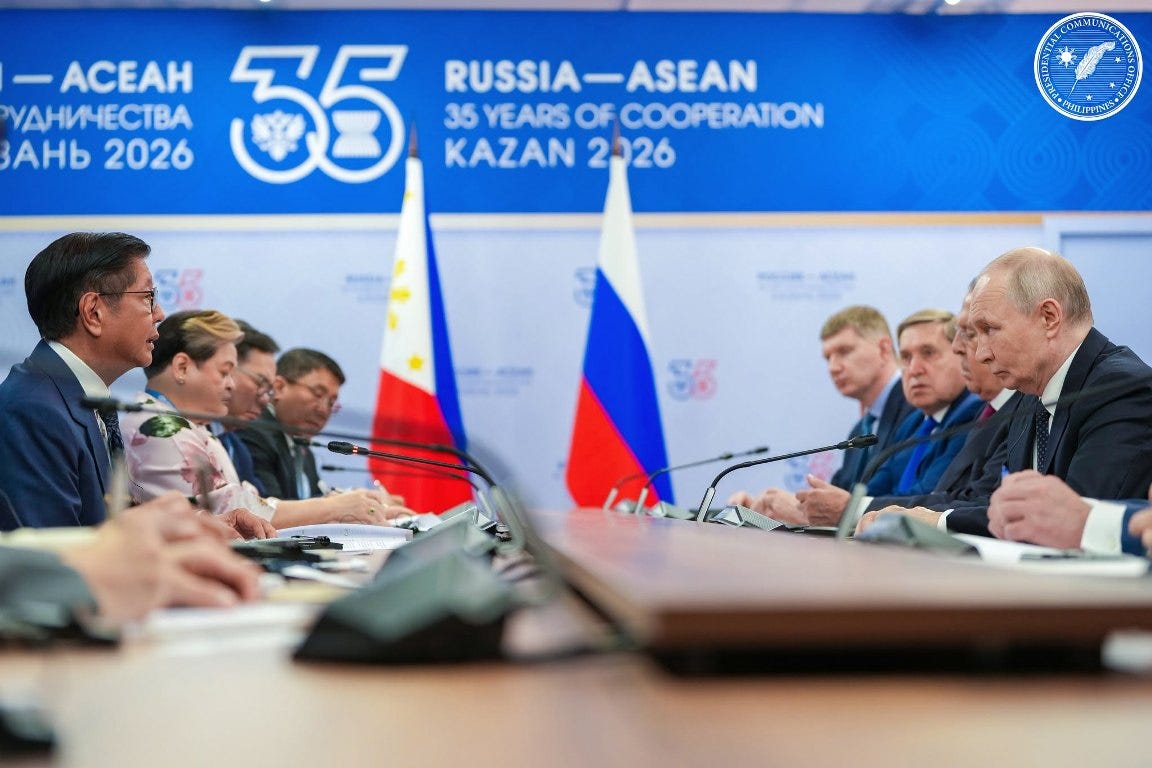
President Ferdinand Marcos Jr and President Vladimir Putin meet for bilateral talks at the sidelines of the Russia-ASEAN Summit in Kazan last Wednesday, June 17. Official handout.
Manuel Mogato | June 18, 2026
MANILA — Did US President Donald Trump try to steal the show from Russian leader Vladimir Putin at the Russia-ASEAN Summit in Kazan, which he hosted this week?
Putin discussed energy and food security at the summit, offering a reliable, steady supply of petroleum products to oil-thirsty Southeast Asian countries as well as fertilizers to sustain productivity.
However, Trump announced a peace agreement with Iran before the Kazan summit, ending more than three months of conflict in the Middle East, which caused global oil prices to soar and supply to tighten. (Also read: Philippines welcomes US-Iran peace deal)
The peace deal will reopen the narrow Strait of Hormuz through which oil flows from Persian Gulf states, Kuwait, and Iran to the world.
Will the end of the conflict stabilize global oil supply and prices?
Although Brent and West Texas prices have declined, there’s still uncertainty whether the peace deal will hold.
It will also take time for the Gulf States to rehabilitate and reconstruct the oil facilities that were destroyed and damaged by Iran’s missile attacks.
Thus, Russia’s food and energy security offerings could remain viable for Southeast Asian states, particularly the Philippines, Thailand, and Vietnam.
Moscow could offer competitive prices for its petroleum products, and delivery times could be much faster due to the proximity of Russia’s Far East to Southeast Asia compared to the Middle East. (Also read: Philippines learns from the Middle East conflict)
However, there could be a complication because the United States and Europe had imposed sanctions on Russia to deny Moscow revenues to finance its conflict in Ukraine.
The sanctions appeared ineffective because China and India continued to import oil from Russia, which offers cheaper oil compared to the Middle East.
At the height of the Middle East conflict, the United States relaxed its sanctions, allowing Russia to sell oil for two months from its tankers floating around the world.
The Philippines said it was negotiating with its former colonial master to allow it to import oil from Russia, extending the waiver for another month to ensure a steady supply of crude oil because it has thin reserve capacity compared with other countries in the region.
The US and European sanctions not only cover energy resources, but also extend to food security by imposing artificial restrictions on production, trade, and transportation of Russian fertilizers and agricultural products.
The US and Europe also wanted to substitute the Russian food supply chain with genetically modified products.
For instance, the Philippines was the first “testing site” for US corporations for spreading GMO products, such as the “golden rice” and other agricultural products, like eggplant.
Worse, the Ukrainian conflict also affected fertilizer supply as vessels transporting agricultural products were often attacked, deepening the food crisis in Africa and Asia.
President Ferdinand Marcos Jr., who co-chairs the Russia-ASEAN Summit with Putin, must work to deepen and broaden energy and food cooperation with Russia, importing more mineral fertilizers and agricultural products, diversifying trade partners, and reducing dependence on the US and other Western states.
Russian fertilizers were designed for tropical countries that are vulnerable to much stronger typhoons during the monsoon period, and drier, hotter weather during dry seasons.
For the Philippines, it is important to increase its farm productivity to feed its growing population.
Rice production in the Philippines is not far behind Thailand and Vietnam. However, it has a much bigger population than its neighbors.
The shortfall in rice production in the country is more pronounced, making the Philippines the world’s largest rice importer.
The shortage could result in price increases and accelerate inflation. Thus, a steady supply of fertilizer is needed to improve rice production and cut the deficiency.
Apart from regional fertilizer and oil supply, Marcos also wanted a separate energy deal to improve power supply in the Philippines.
Moscow is offering a Russian floating nuclear reactor to stabilize power supply and may lower power rates if there is a more adequate supply.
Power deficiency has recently been experienced in the central Philippines and on the main island of Luzon as demand surged due to intense summer heat.
Washington has also signed a 123 agreement with Manila to provide a modular nuclear reactor that could be mounted on trucks and could be moved around the country.
Marcos’ trip to Russia is important. It should not be viewed as breaking away from the American and Western alliance.
The Philippines is only diversifying its relations to advance its own national interests. The Philippines is not taking any side; it is just asserting its foreign policy of being “a friend to all and an enemy to no one.”
