


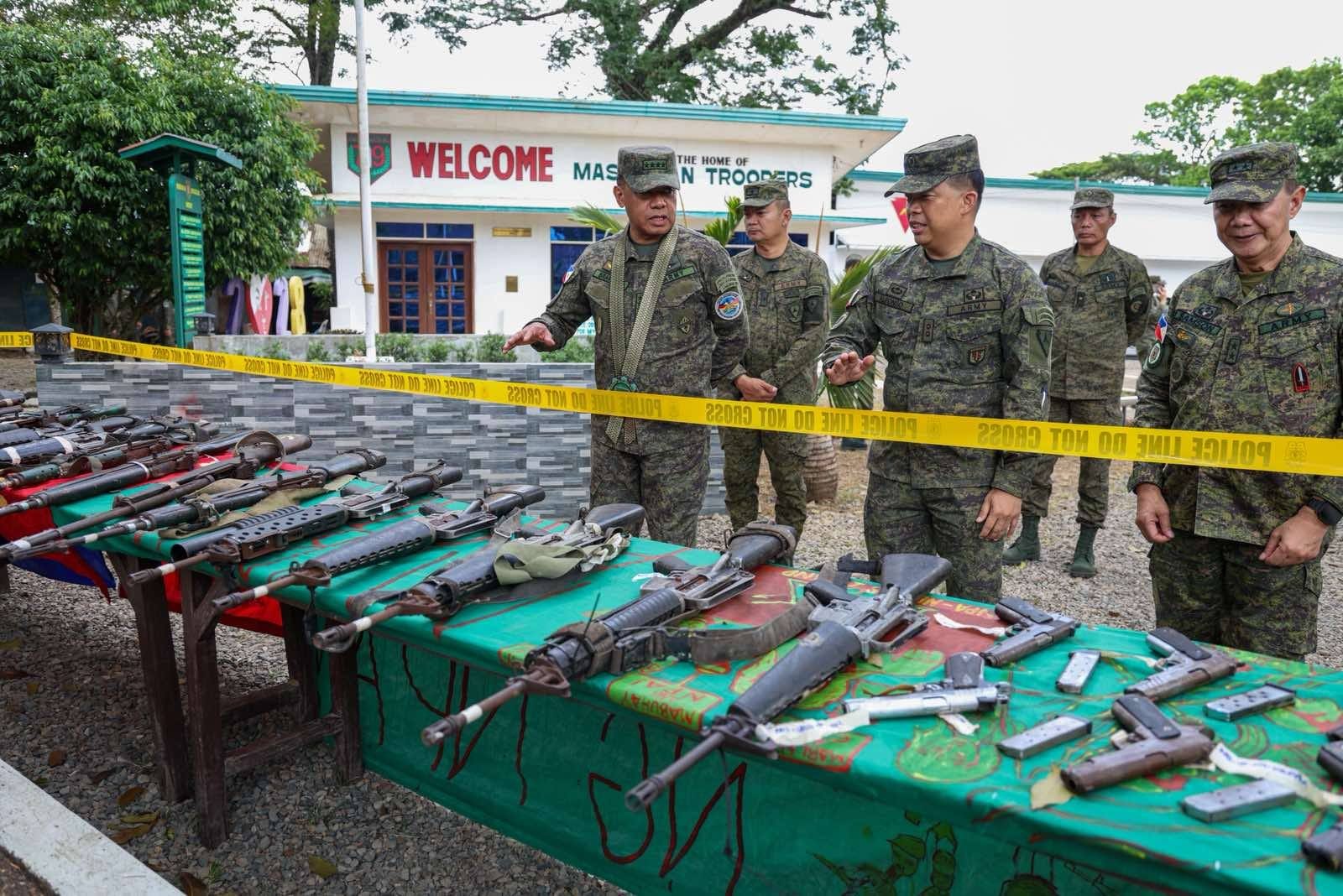
Armed Forces of the Philippines Chief of Staff General Romeo S Brawner Jr inspects the recovered firearms from Communist NPA Terrorists in Sagay City, Negros Occidental, last Saturday, May 2. Photo from AFP.
Manuel Mogato | May 6, 2026
MANILA — President Ferdinand Marcos Jr’s national security adviser supported the defense and military establishments’ position against resuming peace talks with the Communist rebels, saying it would only give “a lifeline to dying insurgency.”
National Security Adviser Eduardo Oban Jr., a retired air force general, said the Maoist-led guerrillas had been exploiting ceasefires and peace negotiations to reorganize and strengthen the rebel movement.
However, Oban favored localized peace talks that would directly address the root causes of insurgency. (Also read: Government troops kill 19 Maoist-led rebels in Negros)
“The Filipino people are not asking for the return of peace negotiations that the CPP-NPA-NDF has historically abused,” Oban said, in a statement, referring to the Communist Party of the Philippines, the New People’s Army, and the National Democratic Front.
“Our communities are asking for roads, schools, livelihoods, justice, local security, reintegration, healing, and protection from recruitment and intimidation.”
The Maoist-led rebels have been waging a protracted guerrilla warfare for nearly six decades that killed more than 40,000 people and stunted economic growth in resource-rich poor rural communities across the archipelago.
Peace talks with the rebels began in 1986 after Corazon Aquino was swept into power after a near bloodless popular revolt against dictator Ferdinand Marcos Sr. the father of the current leader.
Brokered by Norway, the on-again and off-again peace negotiations have not resulted in a political deal, unlike peace talks with Muslim secessionist rebels.
“For close to four decades, the Filipino people have paid the price of misplaced generosity toward a movement that repeatedly used peace negotiations as a tactical instrument for recovery, never a sincere path to reconciliation,” Oban said.
“At this point in our nation’s history, peace talks should not be allowed to become a lifeline for a dying insurgency. To reopen negotiations at this time would only overturn the hard-won victories that Filipino communities have achieved through years of courage, sacrifice, and peacebuilding.”
There had been proposals to resume peace talks with the Communist rebels after a bloody armed encounter between soldiers and guerrillas in northern Negros where 19 rebels died. (Also read: Dangerous recruitment)
Defense Secretary Gilberto Teodoro Jr. and the Army chief, Lieutenant General Antonio Nafarrete, rejected the proposals.
Former president Rodrigo Duterte ended the peace negotiations during his term after rebels continued to attack military targets and the civilian population during the talks.
