


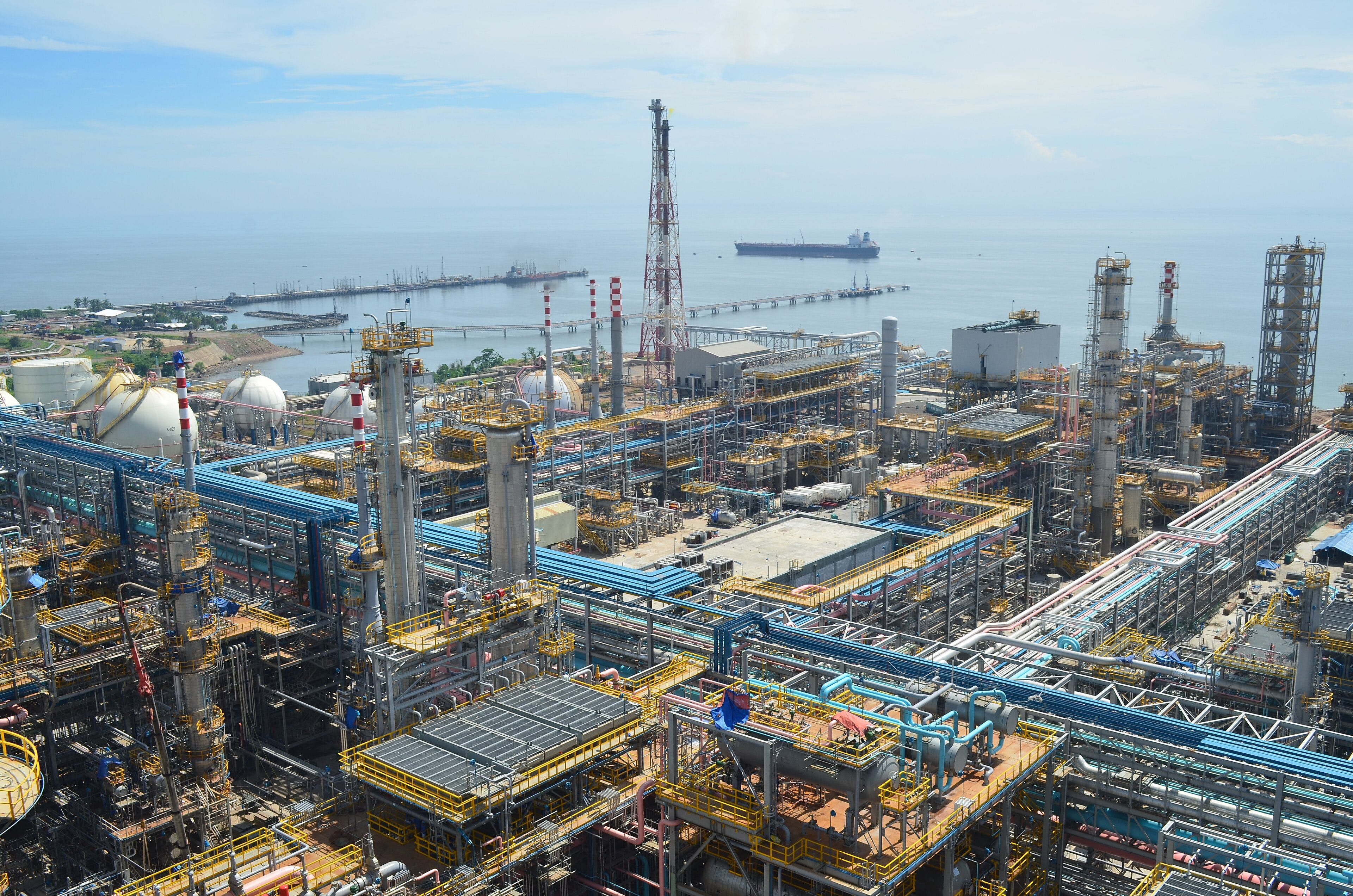
The Petron Bataan Refinery. It is the biggest oil refinery in the Philippines, producing 180,000 barrels per day. Photo by dcperdio, Public Domain, Wikimedia.
Manuel Mogato | April 7, 2026
MANILA — A security think tank opposed the Marcos government’s plans for a joint energy exploration agreement with China in the West Philippine Sea (WPS), describing the giant northern neighbor as an unreliable partner and irresponsible actor.
In a statement, Stratbase Institute warned engaging with China would be “detrimental to the Philippines’ long term national interest.” (Also read: Navy rejects maritime cooperation with China)
“A state that persistently disregards international law and violates Philippine sovereign rights cannot be expected to honor any agreement,” Victor Andres “Dindo” Manhit, president of Stratbase Institute, said in a statement distributed to media.
“Entering into such a partnership would expose the country to unnecessary risk.”
Instead, Manhit said, the government should pursue “clear and decisive measures” including the full implementation of President Marcos Jr.’s Executive Order No. 111, which adopted Philippine names for 131 features of the Kalayaan Group of Islands in Palawan province as an exercise of the country’s sovereignty in the WPS.
He also urged the country to develop its energy resources through partnerships with “like-minded states and credible Filipino private sector actors with the necessary expertise and capacity.”
In a recent interview, President Marcos said he was considering joint oil-and-gas exploration with China particularly in the western section of the Philippines’ exclusive economic zone amid the energy crisis brought on by the Middle East conflict.
President Marcos Jr. said the crisis triggered by Iran’s closure of the critical Strait of Hormuz through which one-fifth of the world’s oil passes — could be the “impetus” for the Philippines to “come to an agreement” on such joint explorations in the disputed regions in the South China Sea. (Also read: Iran will allow the safe passage of the Philippine-bound oil tankers)
However, Manhit believed that the country’s energy security “must never come at the expense of sovereignty.”
“No crisis should be used to justify compromising the Philippines’ legal position or ignoring the lived realities of Filipino fisherfolk and frontliners who continue to bear the consequences of China’s actions in the WPS,” he added.
Stratbase Institute said any discussion of joint energy exploration activities must be firmly anchored in international law as well as the 2016 Arbitral Award that invalidated China’s sweeping claims over the South China Sea.
Beijing has repeatedly dismissed the ruling and maintains its nine-dash claim over the South China Sea, with Chinese Coast Guard (CCG) vessels often restricting areas to areas like Scarborough Shoal through what Philippine officials characterized as “illegal, coercive, and aggressive actions” in the WPS. (Also read: Thinking out of the box)
Manhit said several incidents where China damaged Philippine assets and endangered the lives of Filipino uniformed personnel and civilians “as part of its sustained effort to assert unlawful control over areas that belong to the Philippines under international law.”
“These rights are non-negotiable. All resources must remain under full Philippine ownership, control, and supervision. Any arrangement that creates ambiguity or undermines these rights is unacceptable,” he added.