


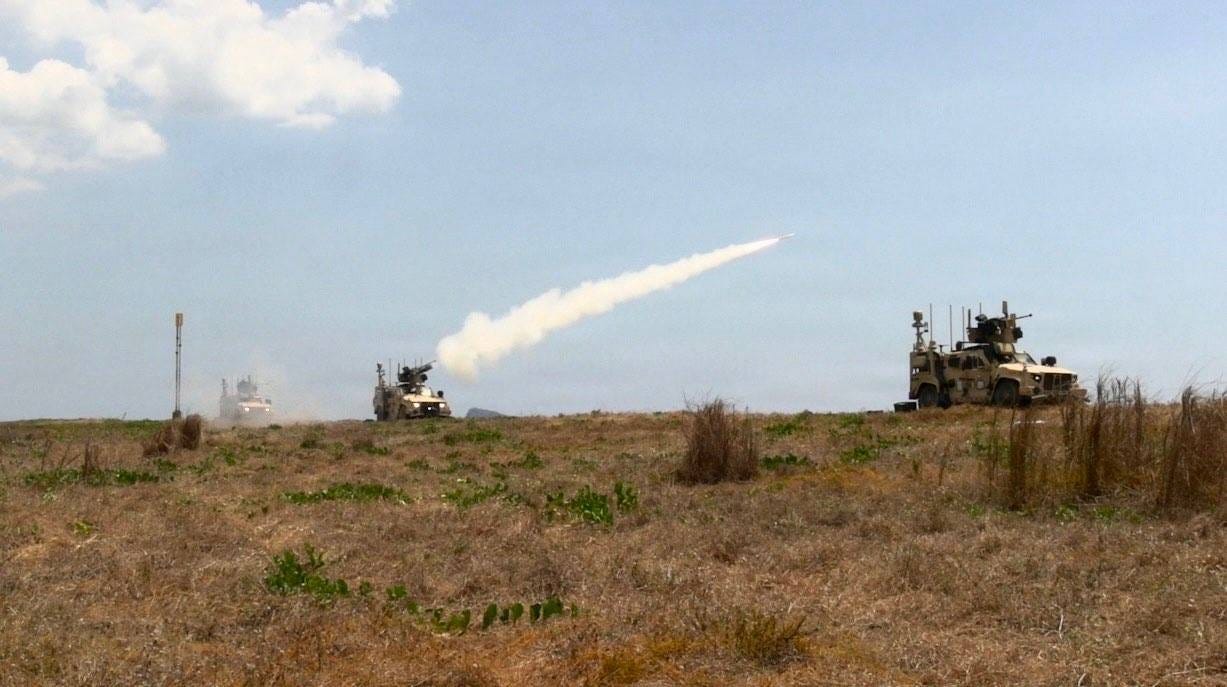
US Marines fired a Marine Air Defense Integrated System (MADIS) as part of the Integrated Air and Missile Defense training events during Exercise Balikatan 2026 in Naval Station Leovigildo Gantioqu last April 28. Photo by U.S. Marine Corps Sgt. Atticus Martinez and Lance Cpl. Benjamin Catindig
COL Dencio S Acop (Ret), PhD, CPP | May 12, 2026
BOSTON, Massachusetts — While weapons of destruction have their strengths, they too have inherent weaknesses. Developments in the three regions of contention today manifest this. Lessons learned from the Russia-Ukraine War, and more recently, the Iran War, are beginning to manifest what may be in store for a potential Indo-Pacific War turning kinetic.
There are a whole range of factors that could be subject to scrutiny in these three regions, but this assessment will focus on the strengths and vulnerabilities of key deployed and developing weapons systems.
First, the war in Ukraine is revolutionizing modern warfare, proving that relatively inexpensive, autonomous systems (drones) can effectively neutralize high-end, mainstream platforms, highlighting the indispensable role of electronic warfare and the need for quick innovations on the battlefield. It has become a deadly, high-tech “strike-counterstrike” cycle, necessitating high-volume, scalable defense production capability rather than reliance on small numbers of high-end systems. The conflict showcases the effectiveness of portable man-pads in combatting massive drone swarms as well as the ineffectiveness of fixed, high-end defense sites (e.g. Patriot). It demonstrates the offensive necessity of encrypted communications and fiber-optic guided drones which emit no radio signals.

Defensively, the ability to jam, track, and disrupt drone control signals has been crucial. Drones need guidance methods to accurately hit their targets. These include satellite, aircraft, or ground controllers allowing them to track both stationary and moving targets. (Also read: Philippines tests anti-drone defense in Zambales)
Some drones, however, have self-contained systems enabling them to autonomously track, focus, and hit their targets. A camera or infrared sensor on the weapon transmits imagery to the operator or uses autonomous image recognition for target recognition and neutralization. The use of drones as reconnaissance in Ukraine is enabling traditional artillery to be more accurate and greatly reduce detection-to-strike timelines.
It has also proved lethal against tanks and armored vehicles requiring integrated EW and anti-drone defenses. Ukraine demonstrated that small, unmanned, and inexpensive maritime surface vessels could effectively neutralize large, high-end surface combatants, thereby redefining naval strategy in denied environments. It also illustrated a critical war-fighting advantage of drone technology over traditional systems — while a drone or jamming technique working today can become obsolete tomorrow, it can be resolved by in-the-field software and hardware updates rather than factory-level maintenance which can take weeks or months to resolve.
Drones are now the undisputed weapons systems of choice due to their effective asymmetric advantages on the battlefield against previously superior traditional platforms. They cause massive damage to the enemy at minimal cost, both in terms of lives and material. They can threaten anything that moves through any space.
Enhanced by AI, they can execute offense and defense at supersonic speed. Perhaps, the only counter-threats that can stop them are those rooted in signal disruption and enemy capacity to out-manufacture them. Drones are, in fact, so effective that even large armies are now adopting them and are going asymmetric themselves which, in the long term, will make warfighting evenly close, prolonged, and more disruptive. But they are perhaps man’s lesser evil choice, than mutually assured nuclear annihilation.
Second, the vulnerabilities of US military power, especially its air power, despite obvious strengths, are laid bare by the Iran War (Operation ‘Epic Fury’). They have strategic bearing on the US’ ability to successfully prosecute its global conflicts simultaneously.
Meantime, and while the US under Trump has managed to stress its relationships with its allies, it is apparent that the US military is learning from Ukraine’s successful use of drones against Russia. The US, wary of China and Russia, is also leveraging its existing advantages and building upon them to sustain its leading spot in the global defense arena. But from all indicators, the US may have gravely underestimated Iran.
Truth is that since February 28, following the US and Israel attack, Iran unleashed over 3,700 missile and drone attacks targeting regional infrastructure behind US air power. The launches hit a US air force E-3 Sentry aircraft at Prince Sultan air base in Saudi Arabia on March 27.
Earlier, on March 13, five KC-135 Stratotanker refueling aircraft were also hit on the flight line. Iran knew what it was doing. It prioritized the crippling of intelligence and communications systems at strategic locations enabling the operationalization of US air power and eventually other weapons systems. It struck radar systems, satellite communications, and mission-critical aircraft at some 7 US bases across Bahrain, Qatar, Kuwait, Saudi Arabia, and United Arab Emirates — focused on infrastructure US forces were dependent on to detect threats, refuel aircraft, and direct air operations in the region.
Just to illustrate how strategic the hits were, the damaged E-3 was one of only 16 airborne warning and control aircraft. Some 70% of these were forward deployed by the US to the Middle East. Waning E-3s and the long replenishment timeline of these expensive systems are forcing the US to rely on the Australian E-7 Wedgetail, an option the generals don’t want due to its reported survivability concerns in contested air space. Even then, the E-7 (costing $724M each) is not expected to be operational until the early 2030s. The Cold War-era KC-135 tanker fleet faces parallel pressures.
As in Ukraine, the effectiveness of precision-guided munitions like drones, tactically and financially, is outweighing traditional infrastructure like bases and fixed systems, costly but increasingly vulnerable airborne warning and control systems, and better suited to the VUCA (volatility, uncertainty, complexity, and ambiguity) of today’s battle spaces. While the US-supplied AW/FPS-132 radar system to Qatar cost $1.1B (in 2013), the Iranian drones that hit it only cost an estimated $40,000 each.
A parallel observation extends to the Iranian drones’ destruction of missile defense infrastructure like the AN/TPY-2 radar which provided sensor support to the US THAAD battery at Muwaffaq Salti air base in Jordan. Without its sensor, the battery could not independently search and track its targets. The effective asymmetric capability afforded by drones is allowing Iran to stand up to the power of the United States. It is also threatening the ability of the US to project that power to the rest of the world.
As pointed out by Kelly Grieco, a senior fellow at the Stimson Center, the effects of the damage by Iranian drones (and missiles) “may already be rippling through the campaign in ways that don’t show up in publicly available strike counts” and that those “less visible metrics include tanker availability, AWACs coverage gaps, and stockpile constraints.”
Moreover, the threat posed by drones is not limited to the region or just one battle space alone for that matter. Philip Sheers, associate fellow at the Defense Program of the Center for a New American Security, says that what’s happening in the Middle East is a “massive alarm bell” of the need for passive defenses, not just for US forces in the region, “but even the homeland where drone incursions are increasingly frequent, and especially in the Indo-Pacific, where the Chinese missile threat is orders of magnitude larger and more difficult to suppress.”
Along with Joe Costa, former DOD deputy assistant secretary for plans and posture, he warns that “if DOD doesn’t take these events as a wake-up call, we are setting ourselves up for a disaster in a future great power conflict.”
Third, while the recent Balikatan Exercise in the Philippines proves promising in terms of what supporting allied weapons systems can do, this development must also be assessed in terms of their vulnerabilities to come up with a viable and holistic joint and combined plan whose chances of success are way above just holding the line. (Also read: Take-aways from Balikatan 2026)
While generally potent weapons, missiles and drones also have their vulnerabilities. Drones are susceptible to electronic warfare jamming and GPS spoofing, low altitude detection, and limited payloads; while missiles, despite their high speeds, can still be detected via radar and advanced air defense systems.
Missiles are also more expensive than drones. Both are vulnerable to attacks on launch, transport, and storage. Thus, cover and concealment are key to the survivability of these weapons systems.
In specific terms, electronic warfare plays a key role in both the offensive and defensive deployments of missiles and drones. Jamming disrupts drone links to their operators. GNSS/GPS spoofing feeds drones false coordinates, leading them off course. There are specialized counter-drone systems which can target even drones flying under radar.
Simple, inexpensive solutions like nets (passive drone defense) can stop FPVs (First-Person View drones) and hovering quadcopter drones. The generally smaller payloads of drones limit their killing impact against hardened, deep targets. Drone cameras and imaging sensors can be blinded by lasers or dazzlers thereby causing drones to lose control and crash.
Meanwhile, missiles are vulnerable once their storage locations and transporters (TELs – Transporter Erector Launchers) are identified and thereby targeted even before launch, especially if not sufficiently protected in hardened aircraft shelters. There is also the high-cost interception imbalance. While successfully stopping around 90% of missile attacks, the high cost of defense missiles is also creating a counterproductive “cost imposition” on the defender, where cheap attacks (like what Iran is doing in the Middle East) exhaust expensive, limited defense stockpiles, then the attacker launches the 10% of missiles which can no longer be intercepted due to the exhaustion of these limited stockpiles.
Some ballistic missiles use predictable flight paths which are easily calculated and intercepted by advanced defense systems (like Iron Dome or Patriot). Large rocket motors on some missiles leave massive infrared signatures making them easy to spot by satellites and radar early in their flight.
Finally, both drone and missile systems are reliant on fuel, guidance, and maintenance parts. The disruption of their logistical supply chains is therefore a strategic vulnerability whose significance mustn’t be underestimated by defense planners. Both weapons systems are complex and tech-heavy, requiring highly skilled personnel and regular maintenance to remain functional. Besides protecting the supply chain, the defense establishment may do well to ensure a lasting pool of cleared uniform and non-uniform personnel protected by counter espionage.
Drones and missiles are vulnerable to kinetic attacks in their staging areas by special operations forces or airstrikes. Intelligence and counterintelligence have a lot to do with enabling and deterring the use of drones and missiles. While the declining use of HUMINT (human intelligence) appears inevitable, the increasing uses of TECHINT (technical intelligence) and EW are not without their own vulnerabilities as well. The mere jamming and spoofing of guidance data can already neutralize an entire army of drones or cause expensive missiles to fail.
For instance, the Tomahawk cruise missile is vulnerable to advanced, layered air defense systems due to its subsonic speed and predictable flight path. While highly effective, its reliance on low-altitude, terrain-following flight leaves it susceptible to detection by modern radar, and its slow, long-range nature makes it ineffective against a rapidly moving target.
Another weapon demonstrated in Balikatan, the Japanese Type-88 surface to ship missile (SSM-1) is a 1980s-era, high subsonic coastal defense weapon, making its primary vulnerabilities its age compared to modern, faster missiles (like the Type 12) and its relatively long deployment time of 45 minutes. While mobile, its reliance on radar homing makes it susceptible to sophisticated countermeasures, and it lacks the advanced networking of newer systems.
Meanwhile, the US AN/TWQ-1 Avenger is a highly mobile, short-range air defense (SHORAD) system that is effective against drones, helicopters, and cruise missiles. But it also has several key vulnerabilities, primarily centered around its lack of armor and limited engagement range against advanced threats like high-speed, modern aircraft. It also relies heavily on the FIM-92 Stinger (an infrared guided missile) which makes it susceptible to sophisticated flares and countermeasures. Due to these vulnerabilities, the Avenger is being replaced by more heavily armored systems such as the Stryker-based IM-SHORAD.
On the other hand, the MADIS is designed as a “drone killer” for US Marines, using Joint Light Tactical Vehicles to destroy drones using 30mm cannons or Stinger missiles. A primary vulnerability of the weapons system is its inability to definitively differentiate between friendly and hostile small, unmanned aircraft systems. Unlike traditional aircraft, small drones often lack “friend or foe” transponders, making it difficult for the system to identify targets accurately, particularly in environments where civilian drones are prevalent.
Finally, the AW-159 Wildcat anti-submarine warfare helicopters purchased by the Philippines are considered very capable platforms for small ships (frigates and corvettes) that cannot operate larger helicopters. Their advanced AESA radar (Sea spray 7400E) and Martlet missile integration make them quite formidable in littoral (coastal) environments and for anti-surface warfare.
However, their primary vulnerabilities stem from their smaller size compared to competitors like the MH-60R, resulting in limited deployment endurance (2-3 hours), smaller weapon payloads, and a smaller dipping sonar. While highly agile and technically advanced, these factors limit their ability to maintain long-term, on-station persistent anti-submarine warfare patrols.
To wrap up, the discussed capabilities and vulnerabilities associated with warfighting developments evolving in today’s regional hotspots are shaping the trajectories upon which the conflicts are moving toward. While the regional developments appear to highlight political and economic give and takes, at the end of the day it is the weapons systems in play which deliver the news that ultimately count. Unmanned drones and missiles are redefining the warfighting doctrines of the modern battlespace.
Global armies, big or small, are being forced to adopt these doctrines into their organizations or perish under the weight of their own miscalculations. There is no clearer proof to this dissertation than the still ongoing war in Ukraine. The war-fighting world cannot but learn from this war. And towards this end, armies and governments can no longer avoid the inevitability of facing the reality that their current policies and organizations are inherently vulnerable and must therefore adapt or perish. The fate of the strongest military in the world is proof of this laid bare by its war against an underestimated enemy in the Middle East. The supersonic speed by which anything in the world moves today, physically and online, has suddenly made obsolete the accumulations of decades past, including warfighting.
Asymmetric warfare is in vogue as it renders gigantic, costly, and slow weapons systems ineffective against small, inexpensive, and rapid ones. Cost effectiveness is meant both in terms of human lives and material.
Why should future governments field costly armies which can be defeated by much less costly ones that are unmanned? In fact, the race towards this end could eventually plunge the world once again into a second “war of the trenches” even with air power this time around.
With relatively equal capabilities and vulnerabilities, in terms of both offense and defense, no army would essentially lose. And none would necessarily win either. Highlighting the capabilities and vulnerabilities of weapons systems, therefore, using the recent Balikatan Exercise in the Philippines, is just a way to showcase this evolving trend in global warfare.
It also argues that the evolving warfare scenario in the Indo-Pacific would not necessarily be a zero-sum game as China or the US might like to characterize. Given the evidence discussed, and barring any use of unconventional weapons just to turn the tide, evolution inevitably points towards the ever-increasing production of offensive and defensive unmanned systems, the exploitation of their vulnerabilities and strengths to win wars, and the threshold levels of humanity to endure.