


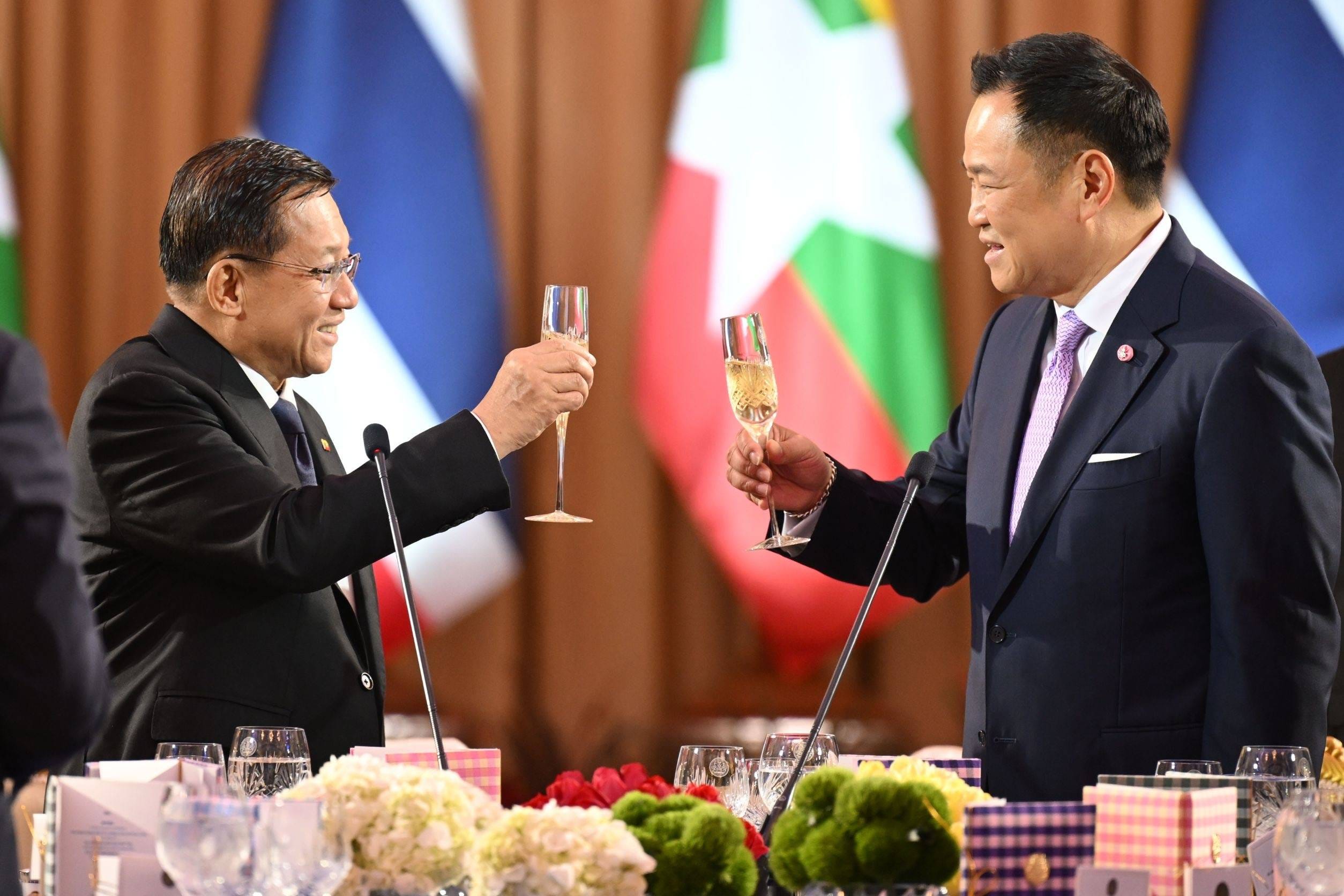
The Prime Minister and Minister of the Interior Anutin Charnvirakul hosted an official dinner in honor of the President of the Republic of the Union of Myanmar General Min Aung Hlaing at Santimaitri Building, Government House on August 6, 2026. Official handout
Prapapoom Eiamsom | August 12, 2026
BANGKOK — Last week, when Myanmar military junta leader General Min Aung Hlaing arrived in Bangkok for a high-profile two-day state visit, the red-carpet reception was intended to convey a sense of normalcy.
At Government House, Thai Prime Minister Anutin Charnvirakul welcomed him with full military honors and hosted a summit that represented Bangkok’s most explicit push to date toward re-engaging Naypyidaw.
For the junta leader, the invitation offered a rare platform of state-level legitimacy. (Also read: Min Aung Hlaing Visits Thailand as Myanmar Seeks Regional Recognition Amid Conflict)
For the Thai government, the meeting was framed as a pragmatic necessity between neighboring countries that share more than 2,000 kilometers of porous border, intertwined security concerns, and mutual economic interests.
The official narrative surrounding the summit focused heavily on bilateral cooperation and concrete solutions to pressing transboundary crises.
Thai officials trumpeted a series of signed Memorandums of Understanding (MOUs) and joint frameworks designed to address severe challenges affecting both nations.
Among the primary issues on the agenda were seasonal transboundary haze caused by agricultural burning, heavy metal pollution contaminating shared border waterways like the Kok River, and the rampant expansion of multi-billion-dollar online scam compounds, human trafficking rings, and illicit drug networks operating along the border.
The two governments also pledged to dramatically expand border trade, setting an ambitious target of 12 billion dollars despite ongoing economic instability in Myanmar. (Also read: India’s Highway to Thailand Hinges on a Peaceful Myanmar)
However, human rights organizations, environmental campaign groups, and regional policy analysts quickly dismantled the government’s celebratory narrative. Critics argue that Thailand traded away its international standing and moral leverage in exchange for hollow paper promises that lack enforcement mechanisms, strict timelines, or real accountability.
A close reading of the environmental agreements revealed significant structural flaws, including a controversial joint-approval clause stipulating that any water or air quality monitoring data will only be published if both governments consent.
Environmental advocates warned that this provision effectively hands the Myanmar military veto power over public transparency, guaranteeing that alarming reports on toxic runoff from unregulated rare-earth and heavy metal mining will remain suppressed.
Furthermore, the root causes of many border issues lie completely outside the junta’s practical control. The vast majority of scam centers, human trafficking hubs, and illicit mining operations flourish in border enclaves governed either by ethnic armed organizations or by junta-aligned Border Guard Forces that operate with near-total impunity.
Expecting Naypyidaw to enforce environmental standards or dismantle lucrative criminal empires in territory it does not govern is fundamentally unrealistic.
As a result, analysts view the signed agreements not as genuine policy breakthroughs, but as convenient political cover for Bangkok to justify its policy of “calibrated re-engagement” with a despotic regime.
The summit triggered even sharper alarm across regional diplomatic channels when Prime Minister Anutin explicitly endorsed Myanmar’s full and equal participation in the Association of Southeast Asian Nations.
In a joint press conference, Anutin affirmed Thailand’s readiness to facilitate the normalization of relations between the junta and the regional bloc. (Also read: ASEAN Foreign Ministers hold an informal meeting with Myanmar)
Since seizing power in the 2021 coup, top junta leaders have been banned from high-level ASEAN meetings due to their brutal campaign against political opponents and their complete disregard for ASEAN’s Five-Point Consensus peace plan. (Also read: ASEAN makes headway in Myanmar, Code of Conduct negotiations)
By unilaterally championing Naypyidaw’s return to the ASEAN fold, Thailand directly subverts the regional bloc’s collective leverage and undermines years of diplomatic effort aimed at stopping the violence.
The domestic and international backlash against the visit was swift and intense. More than a dozen Thai human rights networks, alongside Myanmar activist groups and parliamentarians, staged public protests and issued joint statements condemning the Thai administration.
Beyond the broader geopolitical damage, civil society groups voiced urgent concerns for the safety of democracy activists, political dissidents, and millions of Myanmar migrant workers currently living in Thailand.
Activists warned that closer institutional coordination between Bangkok and Naypyidaw could lead to increased surveillance, intelligence sharing, and potential deportations under the guise of labor regulation and border management.
Ultimately, rolling out the red carpet for a military chief facing International Criminal Court arrest warrant applications does nothing to solve Thailand’s complex border challenges.
By embracing Min Aung Hlaing without demanding meaningful concessions on civilian protection, human rights, or democratic restoration, Bangkok has gained little more than unenforceable declarations.
In doing so, Thailand risks fracturing ASEAN unity, damaging its own international credibility, and prolonging the agonizing humanitarian catastrophe that continues to engulf its eastern neighbor. (Also read: ASEAN sees positive development in Myanmar after ICRC met with Suu Kyi)