


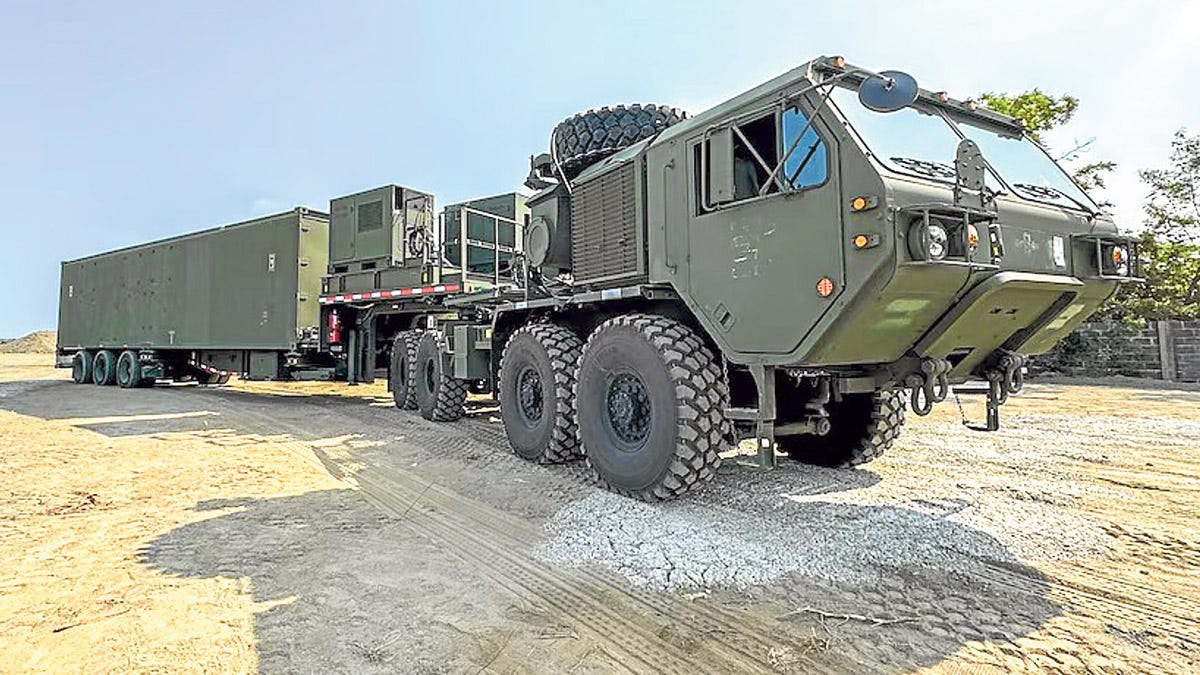
A Typhon Mid-Range Capability missile system in Northern Luzon, delivered on April 2024. Photo handout from USARPAC.
Manuel Mogato | March 15, 2026
MANILA — Washington is running out of missile defense systems as the conflict in the Middle East entered its third week, with Tehran continuing to launch ballistic missiles and cheap drones against US interests in Arab Gulf states and in Israel.
So far, there are reports that the United States has fired 40 Theater High Altitude Area Defense (THAAD) interceptors and nearly 100 Patriot missiles to protect the US bases in the region, as well as critical infrastructure in the Arab states.
As the war progresses, the United States has redeployed its THAAD interceptors and Patriot missiles from South Korea to the Middle East, despite the former’s objection.
Seoul felt less protected from North Korea, which fired several ballistic missiles into the Japan Sea days after the pullout.
The redeployment was necessary to provide an effective shield from Iran’s ballistic missiles, even if US Defense Secretary Pete Hegseth said Iran’s capability to launch missiles has been reduced significantly due to non-stop air strikes by the United States and Israel.
Other allied countries, like members of the North Atlantic Treaty Organization (NATO) and Australia, have sent air-to-air missiles and aircraft to defend the region.
There were apprehensions that the US would pull out more defensive missile systems in the Indo-Pacific and move them to the Middle East.
However, a senior Philippine Navy official, Rear Admiral Roy Vincent Trinidad, gave assurances that the US would not abandon its primary ally in the region, the Philippines.
“There are no indications of the US pulling out military assets from the Philippines,” Trinidad told journalists, in reaction to the pullout of THAAD and Patriot missiles from South Korea.
“The situation in South Korea involves specific air defense systems being redeployed to the Middle East, which is a separate theater arrangement and does not apply here.”
US allies in the region do not want to remove the missile shield in the region, particularly in South Korea, Japan, and the Philippines.
However, tactical and operational requirements suggested redeploying these defensive weapons to where they are needed most.
In short, countries in the Indo-Pacific region may now start rethinking the United States’ reliability and commitment to defend the region against hegemons, like China, and unpredictable states, like North Korea. (Also read: ASEAN calls for cessation of hostilities in the Middle East)
The current conflict in the Middle East demonstrated that the United States is unable and unwilling to safeguard its closest allies in the Middle East and in the Indo-Pacific region.
Washington’s continuing air strikes have further provoked Tehran to target and attack the regional infrastructure to weaken the position of its Middle East competitors in the global energy markets.
China is also watching developments in the Middle East and in the Indo-Pacific region. China’s political and military leaders have been assessing how these changes affect regional power dynamics, as some countries, depending on U.S. protection, might reconsider their security plans if defenses appear stretched or less reliable.
Moving forward, security experts say a potential clash between the United States and China could erupt over Taiwan, as Beijing is determined to reunify what it considers a renegade province. In that likely scenario, the Philippines, like the Arab Gulf states in the current conflict, could be a potential target.
Although the Philippines maintains that the United States has no military bases in the archipelago, American military presence at the so-called “co-location sites”, or the Enhanced Defense Cooperation Agreement (EDCA), is bad news.
These are virtual targets for China’s offensive missiles.
Moreover, Washington has deployed offensive and defensive weapon systems, such as the mid-range capability (MRC) Typhon missile launcher in northern Luzon, as well as the US Marines’ ship-interdiction missile systems (NMESIS) and air defense systems (MADIS).
The US Army also has several High Mobility Artillery Rocket Systems (HIMARS), also in northern Luzon.
During a recent Bilateral Security Dialogue, US diplomats and military officials promised to deploy more drones and cutting-edge missiles to the Philippines.
There were no specifics mentioned, but it is possible that Patriot defensive missiles, the offensive hypersonic long-range Dark Eagle missiles, and additional NMESIS, MADIS, and HIMARS.
The presence of these American missile systems would not ensure the Philippines protection from China’s actions on US military interests in the region.
The Philippines has seen the US failure to provide 100 percent protection to its Arab allies in the Middle East, where the US has military bases.
Like other Indo-Pacific countries, the Philippines should rethink its dependence on the Americans’ security umbrella and stand on its own.
Did the Philippines learn from the past, when the late dictator relied on the US for external defense while focusing on quashing domestic threats from the Communists and the secessionists?
Did the Philippines learn from the 2012 experience when the US abandoned its ally after brokering a deal with China to pull out from Bajo de Masinloc simultaneously? The US was only after de-escalation in Bajo de Masinloc, not the Philippines’ sovereign interests.
Learn from the experience of Arab Gulf states; the US presence in the Philippines is not a guarantee that it will be safe from missiles from American adversaries.