


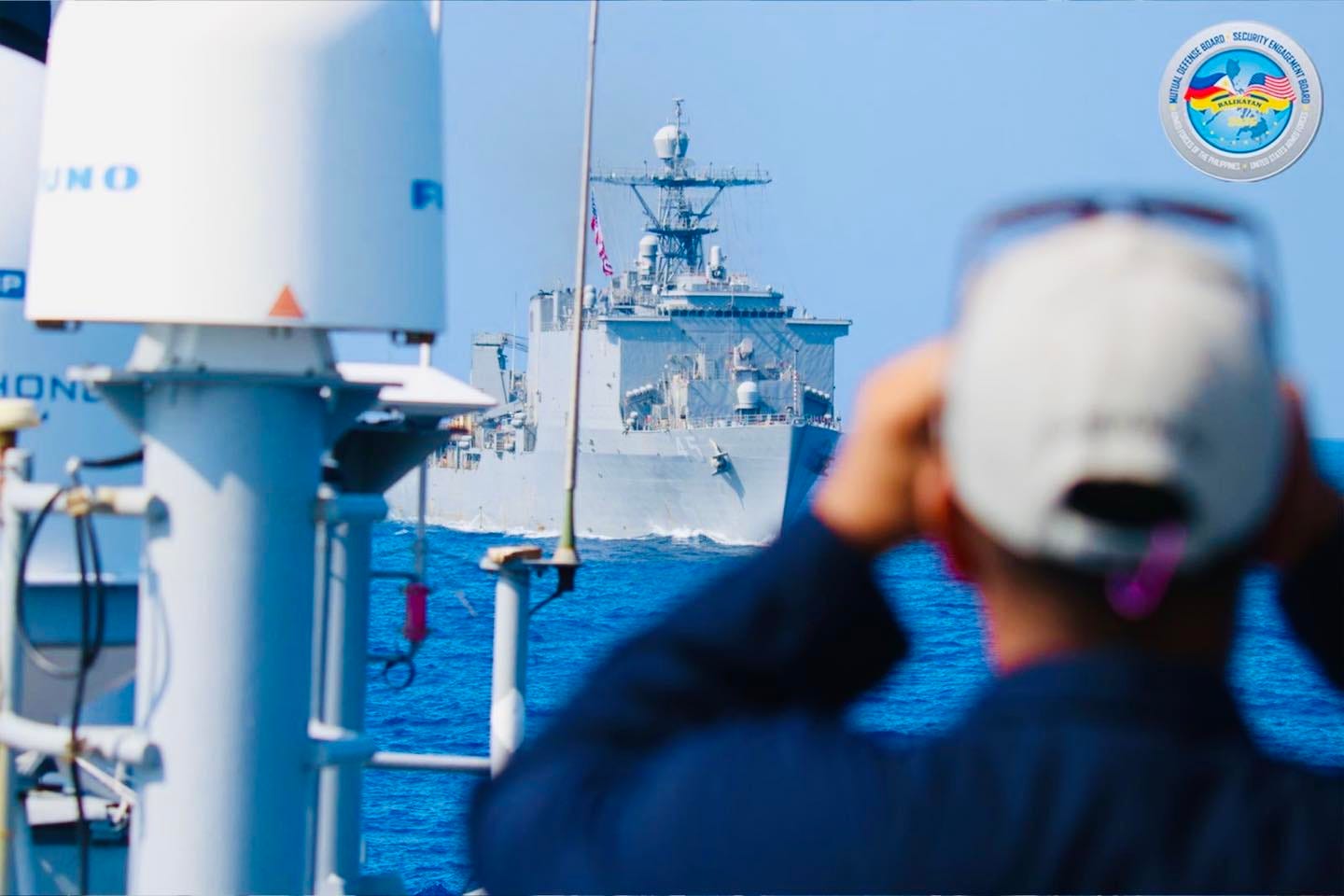
Photo from Philippine Navy.
Manuel Mogato | March 15, 2026
Manila — A naval flag officer has assured the United States will continue to engage with the Philippines in terms of training and exercises after Washington pulled out some air defense equipment in South Korea.
“There are no indications of the US pulling out military assets from the Philippines,” Rear Admiral Roy Vincent Trinidad, a spokesman for the Philippine Navy, told journalists.
“The situation in South Korea involves specific air defense systems being redeployed to the Middle East, which is a separate theater arrangement and does not apply here.”
The US has deployed Theater High Altitude Defense Systems in the Korean peninsula to intercept ballistic missiles from North Korea.
The Middle East needed added protection from Iranian ballistic missiles and drones, which targeted US bases in the region. (Also read: US insists the destruction of Iran’s nuclear facilities)
Trinidad said the scheduled bilateral exercises and cross-training activities with the Indo-Pacific Command will be held next month and will not be affected by the conflict.
The US has deployed a Typhon mid-range capability launcher in northern Luzon and other missile systems, such as Navy-Marine Expeditionary Ship Interdiction Systems (NMESIS), the Marines’ Air Defense Missile Systems (MADIS), and the Army’s High Mobility Artillery Rocket Systems (HIMARS).
“The upward trajectory of the RP-US alliance is manifested in our continuing maritime activities, strengthened MDB-SEB engagements, and the recent approval of the Philippine Enhanced Resilience Act authorizing $2.5 billion in security assistance over the next five years,” Trinidad said.
He also said the EDCA sites are not US bases and are Philippine bases with ”facilities dedicated to mutual defense and humanitarian assistance, and are not to be used as staging areas for offensive operations.” (Also read: What’s the reason behind US expansion of military engagements in the Philippines?)
“Our alliance with the US continues to strengthen, and there has been no change in the level of support being provided,” he added.