


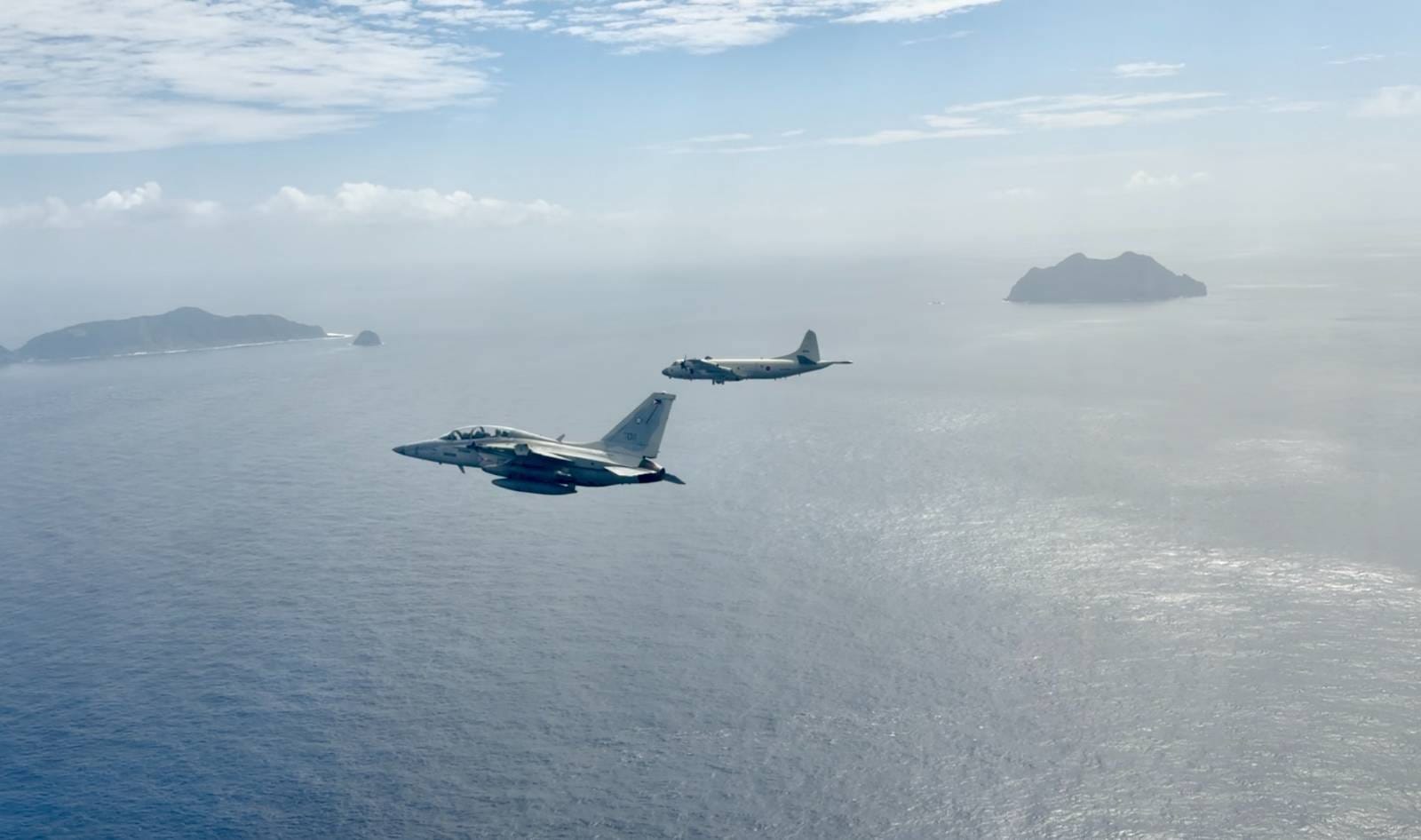
A PAF FA-50PH aircraft flying alongside a JMSDF P-3 Orion aircraft over the West Philippine Sea for a joint patrol last February 27, 2026. Photo from PAF.
Manuel Mogato | March 18, 2026
Manila — Countries observing the raging Middle East conflict have been looking for a viable platform to counter threats from armed unmanned aerial vehicles (UAVs), which proved to be cheap and effective in attacking targets in Israel and Arab states in the Persian Gulf.
Most of Iran’s ballistic missiles fired into Israel and US bases in Arab states have been intercepted, but the armed unmanned aerial vehicles were difficult to stop.
The US and Israel also spent millions of dollars to shoot down the drones, which cost only a fraction of the million dollars of air-to-air missiles used to stop them. (Also read:
Air defense radars also have difficulty detecting and tracking the low-flying drones, making Iran’s asymmetrical warfare effective in the Middle East.
After three weeks of missile exchanges, the US has no clear exit strategy to end the conflict, which has started to hurt the global economy due to soaring petroleum prices and tight supply. (Also read: Think of the civilians, end the Middle East conflict)
About 20 percent of the global oil supply passes through the narrow Strait of Hormuz.
The fuel tanker traffic was not disrupted totally by Iran’s threat to attack an oil tanker, but also by shipping industry insurers in London.
Drones can deliver precision strikes on military and civilian targets, a valuable lesson military planners learned from watching the conflict.
Talking to journalists outside Manila, Defense Secretary Gilberto Teodoro said the Philippines has prioritized defense platforms capable of effectively intercepting ballistic missiles and armed drones.
But these are expensive defense systems, such as the Theater High Altitude Area Defense (THAAD) system and the Patriot missiles, which the Philippines cannot afford.
The Philippines has no missile systems to counter ballistic missiles and no sufficient missile systems to stop armed drones.
It continued to rely heavily on the existing US missile defense shield, including air defense systems, in the Indo-Pacific region.
There is no guarantee that Washington will come to Manila’s side even if the Philippines invokes the 1951 Mutual Defense Treaty,
What is clear, however, is that the nine Philippine military bases with US presence, the so-called EDCA locations, are natural targets by Chinese ballistic missiles. (Also read: What’s the reason behind US expansion of military engagements in the Philippines?)
The US may have some defensive missile systems at the EDCA sites, but the Philippines must prepare for its own defense.
It is also preparing to defend itself from armed drones. It has very limited capability to counter drones. It should begin searching for aerial platforms that will provide air superiority and counter drones. (PODCAST: Pilot Ep: Drone warfare)
Most multi-role fighters, like the F-16s, F-18s, and F-35s, are also capable of downing armed drones, but they are expensive platforms.
Many Asian and African states that cannot afford American fighters have acquired the Czech Republic’s L-39NG Sky Fox, which can double as a trainer jet and a light fighter.
It is also capable of shooting down drones, which was demonstrated in the recent air show in Dubai and Egypt before the conflict erupted.
In Southeast Asia, Vietnam has a squadron of Czech L-39NG SkyFox. It has also offered the Philippines 12 L-39NG SkyFox for less than 30 billion pesos in soft loans. It would be repaid for 21 years.
The trainers are cheaper than the South Korean FA-50 and KF-21 fighters. Like the FA-50s, the L-39NG can also serve as a light fighter.
The Philippines needs trainers to familiarize its pilots with faster jets, like the American F-16, Swedish JAS-39 Gripen, and the French Dassault Rafale.
The Philippines can also use the L-39NG as a counter-drone aircraft, a must for modern air forces, as demonstrated by the conflict in Iran.
