


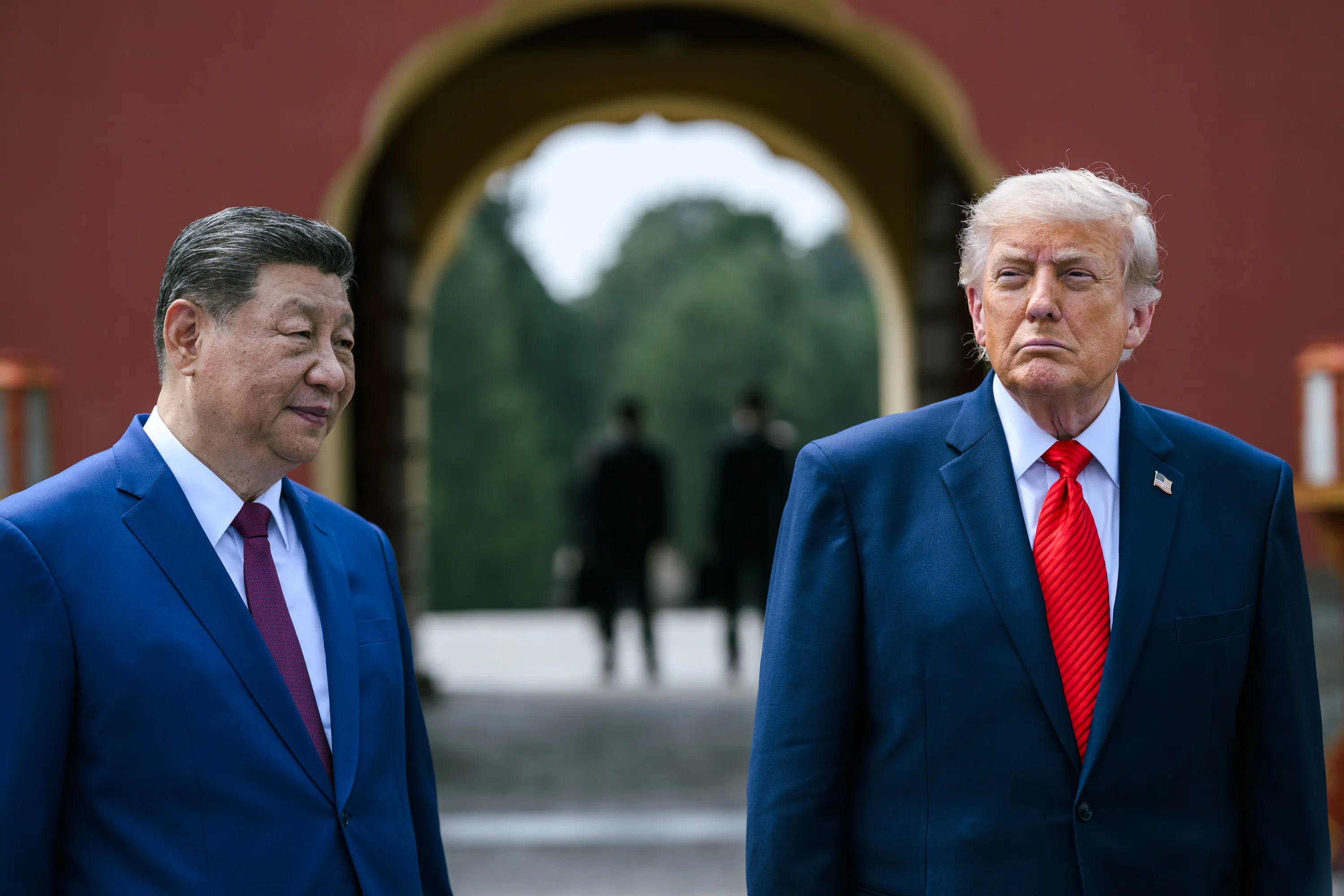
Presidents Xi Jinping and Donald Trump at the Temple of Heaven in Beijing, China during Trump’s state visit last May 13-15, 2026. Official handout.
COL Dencio S Acop (Ret), PhD, CPP | June 15, 2026
The Thucydides Trap was indicated in no clearer terms by Xi Jinping in his last meeting with Donald Trump. But we’ll get to that point in a minute. Save for one key point, the Indo-Pacific Security Program is precisely what the United States and its key allies need towards containing China.
Specifically, the program outlines strategies that strengthen US relationships with its allies and partners such as Australia, India, Japan, the Philippines, South Korea, and Taiwan. (Also read: The Island Dilemma: Quick American Victory or Protracted War?)
Out of this framework most recently came the US-Japan-Philippines Trilateral Cooperation which is now the bedrock of a new US Indo-Pacific Deterrence Strategy. It formally came into fruition in April 2024 when its first leader-level summit was hosted by the US in its capital marking the start of a “new trilateral chapter.”
The substance of this defense initiative is best understood by its policy recommendations currently underway to achieve its goals.
First, the trilateral cooperation has been institutionalized to strengthen deterrence against China’s threats to Taiwan and in the South and East China Seas. Second, Japan and the Philippines are on their way to forging a General Security of Military Information Agreement (GSOMIA) and have already signed a Reciprocal Access Agreement (RAA). Third, the US continues to develop the infrastructure of EDCA sites in the Philippines. Fourth, Japan is also supporting the development of these sites through its Official Security Assistance.
Fifth, the three countries are integrating their foreign national evacuation plans to enhance regional preparedness for a Taiwan contingency. Sixth, pooled resources are underway to significantly enhance naval maintenance, repair, and overhaul capabilities at Subic Bay, transforming it into a resilient regional hub. Seventh, the three allies are shifting from episodic exercises to a persistent, trilateral sea denial posture across the Luzon Strait.
Eighth, the Philippines’ potential in critical minerals and rare-earth minerals are being leveraged to reduce dependency on China. Finally, the allies are pooling resources and coordinating investments to diversify subsea cable infrastructure and improve maritime monitoring. The focused trilateral cooperation will enable the three nations to adopt a unified and coordinated approach to deal with China’s aggression wherever it occurs.
The Philippines has also just recently added Vietnam to its growing list of bilateral allies. Manila and Hanoi elevated their ties to an enhanced strategic partnership and formally renewed their agreement on defense cooperation. The Philippine President hosted Vietnamese leader To Lam in late May this year stating that “as fellow claimant states, we reaffirm that maintaining peace, stability, and freedom of navigation and overflight in the South China Sea remains non-negotiable.”
Vietnam is known to hedge between Washington and Beijing but this most recent state visit to the Philippines clearly underscores its choice to deepen ties with both Manila and Tokyo because “Vietnam’s ambitions in the South China Sea stand in direct opposition to China’s claims.”
Hanoi is also one of the most vocal challengers of Beijing’s claims and has criticized Chinese resource explorations in the disputed waterway. President To warns against a regional order where “the big fish swallows the small fish” thereby advocating mechanisms which can effectively prevent tensions from escalating. As with the US and Japan, the Philippines stands to benefit from Vietnam’s support across diverse defense areas.
But more importantly, Manila and all capitals threatened by China’s aggression in the region now have better chances defending their individual and collective claims. In fact, China may have miscalculated its strategy and tactics if the increasing unity of offended countries lining up against it is to be assessed.
The latest unification of efforts among the US, Japan, and the Philippines, on the one hand, and Vietnam and the Philippines, on the other, is expected to ring the prime alarm bell in Beijing. It is because these latest developments are linking China’s maritime interests all the way from the South and East China Seas to the Luzon and Taiwan Straits into an integrated defense alliance among impacted countries opposed to Chinese unilateralism. (Also read: Philippines protests Chinese structure on Bajo de Masinloc)
These mini-alliances will also complement US bilateral defense arrangements with Canberra, Tokyo, Seoul, Manila, and Bangkok as well as QUAD in the Indo-Pacific. This convergence of defense alliances based on mutual interests offended by its aggression through gray-zone tactics must concern China.
It is a combined capability which now surpasses that of the enemy Beijing assessed to be beneath its own when it started. In its bid to limit Japan’s martial ascent, China is expected to respond by way of pressuring ASEAN to distance itself away from Tokyo’s security overtures but even this wouldn’t be so optimistic since this bloc’s strength is also its weakness — the policy of non-interference.
Association members will join any alliance with Tokyo individually so long as such will serve their interests more. The recent visit of Trump with Xi has the inevitable effect of cementing the far-reaching integration of security alliances surrounding China. (Also read: Dialogue with China Is Imperative: Trump–Xi Summit Proved It)
The Thucydides Trap subliminally messaged by the Chinese leader to his western counterpart also indicated to US regional allies that they cannot cast their bets all on Washington. While sustaining an alliance with the US today has its apparent benefits, it also carries with it an existential cost which is that no ally can fully trust the superpower with Trump at its helm.
It is thus to the benefit of any stakeholder to diversify its alliances with as many partners as it can manage. And the integrated security front that has recently emerged linking common interests from India to Australia to Japan through ASEAN countries is one that can finally stand on its own even without the United States leading it. (Also read: “When Vietnam grows, Thailand grows”: Highest-level Partnership for Shared Growth)
While Washington has been urging its allies to step up their defense spending, it is Trump himself who is managing to hurt western allies in the region by his transactional approach to alliances and his conditional decision on arms sales needed by Taiwan.
Defense Secretary Gilberto Teodoro articulated this crucial point when he said that his country continues to be under “severe threat” from China (despite US assurances of support) and has no choice but to “be resilient and to stand up against Chinese aggression.”
In another interview, he followed-up his earlier statement outlining a “convergence endeavor” of deeper ties with partners, referring to Japan, Vietnam, and Taiwan aimed at deterring China’s coercion. (Also read: Philippines says China’s sanctions against Teodoro are an ‘unfriendly act’)
My assessment is that the US is indeed the declining power in Xi’s Thucydides Trap if Trump abandons his allies in the Indo-Pacific beginning with non-arms sales to Taiwan. While Trump promised to get the US out of wars it did not need, he bombed Iran in the Middle East twice (and the second is still ongoing), targeted Venezuela in South America, almost abandoned Ukraine in East Europe, and now appears to placate China while urging allies to fight on.
Any soldier who has fought will tell you that fighting on too many fronts doesn’t win battles, much more a war. This does not mean that an army foregoes its multiple enemies. It only means that it will fight each one at a time. The US is likely to lose from any arrangement with China that agrees to an exclusive sphere of influence.
Historically and technically, the Indo-Pacific is US domain too. Guam, Hawaii, and its blood allies are all in this region. The containment of China lies in this region and not anywhere else. If the US wants to stop China, it happens in the Indo-Pacific. The US needs to stand with its allies in the region. Lead them. Why? Because allied interests are shared. The winning of this shared interest wins all individual interests.
The US wins, not at the expense of its allies, but with them. This is the only way it can win over China and preserve its place in the world, and that of everyone else, as well. The global order won at the end of the Second World War was not an American order. It was THE world order. There is no other that is worth fighting and dying for. Certainly not Authoritarianism. It applied then. It still applies now. And AI or space advances have nothing to do with it. Because the only order that truly matters is the one with values — a moral order.
China, at its core, cannot win this order. An international order based on alternative truths (lies, technically) cannot advance mutual interests. Only those of the big fish swallowing the little fishes. Like the Nine-Dash Line. Belt and Road Initiative. Or Shanghai Cooperation. US allies in the region know this and are showing the world how it’s done.
In the face of superior firepower and, oftentimes, in the name of that once great benefactor of freedom and values in the world. Their valiant efforts ought to be a constant reminder. To such a world leader, no Thucydides Trap will apply. For fear will not be the cause instilled on the rising power by the established one. But truth. And the oneness in courageous spirit it inspires.
