


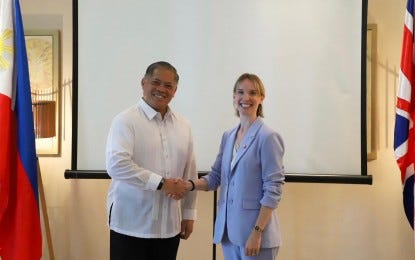
Department of National Defense Undersecretary for Acquisition and Resource Management Salvador Melchor Mison Jr. and UK’s Ministry of Defence Head of Indo-Pacific Amy Senior met in Makato City on Thursday, August 27, for the first round of formal negotiations for the proposed Status of Visiting Forces Agreement (SOVFA). Official handout.
Manuel Mogato | September 1, 2026
MANILA — Last week, senior defense officials from the Philippines met with their British counterparts to start formal negotiations for a possible status-of-forces agreement allowing British troops to hold exercises and training in the country.
The United Kingdom has expressed interest in entering into a military-to-military deal with the Philippines after France signed a Status of Visiting Forces Agreement early this year.
Germany, Poland, and the Netherlands are also interested in similar arrangements, as European powers and North Atlantic Treaty Organization (NATO) members are suddenly expanding their footprints outside Western Europe.
They have similar reasons: to ensure a free and open Indo-Pacific region, allowing free flow of goods from Europe to countries in the Pacific and vice versa.
The South and East China Seas, where more than $3 trillion of seaborne goods pass annually, are important for Europe’s trade.
Of course, there are other geopolitical reasons, as Beijing is now knocking on Europe’s door, with Chinese troops starting military training exercises along NATO’s borders in Belarus and Russia.
Europe is nervous that China would avenge what many European powers did to China in the 19th century, carving up territories to rule in some areas, like Macau, Hong Kong, and southern China up to Shanghai.
China has reacquired the territories and expanded its borders by annexing Xinjiang, Tibet, Manchuria, and parts of Mongolia.
Europeans are alarmed at China’s presence along its eastern borders. Thus, they are also making their presence felt in the Indo-Pacific region.
European powers were no strangers to this part of the world, but retreated after the Second World War and during the Cold War, scuttling the Southeast Asia Treaty Organization (SEATO). (Also read: Canada’s expansion in the Indo-Pacific region)
Only the United Kingdom kept a constant presence through its Five Power agreement with Australia, Malaysia, New Zealand, Singapore, and the United Kingdom. It also has relations with tiny Brunei.
The United Kingdom and the United States are the two enduring powers in the region. They also joined forces to help Australia build its nuclear-powered submarines under an AUKUS arrangement.
The United Kingdom now wants to expand its footprint in the region to include the Philippines, not only from its former colonies in the region.
Manila is now interested in expanding its alliances with like-minded countries to build deterrence against a rising China.
It needs the support of countries that would counter China’s influence and also help train and improve the warfighting skills of Filipino troops who fought internal security threats. (Also read: Teodoro calls on a coalition to resist China)
Manila is not a stranger to partnership with London. In the 1990s, a British company supplied 150 Simba armored vehicles to the Philippine Army. The British Royal Navy sold three Peacock-class vessels to the Philippine Navy before Hong Kong was handed over to China.
A British company, in cooperation with other European companies, delivered aircraft to the Philippine Air Force in the past.
However, the Philippines should carefully assess how it would benefit from the United Kingdom in terms of training, exercises, and other cooperative activities.
It should consider, for instance, that the United Kingdom has reduced its troops’ strength due to financial constraints. Its dependence on foreign technologies and supplies was also increasing, further straining its resources.
There were also indications that Washington has been dictating its defense plans, as London failed to fulfill its obligations to NATO and other European partners.
There were disturbing reports that London cannot provide full-scale and long-term deployments abroad, like in the Middle East after the US and Israel went to war with Iran.
Because of this, Washington may no longer consider London a reliable partner and a major power.
Based on opinion polls last year, London’s international influence has been waning after the United Kingdom reduced funding for aid programs for poorer Global South countries, including the Philippines, in 2025, dropping to its lowest level in 25 years.
Based on a KPMG-UK forecast in late 2025, the United Kingdom’s GDP in 2026 will drop to 1 percent from 1.4 percent in the previous year due to a rising budget deficit, increased unemployment, and limited household consumption.
The impact of COVID-19 and Brexit also affected London’s export share in the global market, as economists labelled London the “sick man of Europe”.
Defense budget, however, has been growing to sustain the conflict in Ukraine, including a recent decision to share the blueprint for its long-range missiles.
Environmentalists, activists and non-government organizations have also criticized British companies for exploiting poor countries and former colonies, disregarding human rights and environmental pollution.
They singled out the giant Shell company, which contributed to global climate change, particularly in Southeast Asia, through fossil fuel extraction.
Greenpeace, for instance, launched an information campaign against Shell for its contribution to the adverse weather effects, including Typhoon Odette in 2021.
There was also the issue of human rights after the BBC reported in December 2025 that British soldiers were accountable for rights violations in Kenya, where for decades its troops were holding training and drills.
Kenya’s parliament produced a 94-page report detailing British rights violations and other ethical breaches over the years.
Manila should carefully consider London’s offer to deepen military cooperation and the possibility of helping deter China in the South China Sea issue, and assess whether the British can honor its commitments.
Manila may also consider the experiences of former British colonies in Southeast Asia in hosting British troops for training and exercises. (Also read: Reviving SEATO or building an Asian NATO?)
The Marcos administration should assess whether allowing British troops would help the Philippines deter China or would only advance British interests in the region.