


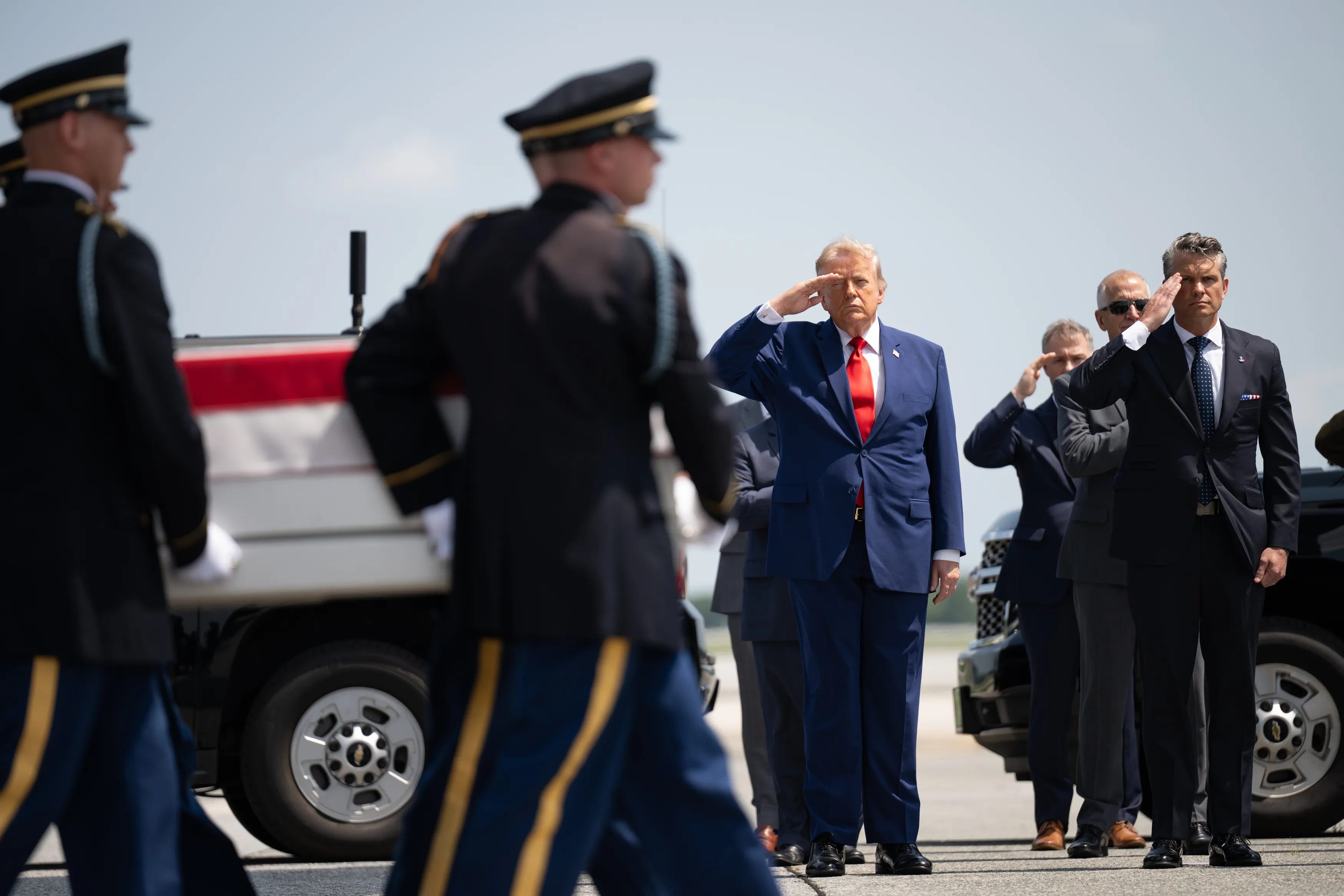
US President Donald Trump salutes before the caskets of U.S. soldiers killed in the Middle East, last July 22, 2026, at Dover Air Force Base, Delaware. Official handout.
Manuel Mogato | August 25, 2026
MANILA — US President Donald Trump has made unreasonable demands to security allies and partners as the war with Iran drags on without clear strategic results.
Determined to bring Iran to its knees, Trump has stepped up pressure on both his perceived “enemies” and “allies.”
Trump also began “punishing” allies and partners that refused to help the United States in confronting Iran, making “enemies” of middle power states that used to support Washington’s engagements.
For instance, it slapped a 50 percent tariff on exports from its northern neighbor, forcing Canada to retaliate with $20 billion counter-tariff on American goods, such as steel and dairy products.
In other parts of the world, Trump was using the nuke card to scare allies.
Facing real nuclear weapons threats from the north, South Korea was forced to rely on its own defense posture after Trump redeployed the US Terminal High Altitude Area Defense (THAAD) anti-ballistic missile from the Korean peninsula to the Middle East.
Early this month, Trump scaled down annual joint military drills with Seoul after its leader declined to help Washington confront Tehran.
Trump’s transactional leadership has forced allies and partners to reassess engagements with the United States. (Also read: “Middle Powers” rise as doubts of US reliability deepen)
For instance, these allies resented Washington’s meddling in their domestic policies, particularly when the US pushes its allies to spend more on national defense and security.

For instance, Washington’s national security officials have been pressuring European and Asian allies and partners to raise defense spending to 3 percent of GDP to share the burden in deterrence. (Also read: Rubio wants Asian states to send ships to protect the Strait of Hormuz)
For most smaller and weaker states, increasing defense spending would be a burden because meager resources compete directly with social development programs, such as health, education, and other poverty alleviation projects.
For instance, the Philippines’ defense spending for 2027 was only a little over 1 percent of its GDP, making it difficult to modernize its defense capabilities. Defense spending was projected to grow by 7 percent to 328 billion pesos in 2027.
The Philippines would need at least 100 billion pesos a year to meet its target of building a minimum defense capability in 10 years
With that budget, it would not be enough for the Philippines to spend on expensive US weapon systems to boost its deterrence capabilities.
No one is willing to pay for expensive US weapons systems if American defense suppliers cannot deliver on schedule.
The Australians must be frustrated that they discarded the French contract for the American nuclear-powered sub-surface vessels under a trilateral Australia-United Kingdom-United States (AUKUS) partnership because the submarine project faces delays.
Trump may have miscalculated the United States’ capacity to build weapons as fast as it can, given the amount of missiles it has used in the war with Iran as well as the support it has been giving to Ukraine.
At the current stage, the US defense industry has serious problems with the export of its defense products due to limited production capacities and weakening cooperation with European allies and Israel. (Also read: Drones & chokepoints: Lessons for PH from Ukraine, Iran)
Washington’s “Operation Epic Fury” was an epic failure, clearly demonstrating the deficiency in how to wage a war with a middle power, like Iran.
Its expensive and advanced weaponry seems vulnerable to cheaper Iranian drones and missiles.
In the first two months of “Operation Epic Fury”, the US expended thousands of missiles and munitions that could take years to reproduce, bleeding the Pentagon of at least $25 billion.
Moreover, the US military lost several aircraft, such as F-35A, F-15E, KC-135, E-3, A-10, MC-130J, helicopters, and an MQ-9A Reaper drone.
Its bases in the Middle East were vulnerable too to Iranian missiles and drones, and about a dozen US soldiers had died.
US defense industries are losing customers, and many allies and partners have started reviewing cooperative arrangements with Washington.
The conflict in Ukraine and Iran has created demand for weapons systems and equipment, especially for Israel and Ukraine.
However, American and European industrial bases are becoming exhausted due to prolonged conflicts, as production has slowed amid rapid use on the front lines.
With US missiles and munitions depleted and production falling behind, US military dominance is in doubt.
Trump’s actions against both “enemies” and “allies” are not helping Washington’s cause in ending the war in Iran.