


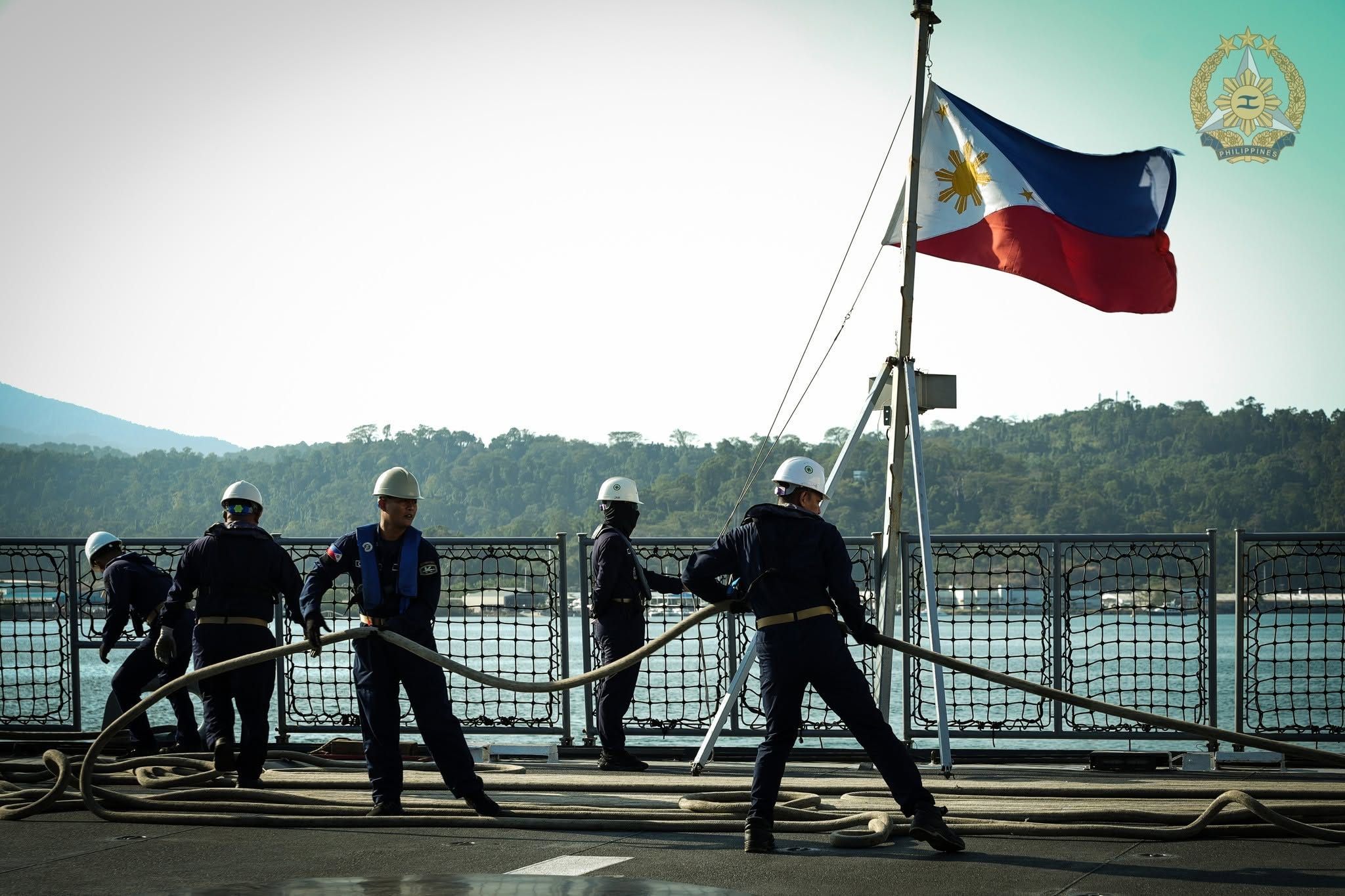
BRP Antonio Luna’s deck crew managing lines during the 15th Multilateral Maritime Cooperative Activity (MMCA) in West Philippine Sea last February 20-26, 2026. Official handout.
Rodney J. Jaleco | June 27, 2026
WASHINGTON, D.C. — The United States Senate proposal to tie military aid to Taiwan and the Philippines in a single billion-dollar package could signal a shift in US defense strategy, thrusting the Philippines to a more significant role.
The Senate Armed Services Committee’s markup for the 2027 National Defense Authorization Act (NDAA) will loop Taiwan and the Philippines into a joint defense scheme dubbed the First Island Chain Security Cooperation Initiative.
It could mark a shift in US policy that traditionally treated their two allies separately — unlike the Philippines which has been a long time treaty ally, there is no formal and official relations between the US and Taiwan.
The “mark-up” is the first step in the legislative budgetary process and could be subject to layers of review and amendments before they can become part of the final NDAA.
The proposed package will replace the Taiwan Security Cooperation Initiative and authorizes up to $1.5 billion in assistance to be shared between Taipei and Manila for fiscal year 2027. (Also read: Taiwan raises defense spending to build air defense to counter China’s threats)
Diplomats here say that if approved, it reaffirms the elevation of the Philippines in US defense planning — Manila is no longer viewed solely as a treaty ally but as a key partner in maintaining deterrence in the Indo-Pacific region.
This was also seen as acknowledgment that Taiwan’s security is now integral to regional security. Rather than treating Taiwan as a standalone issue, lawmakers are framing Taiwan and the Philippines as interconnected elements of Indo-Pacific defense.
The possible shift in US strategy could be a boon for the Philippines that’s struggling to upgrade military capabilities while coping with the twin challenges of increasing Chinese aggression in the country’s exclusive economic zone, and a domestic crisis spawned by a corruption scandal and rising prices. (Also read: Security-linked investments — aimed at taming China — spurs PH economy)
This joint first island chain security assistance scheme marks the latest tranche of authorized funds for the Philippines. The number comes after $2.5 billion was authorized in December of 2025 for the Philippine Enhanced Resilience Act.
The Senate proposal also authorized a war reserve stockpile program for Taiwan. While details for the implementation and composition of this stockpile were not specified, the program may look like similar initiatives with Israel and South Korea.
According to the Defense Security Cooperation Agency, war reserve stocks programs aim to “ensure support for selected allied forces in time of war until future in-country production and external resupply can meet the estimated combat consumption.”
Another line item from the Senate Armed Services Committee’s markup listed a new requirement from the Pentagon for a dedicated crisis management strategy for the South China Sea, which has proven to be the most contested body of water in the Western Pacific within the last two decades.