


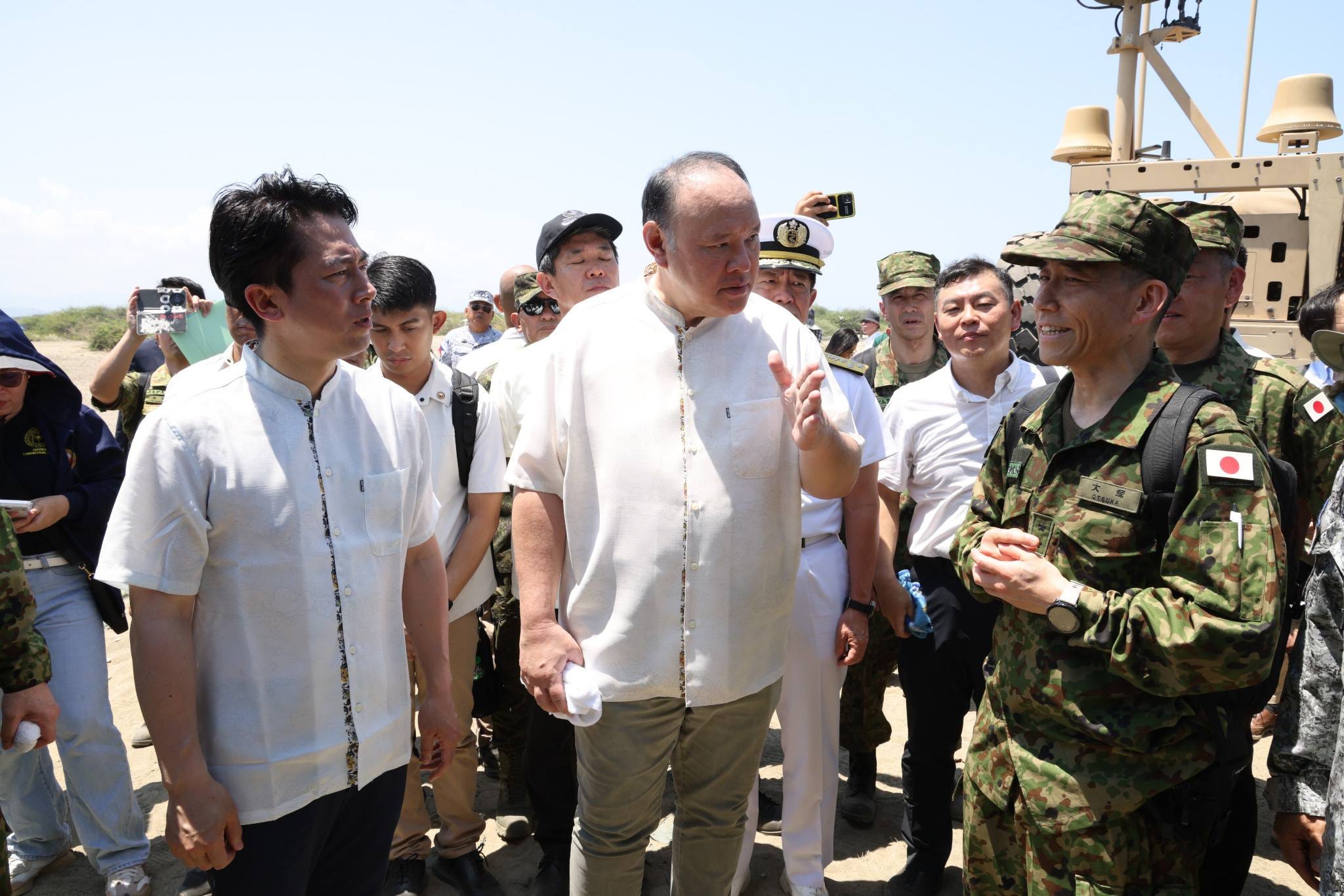
Japan Defense Minister Shinjiro Koizumi and Philippine Defense Secretary Gilberto Teodoro Jr. observes a Balikatan live fire drill in Laoag, Ilocos Norte on Wednesday, May 6. Photo from DND.
Manuel Mogato | May 7, 2026
MANILA — Japan has started to flex its military muscle as uncertainty over United States’ commitment to the defend the Indo-Pacific region hangs, as China’s influence grow to change the status quo in this part of the world.
Japan has taken the initiative to build its own credible deterrence capability as the United States was busy attending to other security problems in other parts of the world.
The first five months of 2026 showed that the world’s superpower may no longer be capable of fighting conflicts in two theaters simultaneously.
The conflict with Iran has dragged on for more than two months, in contrast to the quick capitulation of Venezuela early this year.
Did Donald Trump miscalculate Tehran’s will to put up a fight? The Americans had indeed crippled the Islamic Revolutionary Guards, but Iran continued to hold the world as hostages through the Strait of Hormuz.
Pump prices soared, and fuel supply tightened.
Meanwhile, Washington continued to build up forces in the Middle East, pulling troops out of Europe and Asia and deploying them to the Mediterranean and Arabian Sea.
Amid this chaos, Tokyo has quietly slipped into the American shoes, hardening its defenses and helping weaker neighbors to increase deterrence.
For instance, Defense Minister Shinjiro Koizumi, the second son of Japan’s former prime minister, had gone on a short two-nation tour of Southeast Asia to deepen and broaden defense and security cooperation.
In Jakarta, Koizumi made a sales pitch for its compact Mogami-class multi-mission frigates and diesel-electric submarines to beef up Indonesia’s maritime force against China’s frequent intrusions into its exclusive economic zone.
Koizumi also discussed joint training and exercises with the Indonesian Armed Forced as well as joint development and production of defense equipment.
Japan has sold its state-of-the-art Mogami-class guided-missile frigates to Australia, promising to deliver the first boats by 2029.
The Mogami-class guided-missile frigates replaced the soon-to-be mothballed Abukuma-class destroyer escorts vessels.
Japan is willing to transfer six Abukuma-class vessels to like-minded countries, including the Philippines, the largest recipient of its Official Security Assistance (OSA).
From Jakarta, Koizumi next visited Manila, where he signed deals with his Filipino counterpart, Gilberto Teodoro Jr., to deepen defense ties as part of the expanding trilateral partnership with the United States and the Philippines.
The defense agreements include the possible transfer three Abukuma-class destroyer escorts and five TC-90 surveillance planes. (Also read: There is no such thing as a free lunch)
Tokyo might throw in an aging Soryu diesel-electric submarine, enhancing Manila’s sea denial capability.
The three Abukuma-class vessels would increase the Philippines’ naval capabilities, which rely on four guided-missile frigates, an aging corvette from South Korea, three ex-Hamilton-class cutters, and three ex-Hong Kong offshore patrol vessels, to counter China’s activities and presence in the West Philippine Sea.
Beijing has been bullying Manila, sending armed vessels and research ships within 30 to 40 nautical miles west of Luzon’s western coastlines. (Also read: Chinese vessels observe Philippine maritime drills with allies)
After holding talks in Manila, Koizumi traveled with Teodoro to northern Luzon and personally observe Japan’s Type 88 surface-to-ship missile sink an old and decommissioned minesweeper off Ilocos Norte.
Next month, Koizumi would visit South Korea as Japan rushed to create a web of security alliances and counter China’s increasing presence and activities in the South China and East China Seas.
Koizumi was instrumental in Tokyo’s new defense policy to allow exports of lethal weapons to like-minded states in the region.
Under its Pacifist Constitution, Japan was only allowed to transfer defense equipment for transportation and search-and-rescue missions.
Before the government of Sanae Takaichi adopted the changes in its defense export policies, Japan had to strip the three Abukuma-class destroyer escorts of their armaments, including missiles and torpedoes, before turning them over to the Philippines.
That has changed last month.
Japan may now keep the armaments, electronic warfare systems, and naval combat systems on the three Abukuma-class vessels after Takaichi’s government changed the defense policies.
Japan is now putting more premium on helping like-minded countries strengthen and harden their defenses, lessening the burden of sharing the load from the Americans in defending the first island chain.
The island-chain is an imaginary line from Japan in the north to Australia in the south that includes Taiwan, the Philippines, and Indonesia.
The Philippine is seen as the weakest link in the defenses, a reason why Japan decided to pour more defense resources to make it difficult for China to target the Southeast Asian country. (Also read: What’s the reason behind US expansion of military engagements in the Philippines?)
Koizumi’s two-nation Southeast Asian’s swing betrays Japan’s concern with China and eagerness to improve the two countries’ capacity and capability to deter.
Japan can do more, acting not as surrogate to the United States, but as the leader of the free world in the region.
For eight decades, Japan held its punches, relying heavily on the United States for its defense in the volatile Indo-Pacific region.
Although Tokyo has a capable military force in the region, next to the United States and China, it does not have offensive capabilities, such as an aircraft carrier, a nuclear-powered submarine, and long-range missile systems.
The late Shinzo Abe had slowed changed that, quietly rearming Japan and building broader alliances, such as the Quadrilateral Dialogue with the United States, India, and Australia.
Abe also allowed the deployment of Japan’s Self-Defense Forces (JSDF) abroad and his successors sharing defense resources to smaller and weaker states in the region.
China has been invoking the memories of World War II to vilify Japan and reminding the countries victimized by Japanese atrocities that Tokyo’s leaders continued to harbor imperialism through annual visits to Yasukuni shrine.
However, some Southeast Asian states are not bothered by this. They feared China’s actions because Beijing does not matched its words with actions to create a stable region.
There should be no fear nor apprehension about Japan’s rearming itself as long as it helps other countries in the region to stand up against China’s bullying.
Japan is not a hegemon. It should actually do more to counter China’s ambitions.