

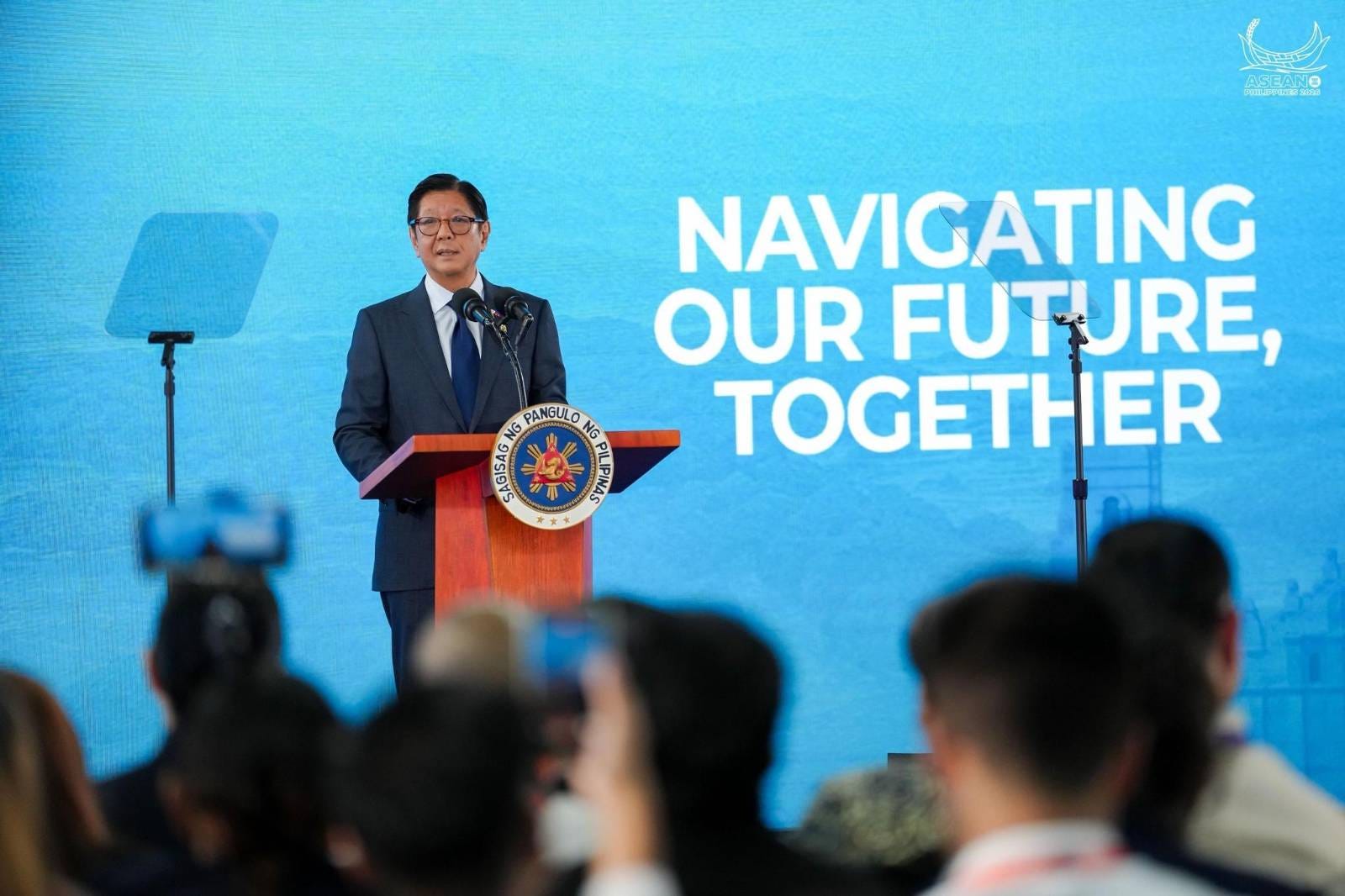
Ferdinand Marcos Jr. during the 48th ASEAN Summit in Cebu last May 8. Official handout.
Rommel C. Banlaoi | June 15, 2026
Note: This article is based on the lecture delivered at the “APEC Economies China Studies Scholars Forum” organized by Jinan University, Sun Yat Sen University and Guangdong University of Foreign Studies at the Guangzhou Baiyun International Convention Center, Guangzhou, China held on 12 June 2026.
Despite the region’s immense diversity in terms of cultures, economies, and political systems interwoven across seas and borders, nations in the Asia Pacific share common aspirations for peace, prosperity, and stability. The Association of Southeast Asian Nations (ASEAN), a key driver in the Asia Pacific Economic Cooperation (APEC), has long been the bridge connecting these aspirations. As this year’ ASEAN Chair, the Philippines must strengthen that bridge.
The Imperative of Maritime Cooperation and Ocean Governance
In the diverse APEC region, no single nation can tackle climate change, maritime insecurity, or uneven economic growth alone. That is why bridging leadership is essential. Such leadership not only connects stakeholders, mediates differences, and builds trust among nations, but also strengthens maritime cooperation and advances ocean governance.
By working together to safeguard shared waters, ensure sustainable fisheries, and protect marine ecosystems, APEC economies can transform the ocean into a platform for collaboration rather than contention. This collective stewardship of the seas will bolster resilience against climate threats, secure trade routes, and promote inclusive prosperity across the Pacific. (Also read: Canada’s expansion in the Indo-Pacific region
The Philippines is uniquely positioned to play this important role. Its vulnerability to climate impacts and maritime disputes gives the country strong incentives to push for a collective action for maritime cooperation and ocean governance. Its current leadership in ASEAN also provides the conducive platform to convene dialogue.
But leadership requires patience and persistence to act even when outcomes are uncertain. Bridging means enabling diverse nations to work together despite differences, showing that bridging leadership is strengthening connection.
Navigating Major Power Competition
Regional cooperation within APEC unfolds against the backdrop of intensifying U.S.–China rivalry. The Philippines, both an ally of the United States and a permanent neighbor of China, must resist rigid choices. The role of the Philippines, therefore, should build bridges that prevent conflict and promote dialogue.
Towards this end, balance is therefore needed. ASEAN must engage constructively with all partners while resisting dominance by any single power. As ASEAN Chair, the Philippines must strengthen intra-ASEAN unity and cooperation, diversify partnerships, and assert consensus-based decisions. This ensures ASEAN remains central in regional affairs, not sidelined by great power competition.
ASEAN’s credibility in APEC rests on peaceful coexistence. The Philippines must highlight this principle by encouraging dialogue, promoting respect for sovereignty, and advancing initiatives that reduce tensions. ASEAN must be a venue where disputes are managed diplomatically, where cooperation on disaster relief, infrastructure, and sustainable growth builds trust.
China’s Role in Regional Security
China’s various global initiatives (the Belt and Road, Global Development, Global Security, Global Governance, and Global Civilizational Initiatives) seek to get involved in the shaping of the regional order. ASEAN has engaged China constructively through infrastructure projects and expanded trade under APEC, the ASEAN-China Free Trade Area (CAFTA), Regional Comprehensive Economic Partnership (RCEP) as well as defense dialogues, and cultural exchanges.
For ASEAN, the challenge is to welcome cooperation while ensuring inclusivity, transparency, and respect for sovereignty. (Also read: Frustrations over US unpredictability lure Thailand closer to “big brother” China)
Stabilizing Philippines–China relations is also necessary for the pursuance of maritime cooperation and ocean governance in the Asia Pacific. Stable Philippines-China relations can reduce tensions in the South China Sea and foster conditions for the conclusion of the Code of Conduct (COC), which is ASEAN’s cornerstone for regional peace.
ASEAN Centrality and Unity: Three Concrete Bridges of Maritime Cooperation and Ocean Governance
ASEAN’s strength lies in unity. As Chair, the Philippines must lead by example, promoting consensus and inclusivity. ASEAN cannot be a passive bystander in maritime disputes, economic competition, or shifting alliances. Manila must remind the world that ASEAN is an architect of maritime order in the Asia Pacific. (Also read: ASEAN: Finding relevance in a burning world)
Economic integration is an important bridge. Regional frameworks like APEC, RCEP, and CAFTA provide Manila not only with opportunities to strengthen trade and investment flows, harness digital transformation, and promote sustainable development, but also with a platform to advance maritime cooperation and effective ocean governance.
Since the Philippines’ economic lifelines depend heavily on secure and efficient sea lanes, regional integration naturally reinforces the need for collaborative port development, smart shipping technologies, and transparent digital customs systems. At the same time, embedding sustainability into trade agreements aligns with ocean governance priorities such as reducing marine pollution, protecting biodiversity, and fostering the blue economy.
By linking economic growth with maritime cooperation, Manila can safeguard its strategic role in the South China Sea, ensure inclusive prosperity, and position itself as a regional leader in balancing commerce with ecological stewardship. (Also read: 10 years after arbitral win, new high seas treaty to also reinforce rules-based order, marine protection in WPS)
Maritime security also serves as a vital bridge. Enhancing maritime cooperation and strengthening ocean governance in the South China Sea by safeguarding freedom of navigation and preventing escalation through dialogue and confidence-building measures is essential for regional stability in the Asia Pacific.
Human connectivity forms the third bridge. Expanding educational exchanges, cultural programs, and labor mobility will deepen bonds among our peoples, ensuring that ASEAN’s unity is not only institutional but personal.
Together, these three bridges create the way toward trust, cooperation, and shared prosperity.
The Philippines’ Bridging Leadership
As ASEAN Chair, the Philippines must convene, mediate, and inspire. Its leadership must ensure that ASEAN remains a family of nations where differences are managed peacefully. China’s role is vital. Its accession to the Treaty of Amity and Cooperation (TAC), which marks its 50th anniversary this year, reflects a shared commitment to dialogue and noninterference.
In the context of major power competition, ASEAN must reaffirm, along TAC, its principle of declaring the region a zone of peace, freedom, and neutrality and not a theater of regional conflict. By fostering constructive ties with China, the Philippines strengthens ASEAN’s collective capacity to balance interests and advance prosperity.
Conclusion
The future of the Asia Pacific will be defined by maritime cooperation not division and by building bridges and not walls of ocean governance. As ASEAN Chair, the Philippines needs to commit to building bridges of trust, dialogue, and peace.
A stable Philippines–China relationship is imperative to ease tensions and show the world that differences can be managed through dialogue and respect. With China’s constructive engagement alongside ASEAN and APEC, the Philippines can help shape a future maritime order where the Asia Pacific is not a stage for competition but a community built on peace, friendship, and cooperation.
Rommel C. Banlaoi, PhD, is the Director of the Philippines-China Studies Center at Diliman College and President of the Philippine Society for International Security Studies.