

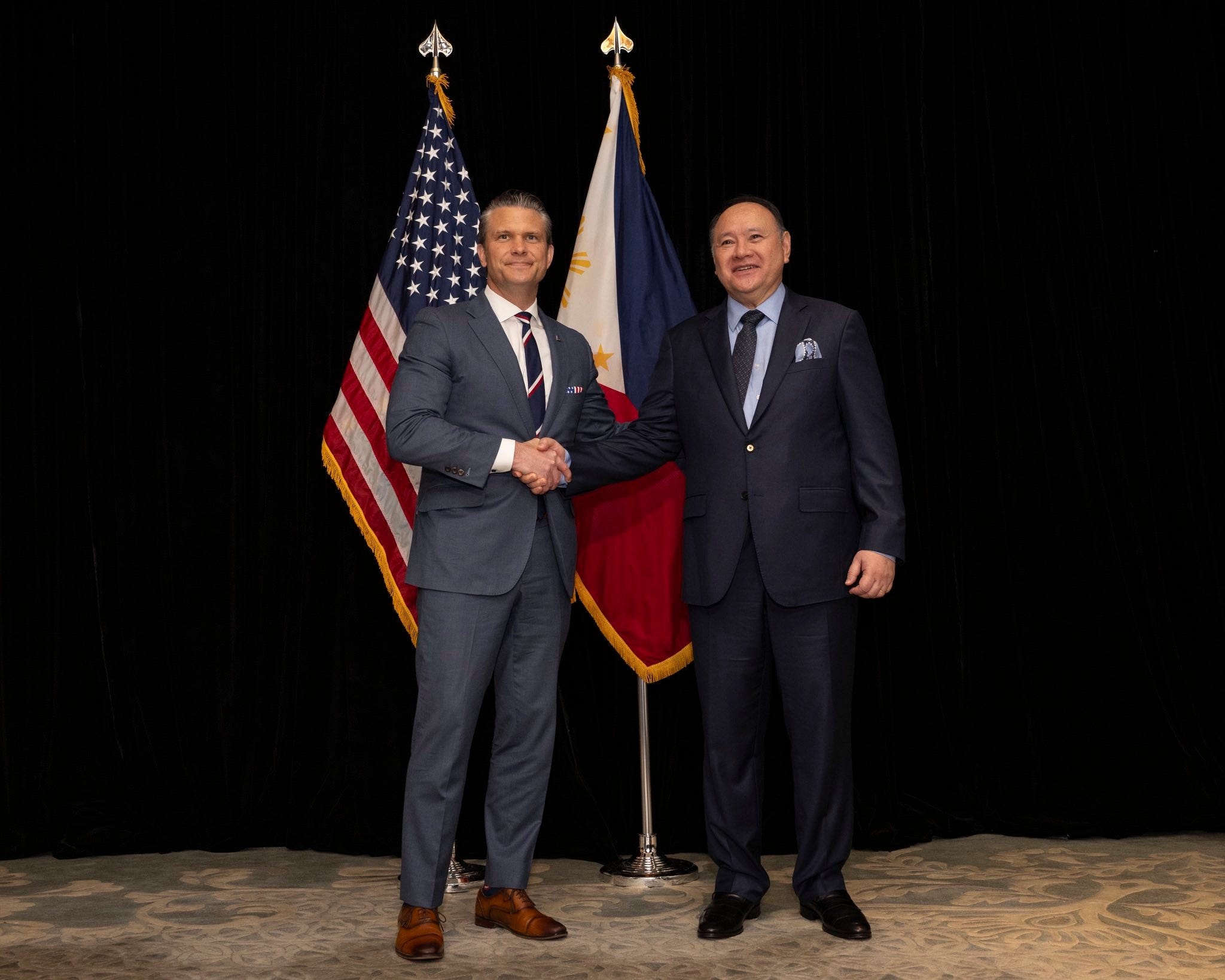
US Defense Secretary Pete Hegseth and Philippine Defense Secretary Gilberto C. Teodoro Jr. at the sidelines of the Shangri-La Dialogue in Singapore, last Saturday, May 30. Official handout.
Rommel Banlaoi | June 1, 2026
At the recently-concluded Shangri-La Dialogue, US Defense Secretary Pete Hegseth’s commendation of the Philippines for its defense “burden-sharing” must be read as a strategic signal. Washington is recalibrating its security posture in Asia, urging allies to move beyond dependency and embrace co-responsibility. For Manila, this is a recognition of its growing relevance in the Indo-Pacific chessboard, where the Philippines is no longer viewed as a passive recipient of American protection but as an active contributor to regional stability. (Also read: US, Philippines agree to strengthen deterrence in the region)
Yet this empowerment carries inherent dilemma. Greater responsibility means Manila must brace for sharper exposure to geopolitical friction, especially amid intensifying US-China rivalry. The Philippines is being asked to step into a role that demands both courage and caution—leveraging its alliance with Washington while safeguarding its national interests. This represents the paradox of Philippine security: empowerment through security partnership, but vulnerability through geopolitical entanglement.
A Stronger Security Posture
The Philippines’ decision to boost its defense budget and expand Balikatan exercises with likeminded partners signals a long overdue shift toward external defense. For decades, the Armed Forces of the Philippines (AFP) remained focused on counterinsurgency operations at home. Today, however, modernization efforts, ranging from enhanced naval patrols and new air defense systems to joint drills with US forces, are explicitly designed to counter Chinese activities in the West Philippine Sea. (Also read: RECAP: Exercise Balikatan 2026)
This is a welcome development. A credible national defense posture strengthens sovereignty and signals to Beijing that Manila is no longer a passive claimant but an active defender of its territorial sovereignty and maritime rights. It also reassures the Filipino people and regional partners that the country is committed to safeguarding its future.
Implications for South China Sea Stability
Yet, burden-sharing has wider consequences for regional stability. The South China Sea is already a contested maritime theater, where overlapping claims and military maneuvers create a volatile environment. By deepening defense cooperation with the US, Manila contributes to a more militarized balance of power in Asia and the wider Indo-Pacific region. (Also read: South China Sea Must Avoid Becoming Hormuz)
This can cut both ways. On one hand, stronger Philippine capabilities may discourage Chinese coercion, reducing the likelihood of unilateral actions. On the other, it raises the risk of miscalculation where routine patrols or exercises could spiral into confrontation. Stability in the South China Sea will depend on whether deterrence is matched by dialogue.
The China Factor
China perceives the intensification of US-Philippine defense cooperation as a deliberate component of Washington’s containment strategy. Expanded American access to Philippine bases and the conduct of larger joint military exercises are interpreted in Beijing not merely as deterrence measures, but as direct provocations that heighten the risk of miscalculation. In this context, every incremental step toward strengthening deterrence simultaneously carries the potential to escalate tensions in the region. (Also read: The US to help set up industrial hub in the Philippines)
At the same time, China remains the Philippines’ foremost trading partner, anchoring Manila’s economic growth through investments and trade flows. The possibility of economic retaliation whether in the form of slowed investments or restrictive trade measures cannot be dismissed.
Thus, the Philippines faces a strategic dilemma: it must assert its sovereignty and safeguard national security, while carefully avoiding actions that could trigger punitive responses capable of undermining its economic stability. Navigating this tightrope requires a nuanced balancing of security imperatives with economic realities.
The Need for Balance and Independence
The Philippines cannot afford to lean too heavily on either Washington or Beijing. Over dependence on the US risks entanglement in great power rivalry, while excessive accommodation of China can undermine Philippine sovereignty. The strategic imperative, therefore, is balance: strengthening defense ties with the US while maintaining constructive engagement with China.
But balance alone is not enough. Manila must assert an independent foreign policy that prioritizes Philippine national interests above the agendas of external powers. Defense modernization must be pursued not as a proxy for US strategy, but as a sovereign choice to protect Philippine territory. Engagement with China must be calibrated, advancing peace and stability without compromising sovereignty.
Reviving the Self-Reliant Defense Posture
To attain genuine strategic autonomy, the Philippines must revisit and reinvigorate its Self-Reliant Defense Posture (SRDP) program. Conceived to reduce dependence on foreign suppliers, the SRDP remains a vital framework for cultivating indigenous defense capabilities. Revitalizing this program can stimulate local defense industries, foster innovation, and strengthen the country’s technological base.
By investing in the domestic production of naval vessels, aircraft, surveillance systems, and other critical platforms, the Philippines can gradually diminish its reliance on external powers. Such investments not only enhance national defense but also ensure that defense modernization is sustainable, cost-effective, and aligned with national priorities.
True strategic autonomy requires that Manila’s defense posture be anchored in self-reliance, while still engaging in cooperative security arrangements with allies and partners. In this way, the Philippines can balance external collaboration with internal strength and can build a defense ecosystem that is resilient, adaptive, and firmly rooted in national sovereignty.
Conclusion
Hegseth’s commendation underscores Manila’s growing maturity in defense affairs. Yet it also serves as a reminder that sovereignty is inseparable from responsibility and risk. For the Philippines, burden-sharing must be embraced not as a march toward confrontation, but as a strategy to safeguard peace. At the same time, diplomatic agility remains essential to ensure the South China Sea does not become the next flashpoint in great power rivalry.
In the end, Manila’s gargantuan challenge is to integrate defense and diplomacy within a coherent national strategy: strengthen territorial defense, pursue an independent foreign policy, and institutionalize the revival of the SRDP program as a pillar of military modernization. Achieving these objectives is essential for the Philippines to secure a genuine strategic autonomy safeguarding sovereignty while balancing relations with both Washington and Beijing.
Rommel C. Banlaoi, PhD, is the Director of the Philippines-China Studies Center at Diliman College and President of the Philippine Society for International Security Studies.