

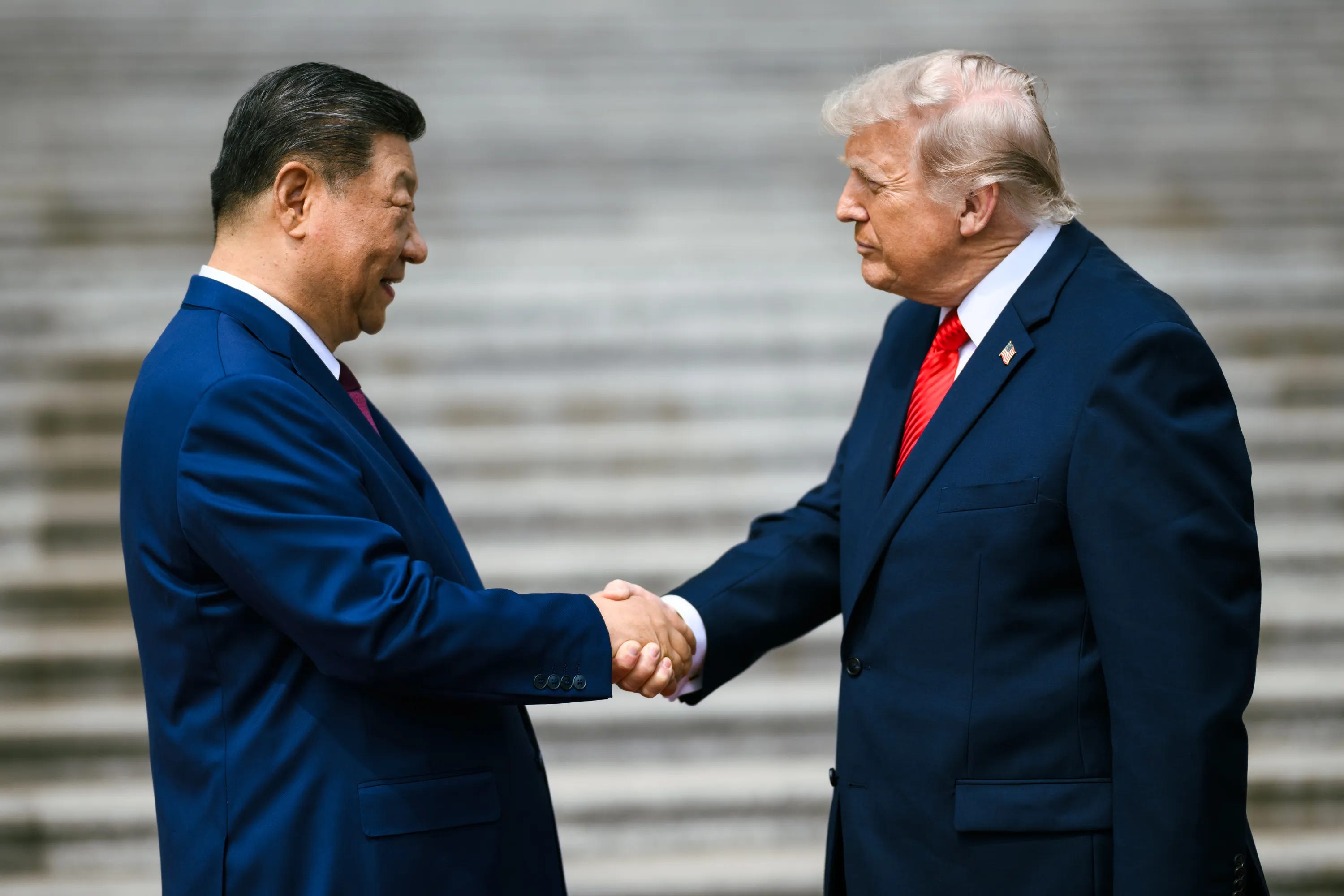
US President Donald Trump shaking hands with Chinese president President Xi Jinping at the welcome ceremony ahead of the US-China bilateral meeting in China. Photo from The White House
Rommel Banlaoi | May 18, 2026
Repeated remarks from within the Philippine defense and military establishments declaring that China cannot be trusted in talks apparently reflect a very deep frustration with Beijing’s current actions in the South China Sea. This is understandable. (Also read: Balikatan 2026: Manila’s Tightrope Between Deterrence and Diplomacy)
But to elevate distrust into a national security doctrine inevitably risks weakening the Philippines’ ability to actually protect its vital national interests and shape Asian regional order. Dialogue, even with rivals or adversaries, is a prerequisite, particularly for a developing Asian country like the Philippines whose security and prosperity are inextricably linked to regional stability and good neighborliness.
Distrust Is Natural, But Should Not Be A Dogma
Undeniably, suspicion is inherent in international politics. States, as rational players in international politics, oftentimes pursue colliding national interests. China’s tougher attitude in the West Philippine Sea has understandably bred stronger domestic skepticism and regional suspicion.
But to arbitrarily declare China as automatically untrustworthy is regrettably denying the utter complexity of state behavior. Such hardline attitude fueled by dogmatism is counterproductive as it forecloses the possibility of a peaceful negotiation, leaving the Philippines lamentably trapped in useless confrontation without avenues for confidence-building needed for productive cooperation.
Actual practices have displayed that even rival states directly negotiate to achieve peace. During the Cold War, the United States and the former Soviet Union seriously engaged in practical arms control talks to reduce nuclear risks for purposes of maintaining international security. At present, the U.S. and China are cautiously engaged in pragmatic comprehensive talks to address the current state of their major power relations in this turbulent era. In fact, U.S. President Donald Trump actually met President Xi Jinping in Beijing on May 14–15, 2026—the first American state visit to China since 2017—deliberately pursuing major power dialogue despite years of profound mutual distrust and bruising trade conflict.
The Trump–Xi Beijing Summit was, in fact, a powerful and timely validation of this very argument. Two nuclear-armed great powers, bound together by staggering economic interdependence yet deeply divided by trade hostility, technology rivalry, and competing visions of the Asian regional order, chose pragmatic engagement over dogmatic estrangement.
If Washington and Beijing, with all their monumental mutual suspicions, can negotiate wisely and patiently toward strategic stability, then Manila has absolutely no rational justification to permanently foreclose such channels with its own neighbor across the West Philippine Sea. It is paramount for the Philippines to also adopt a similar pragmatic outlook, recognizing that dialogue is an integral part of the arsenal of national security and a vital instrument of statecraft.
Negotiations Manage Distrust
Talks are not designed to eradicate mistrust. Talks are, in fact, designed to manage and deal with it. By outrightly rejecting dialogue, the Philippines risks confusing suspicion with incapacity to negotiate and engage. Negotiations provide mechanisms to deescalate prevailing tensions, clarify strategic intentions, and prevent miscalculations. Without them, unintended violent encounters at sea become more dangerous, and the Philippines loses opportunities to shape beneficial outcomes to advance national interests and to promote a peaceful regional order.
For a nation committed to a peaceful resolution of disputes under international law, constructive and cautious dialogue with China is pivotal in asserting national sovereignty while avoiding regional escalation and further hostility. As stressed by Antonio Guterrez, 9th Secretary General of the United Nations, “In all circumstances in the world — even the most difficult circumstances — we need to push for dialogue.”
Dangers of Military Mindset
Viewing China solely through a narrow and parochial military lens obscures the big picture. The Philippine security sector perceives China as a maritime security rival. But that is just one small slice of a large pie. China is also the Philippines’ major trading economic partner, a source of foreign investment and tourism, and a regional power whose cooperation is essential in addressing transnational and non-traditional security challenges like climate change, global pandemics, and international terrorism. To securitize and militarize every aspect of the relationship risks crowding out bigger opportunities for economic development and cultural engagements that can benefit Filipinos.
Hyping on the issue of distrust also risks tethering the Philippines too tightly to potent external powers.
While the alliance with the United States remains crucial to advance Philippine security interests in this era of regional and global uncertainties, overreliance erodes Manila’s well-deserved strategic autonomy. (Also read: What’s the reason behind US expansion of military engagements in the Philippines?)
Engaging China cautiously, even skeptically, signals that the Philippines is not merely a pathetic pawn in great power rivalry or a piteous proxy of a major power but a confident sovereign international player capable of standing on its feet in order to manage its own disputes with neighbors. This is the essence of an independent foreign policy enshrined in the 1987 Philippine Constitution.
Trust Is Earned, Not Given
Trust is not a precondition for talks but it is an outcome. It is earned incrementally through protracted dialogues, patient consultations, sustained confidence-building measures and persistent preventive diplomacies.
The Philippines can pursue practical, vigilant, and constructive engagement: negotiate, verify, and hold China accountable, while prepared to defend national interests. This practical approach avoids naivety while recognizing that trust is not binary. Manila can attentively cooperate with China in areas, such as trade, investment and tourism or disaster relief and humanitarian assistance, while remaining vigilant in maritime security. Such categorized trust allows the Philippines to maximize economic benefits while minimizing security risks. That is a rational choice.
Strategic Autonomy Through Dialogue
Balancing cooperation and competition can enable the Philippines to effectively navigate complex geopolitical dynamics in the South China Sea and the wider Asian region. Rejecting talks outright undermines this strategic posture. (Also read: Securing China’s ‘front door’: Peacemaking mission in mainland Southeast Asia)
By comprehensively engaging China, the Philippines preserves flexibility, strengthens its bargaining position, and truly demonstrates independence or strategic autonomy in foreign policy. Dialogue, even in the environment of distrust, is one way to assert Philippine sovereignty while maintaining peace and stability in the South China Sea region. (Also read: Navy rejects maritime cooperation with China)
Negotiating Wisely and Patiently
The Philippines’ security sector’s worsening frustration with China is undeniably justified. It is a sign of the utter lack of strategic patience. To transform distrust into a national security doctrine is a tantamount display of strategic weakness. (Also read: AFP, defense experts: PH already in ‘political, informational war’ as arbitral ruling turns 10)
Distrust should inform negotiations, not prevent them. Dialogue is not about trusting completely or blindly. Dialogue is about negotiating wisely, leveraging diplomacy as a tool to advance national interest.
There is no doubt that the Philippines is facing a complex future in the South China Sea because of current security uncertainties. Manila needs to overcome this perennial security dilemma by avoiding the trap of dogmatic distrust. Instead, it has to be open-minded by embracing cautious, but still rational, proactive and patient, engagements with China.
The Trump–Xi Beijing Summit demonstrated unmistakably that even the most powerful states understand that structured engagement, not mutual recrimination, is the irreplaceable foundation of regional order. Manila must draw the appropriate lessons from this historic geopolitical moment.
Rommel C. Banlaoi, PhD, is the Director of the Philippines-China Studies Center at Diliman College and President of the Philippine Society for International Security Studies.