


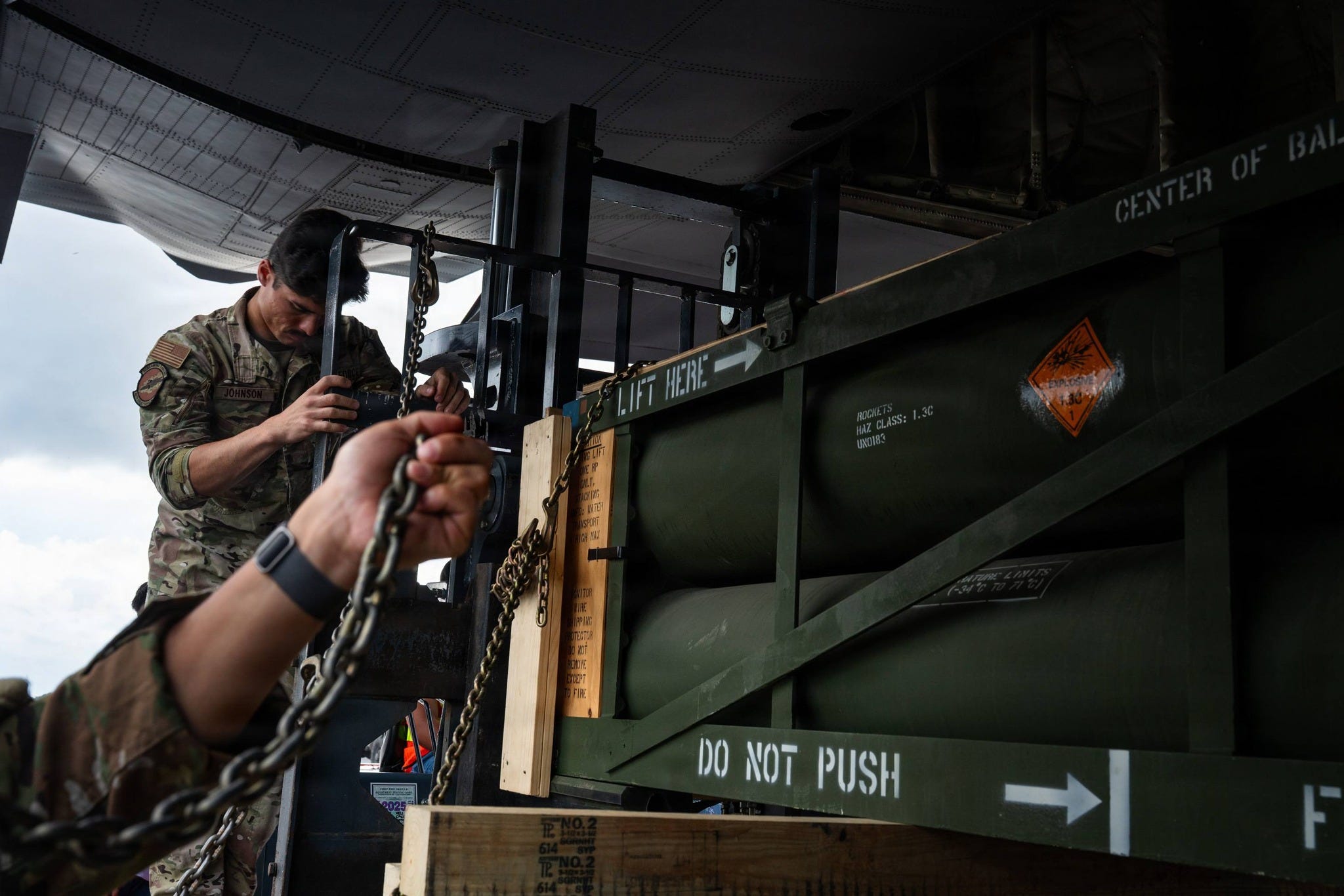
American soldiers prepare a US Army Guided Multiple Launch Rocket System pod in Palawan during Exercise Balikatan last April 29. Photo by U.S. Air Force Senior Airman Jade Caldwell
Manuel Mogato | May 27, 2026
MANILA — Washington has announced a pause in its $14 billion arms sales to Taipei after President Donald Trump recently held talks with Chinese leader Xi Jinping.
Although some senior US defense and military officials said the decision to withhold the export of defense missiles, rockets, and armed drones to Taipei was due to the Middle East conflict, many believed China may have been behind the sudden policy change.
Beijing has been trying to stop Washington from selling arms to Taipei, a self-ruled island which China considers a renegade province.
What could the arms sales pause mean to Taiwan’s defenses when China reportedly planned to take over the island by 2027, as many US generals had predicted?
Can Taiwan still rely on the United States to defend the island? Will Taiwan look for alternative defense suppliers?
Just after Washington’s decision not to honor deals to deliver defense equipment to Taipei, Beijing’s Coast Guard moved close to Taipei-administered Pratas Island in the northern part of the South China Sea.
There was a brief standoff as the Taiwanese Coast Guard issued a radio challenge to the intruding Chinese Coast Guard vessels, which eventually left the area. (Also read: Taiwan raises defense spending to build air defense to counter China’s threats)
The recent Pratas incident would serve as a serious warning to Taiwan on what China would do now that the United States can abandon a security partner in an instant.
Taiwan is an integral part of the United States’ first island chain, which includes Japan in the north and the Philippines in the south. (Also read: Preparing for a humanitarian crisis if conflict erupts in Taiwan)
What message does Washington want to send to its allies in the region if it is willing to compromise the defense of an island, which is an important part of its imaginary defense line?
If the United States can easily abandon Taiwan, it could also renege on its commitment to the South China Sea if it runs counter to its interests, particularly in dealing wth China.
For instance, Beijing has started dumping US treasuries, a strategic diversification away from dollar-denominated assets and a de-risking maneuver amid geopolitical tensions.
Even if China cannot weaponize US debt, it may also damage its own economy by raising its currency’s value, making its exports less competitive.
However, it could raise US interest rates, and US bonds could plunge.
Thus, the direct impact of the US decision to withhold arms sales to Taiwan could be on the security, not only of the island, but also of the region.
Before Taiwan, the United States also pulled out its Terminal High Altitude Area Defense (THAAD) in South Korea, redeploying the weapons systems to the Middle East to help intercept Iranian ballistic missiles.
Washington removed the missile interceptors despite protests from Seoul, which is worried about Pyongyang’s ballistic missile threats. (Also read: South Korea, Philippines deepen security, economic relations)
These lessons should make the Philippines rethink its defense and military cooperation arrangements with the United States.
Washington can pull out from Manila anytime, several of its missile systems - Typhon, HIMARS, NMESIS, and Marine Air Defense Integrated System (MADIS).
It could also reverse its South China Sea policy and reduce its presence in the nine Enhanced Defense Cooperation Agreement (EDCA) locations.
Trump has secured Xi’s promise not to send arms to help Iran; he has to make some concessions as well.
Taiwan was the most obvious bargaining chip.
Taiwan serves as a lesson. Washington generates profits from arms sales from Taipei. It has not sold any defense equipment from the Philippines, except for three Lockheed Martin C-130J Hercules transport planes.
It was not successful in offering F-16 multi-role fighters. It may sell surveillance drones and other platforms, such as the Navy-Marines Expeditionary Ship Interdiction System (NMESIS) and the Army’s High Mobility Artillery Rocket System (HIMARS). (Also read: Why does the Air Force need a dedicated fighter trainer aircraft?)
No wonder Japan has started to flex its defense muscle, abandoning its Pacifist Constitution to rearm itself and export lethal weapons to its neighbors to strengthen the collective defense of the region if the United States retreats into its shell. (Also read: Is a militarized Japan a threat to the region?)
Countries in the Indo-Pacific should take care of their own security rather than rely on the waning power of the United States.
In Europe, the United States has allowed the North Atlantic Treaty Organization (NATO) not only to share the burden but also to carry the defense load. Europe was also tasked to help Ukraine fight Russia.
Washington also focused on Iran, as the United States recognized that it could no longer fight in two theaters simultaneously.
The US allies and partners in Europe and the Indo-Pacific region could no longer depend on Washington for providing a security umbrella.
They have to stand on their feet and fight without the US.