


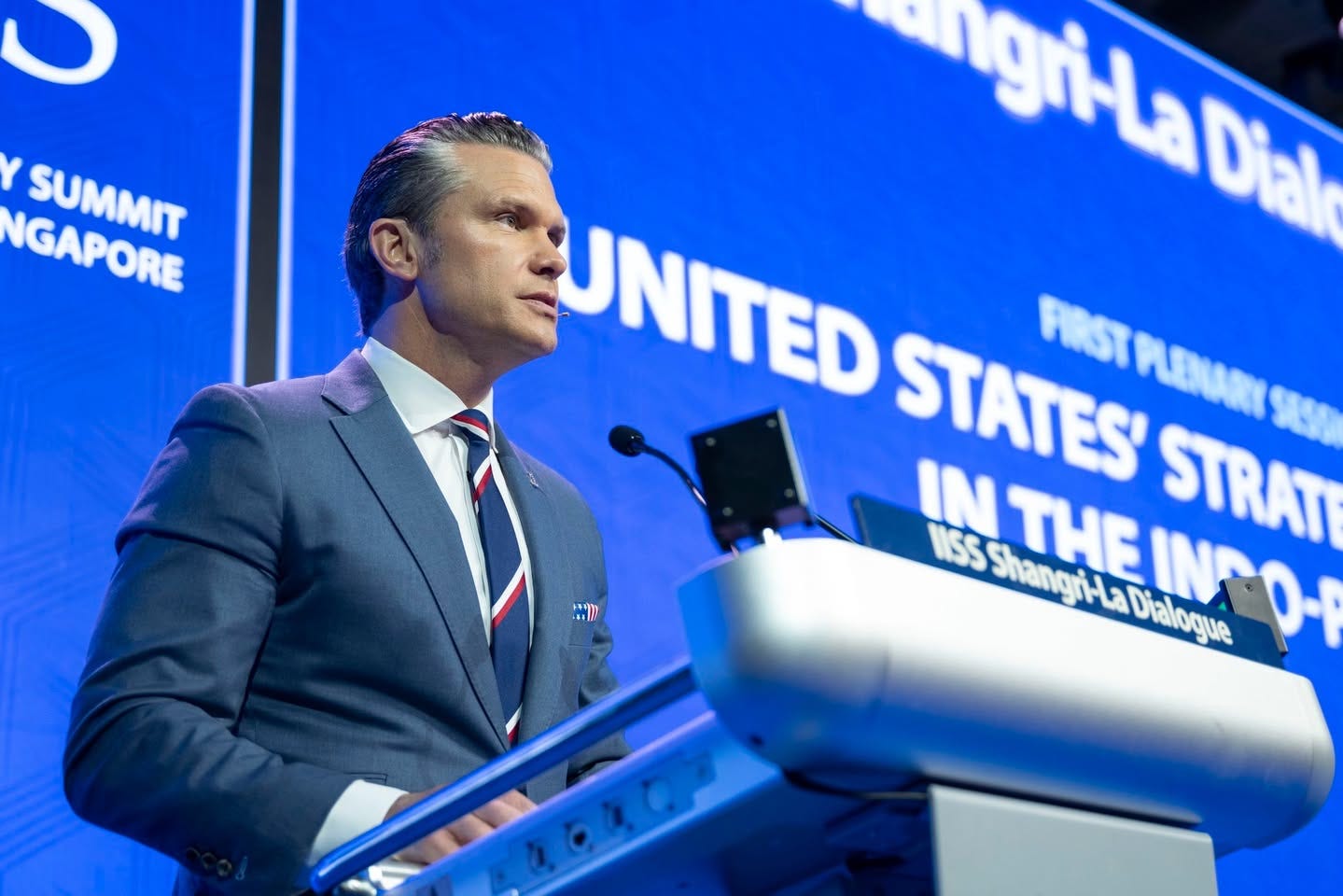
US Secretary of War Pete Hegseth at the Shangri-La Dialogue. Official handout.
Manuel Mogato | June 1, 2026
SINGAPORE — US Defense Secretary Pete Hegseth has urged Asian allies to raise their military spending to counter China’s growing power and prevent its dominance in the region.
Speaking at the annual Shangri-La Dialogue in Singapore, Hegseth said stronger, more self-reliant allies are key to deterrence. (Also read: US, Philippines agree to strengthen deterrence in the region)
“The era of the United States subsidizing the defense of wealthy nations is over,” Hegseth said. “We need partners, not protectorates. We don’t have a strong alliance unless everyone has skin in the game. No freeloading.”
The US expects its Asian allies and partners to increase defense spending to 3.5% of GDP as it pledged a US$1.5 trillion investment in its military, he added. (Also read: Strengthening the US’ first-island-chain)
Hegseth said allies want stability, not escalation.
“What they want, and what the United States delivers, is strength that is disciplined, resolve that is steady, and leadership that is confident enough to speak and walk softly while carrying a big stick.”
US President Donald Trump has demanded that allies in Europe and in the Indo-Pacific regions boost defense spending and reduce reliance on Washington. (Also read: The Philippines: a new laboratory for US cutting-edge missiles and drones)
Reacting to Hegseth’s speech, the Malaysian defense minister said Kuala Lumpur will not rush to increase its defense budget.
“It doesn’t mean that we will implement it immediately because America says so,” Khaled Nordin, said in an interview on the sidelines of the Shangri-La Dialogue on Saturday.
“Our budget needs to be allocated to various sectors because we are not a developed nation.”
He said Malaysia has been pursuing asymmetrical warfare capabilities, focusing on low-cost, mass-produced weapons like drones and rockets. (Also read: Malaysia protests Norway’s cancellation of missile contract)