


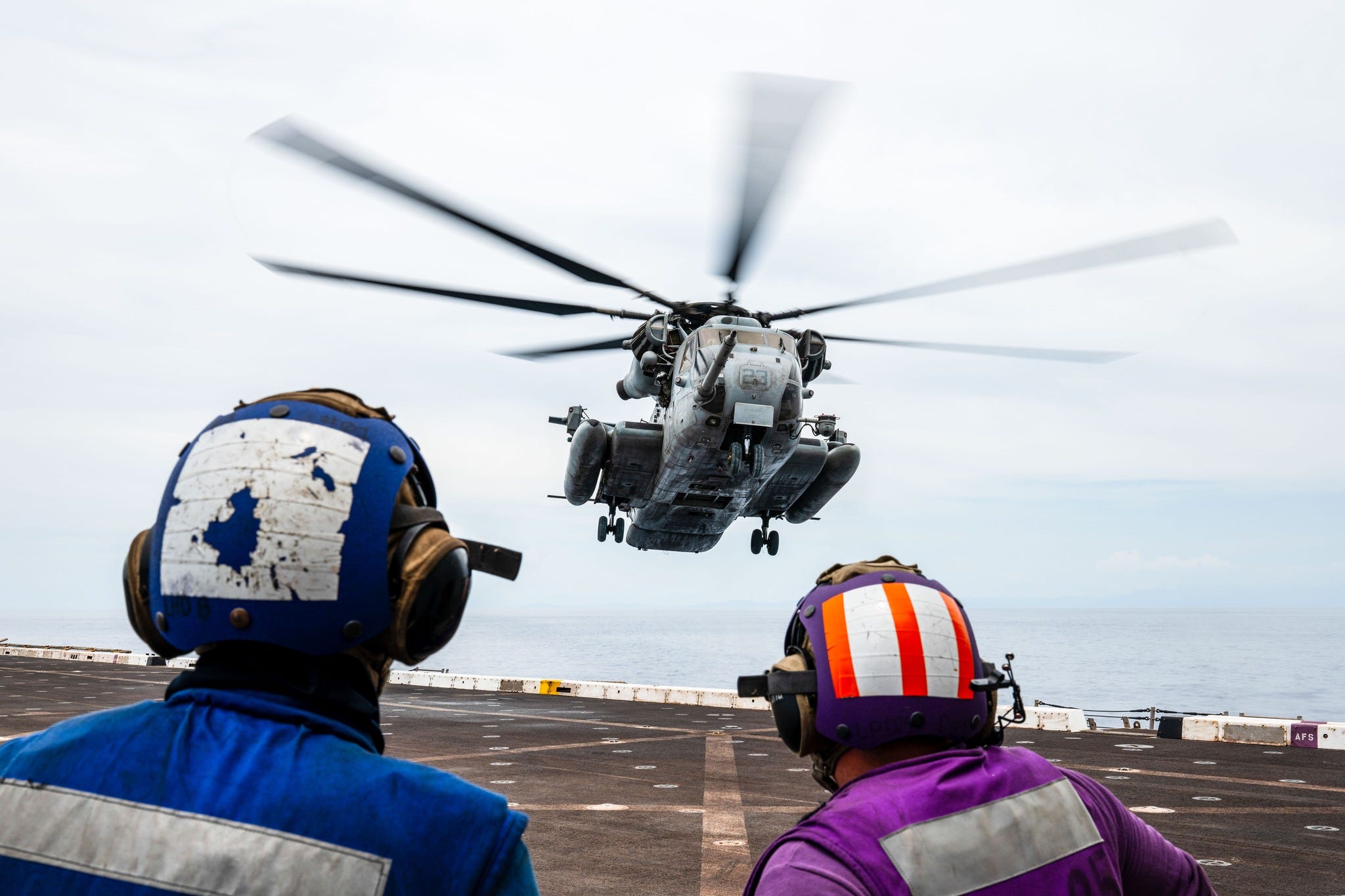
US Marines conduct flight deck operations aboard the amphibius assault ship USS Somerset (LPD 25) during Balikatan last May 1, 2024, at South China Sea. Photo by US Navy Mass Communication Specialist 2nd Class Evan Diaz.
Manuel Mogato | March 26, 2026
Manila — The Philippines and its three allies will hold the “biggest” conventional wargames next month amid global uncertainty due to escalating conflict in the Middle East.
About 1,000 members of the Japanese Ground Self-Defense Forces will be joining for the first time in the three-week drills starting April 20.
Armed Forces chief of staff, General Romeo Brawner Jr., said Japanese troops will return for the first time after 81 years in the largest military drills since 1990. (Also read: Philippines, Japan may sign treaty in July)
“It will be the biggest, in terms of intensity of the exercises that we’re going to do,” Brawner told journalists at the sidelines of the Stratbase Institute forum for the 70th anniversary of the Philippines-Japan diplomatic relations.
“When you say biggest, it’s not just in the numbers, number of troops participating but in the number of activities that we’re doing.”
Previously, Japan sent a token number of soldiers to take part in the humanitarian assistance and disaster response (HADR) component of the annual “Balikatan” exercises. (Also read: Japan Ground Self-Defense Forces join ‘Salaknib” drills in April)
But, for this year, Japanese troops will be joining the field training exercises and other activities, like command post exercises and the cybersecurity tabletop drills.
The Japanese troops are also bringing in several pieces of artillery and armored vehicles, planes and vessels.
Brawner also made assurances that there will be no scaling down of military activities despite the conflict in Iran. (Also read: Philippines learns from the Middle East conflict)
“We received confirmation from (Indo-Pacific Command commander-in-chief) Admiral (Samuel) Paparo that this will still be the biggest Balikatan despite the war going on in the Middle East,” Brawner said.
“He said we’re not going to be affected (by the Middle East conflict). All our planned activities will push through, the scale, the scope will be the same.”
Brawner did not say how many troops from the US, Australia, Japan, and the Philippines will be participating in the exercises.
“We are going to continue on with all the Balikatan exercises with all the components of these exercises despite the war going on in Iran,” he added.
The four allies are part of a new security architecture called “SQUAD” security dialogue.
In 2023, a total of 17,600 US and Philippine military troops - infantry, sailors, aviators, and Marines — took part during the Balikatan exercise, the largest in terms of numbers.
The number would likely be about exceeded due to the participation of Australia and Japan as well as observers from a dozen countries.
The Philippine Coast Guard, Philippine National Police, and the Office of Civil Defense are also joining Balikatan’s non-military component , focusing on HADR operations.
As to the new systems that will be incorporated in this year’s Balikatan, Brawner said: “I cannot divulge information on that.”
“The exercises we are going to conduct will be larger and we’re going to be more prepared for any eventuality, whether it is man-made or natural,” Brawner said. (Also read: Teodoro: Prepare for a conventional war scenario)
Brawner said another new feature of the drills will focus on cybersecurity exercises.
“It is very important that we develop this capability of depending on our cyber networks, “ he said, learning from the experiences in conflict in Ukraine, Venezuela, and in the Middle East.