

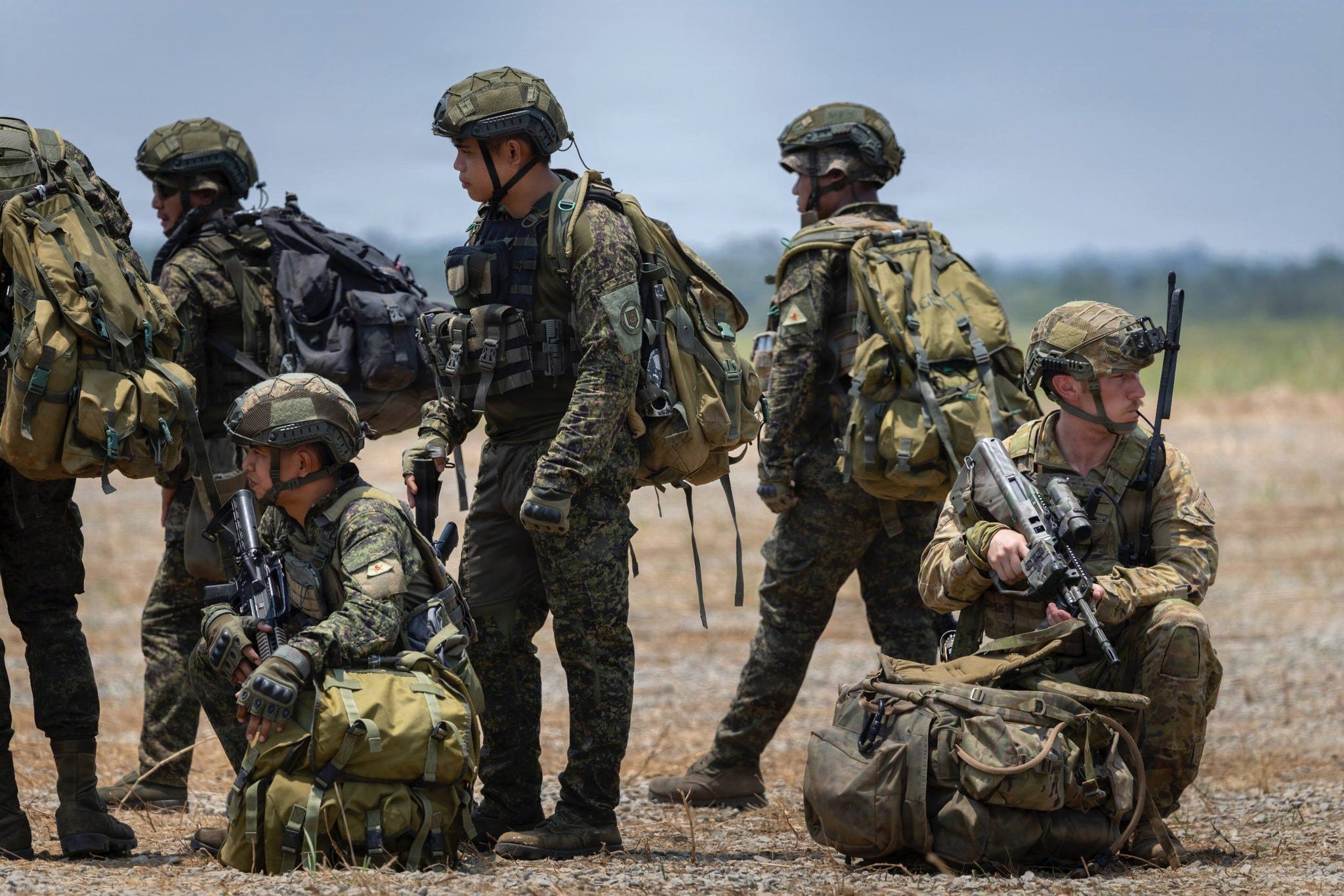
Troops from Australia, the Philippines, and US deployed in Lal-lo for a CH-47 Chinook cold-load training last April 22. Photo by U.S. Army Sgt. Olivia Cowart
Dear readers,
Today is the last day of this year’s iteration of Balikatan Exercise, dubbed as the “biggest” by Armed Forces chief of staff General Romeo Brawner Jr.
Brawner pointed to a larger number of troops taking part in the multilateral, multi-domain drills, as well as in the intensity of exercises, which includes countering amphibious assault landing, anti-drone defense, cyber warfare, live-fire drills, tracking submarines, as well as test firing shore-to-ship, short-range and mid-range missiles.
In his column, API editor-in-chief Manuel Mogato wrote how cybersecurity, drone warfare, and utilizing more sophisticated weapons systems have become a centerpiece in this year’s exercises — a much needed boost for the Philippines as it shifts its focus from counterinsurgency to external defense.
Balikatan 2026 is also memorable for another reason: this is the first year that Canada and Japan join as full participants following the signing of visiting forces agreements with the Philippines. Japan’s full-blown participation is particularly historic, as this year is the first time in 81 years since Japanese soldiers have stepped foot in Philippine soil.
Some 1,400 Japanese soldiers were sent to participate in Balikatan, while a couple hundred others were sent to Salaknib drills, a trilateral army-to-army drill that includes the United States.
It seems Japan is slowly establishing itself as a reliable defense partner in the region, after its lawmakers in April relaxed restrictions on exporting defense equipment to allow them to transfer lethal weapons to Southeast Asian nations.
Defense Minister Shinjiro Koizumi on Tuesday met with his counterpart, Defense Secretary Gilberto Teodoro Jr. to sign an agreement to further promote defense equipment and technology cooperation. The next day, both officials observed a live-fire drill involving Japan’s Type 88 missile system in Laoag, Ilocos Norte.
Manuel Mogato’s next opinion piece notes the timeliness of Japan filling in the gap of the United States left in the region currently grappling with China’s looming presence in South China Sea, as the world’s superpower struggles to conclude its conflict with Iran.
What do the future joint exercises have in store for us? Should a war break out, is the Philippines truly prepared?
Let us know your thoughts!
Before we end this newsletter, we’re inviting you to follow us on Youtube where we upload a monthly hour-long podcast with our resident columnists Ret. Col. Dencio Acop and Rodney Jaleco. Stay tuned for our next episode, which will be about the Balikatan exercises.
If you have made it this far, thanks for reading!
Happy weekend!
Anna Mogato,
Deputy editor