

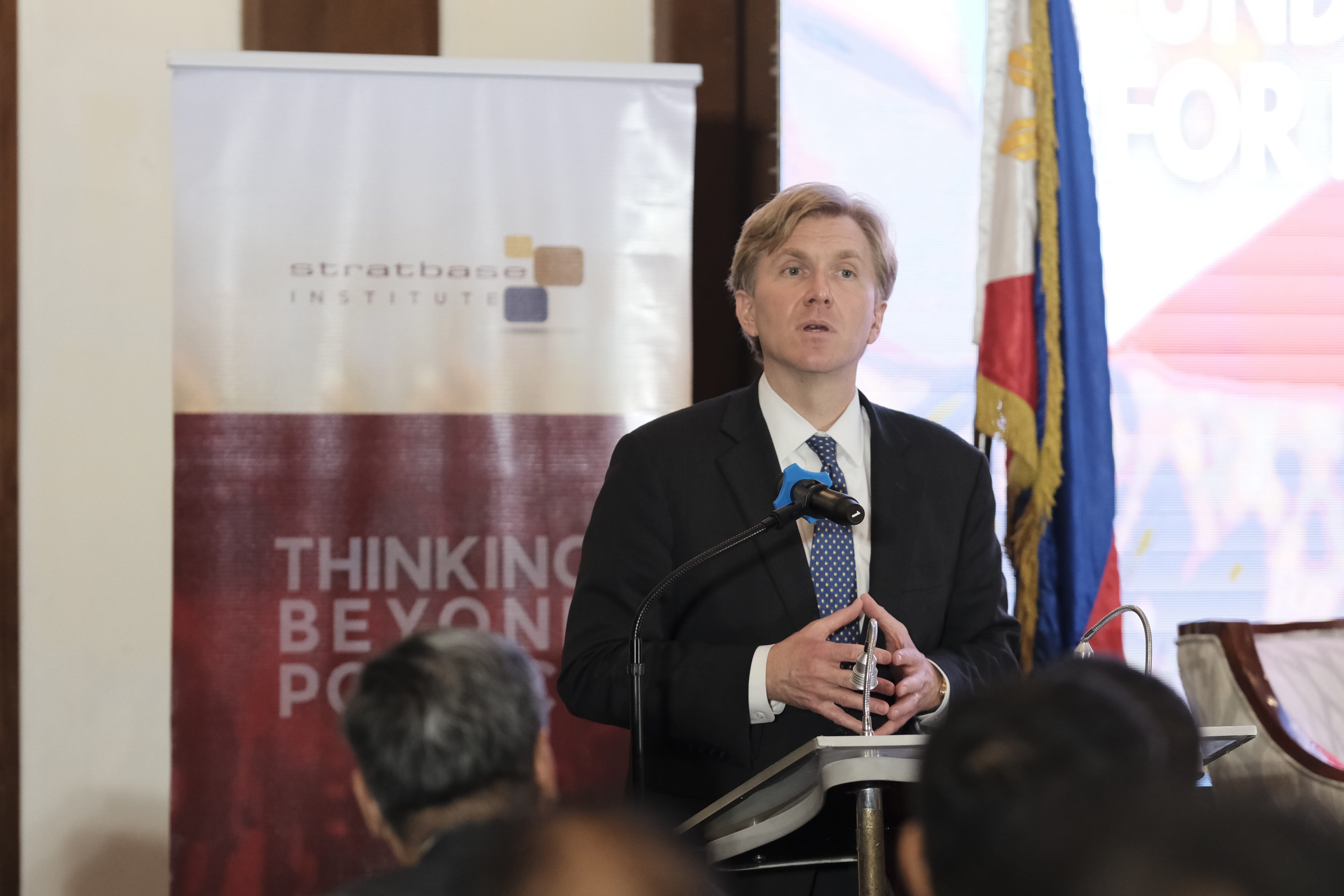
U.S. Undersecretary of War for Policy Elbridge Colby speaks at a Stratbase Institute forum on Monday, August 10. Official handout.
Stratbase Institute | August 10, 2026
MANILA — A U.S. senior defense official on Monday hailed the Philippines as a “model ally” actively leading its own defense modernization, as he also reaffirmed the United States’ commitments with its oldest treaty ally in Asia especially when it comes to credible deterrence.
In a keynote speech during a forum organized by the Stratbase Group, U.S. Undersecretary of War for Policy Elbridge Colby assured that the United States remained a "willing partner” amid a perceived shift in U.S. President Donald Trump’s foreign policy, and that their new approach was to “build strength in ways that are durable and achieve their intended effect, of genuine peace through strength rather than rhetorical pressurization without adequate material strength and resolve.”
"We seek partnerships, not dependencies, and we understand that countries will engage widely just as we do,” Colby said. “We are putting our alliances on a sustainable, realistic, and durable footing for the long haul. When we ask our allies and partners to step up, to invest more in their own defense, and to take responsibility for their own sovereign security, we are not signaling abandonment.” (Also read: Doubts about America’s ‘ironclad’ commitment in the region)
“We are looking for partners, not protectorates. When our partners are strong, deterrence is strong. And that is exactly what we have here in Manila under the leadership of President Marcos, Secretary of National Defense Teodoro, and other key leaders,” he added.
Colby’s visit to Manila – his first as Undersecretary of Defense for Policy – is part of his four-nation tour including Indonesia, Thailand and Cambodia as part of the United States’ efforts to reaffirm the country’s commitment to build durable peace in the Indo-Pacific region. Colby also met with President Ferdinand Marcos Jr. in the morning before the forum.
In his opening remarks, Stratbase Group President Victor Andres Manhit said Colby’s visit was also timely given that the Philippine-U.S. alliance “carried greater weight than any point in recent memory.”
“The United States consistently ranks first among the countries they want the Philippine government to work with in defending our seas, especially in defending the West Philippine Sea and advancing our economic security. Today, that is precisely what we hope to explore, how this trust can be translated into a stronger, more capable, and more resilient alliance that responds to present challenges and contributes to a free and open rules-based Indo-Pacific,” he said.
Echoing this sentiment, Colby emphasized that the administration’s defense strategy was focused on cultivating a “network of highly capable sovereign nations” that could establish a “denial defense” along the first island chain to ensure that any potential aggression in the region was rendered completely infeasible.
In line with this, the U.S. senior defense official said the United States touted the Philippines as a “resolute and proud nation...determined to strengthen its own capabilities to better defend itself and its allies.” (Also read: Hegseth urges Asian allies to raise defense spending to 3.5 percent of GDP)
He also praised Manila’s “clear-headed pragmatism” as the exact strategic fit required for the region's strategic demands, and that through the help of Manila and other allies, “we are actively building a strong denial defense to back up a peace-through-strength approach of a lastingly favorable balance of power in Asia.”
Colby pointed to several areas where the two countries were seeking to translate their alliance into greater military capability, including the operationalization of the Enhanced Defense Cooperation Agreement (EDCA), investments in resilient defense infrastructure and expanded joint training.
He said Washington was also supporting Philippine defense investments through the rotational deployment of four US Coast Guard Fast Response Cutters, which would work with the Philippine Coast Guard in securing and patrolling the country’s exclusive economic zone. (Also read: Reviving SEATO or building an Asian NATO?)
“This is not a one-sided partnership,” Colby said, noting the Philippines’ increased investments in modernizing its armed forces and coast guard. (Also read: Teodoro urges government to increase defense spending to build credible deterrence)
“Alliances are most durable when they are based on shared responsibility, mutual interests governed by pragmatic respect, and underwritten by real capability on both sides, rather than permanent dependency,” he added.
Colby’s visit also comes as Manila and Washington continue to deepen defense cooperation amid growing security tensions in the Indo-Pacific, particularly in the South China Sea. (Also read: Trump assures Marcos to take sea dispute with China)
The United States has repeatedly reaffirmed that the 1951 Mutual Defense Treaty covers armed attacks on Philippine armed forces, public vessels or aircraft – including those of its coast guard – anywhere in the South China Sea.