


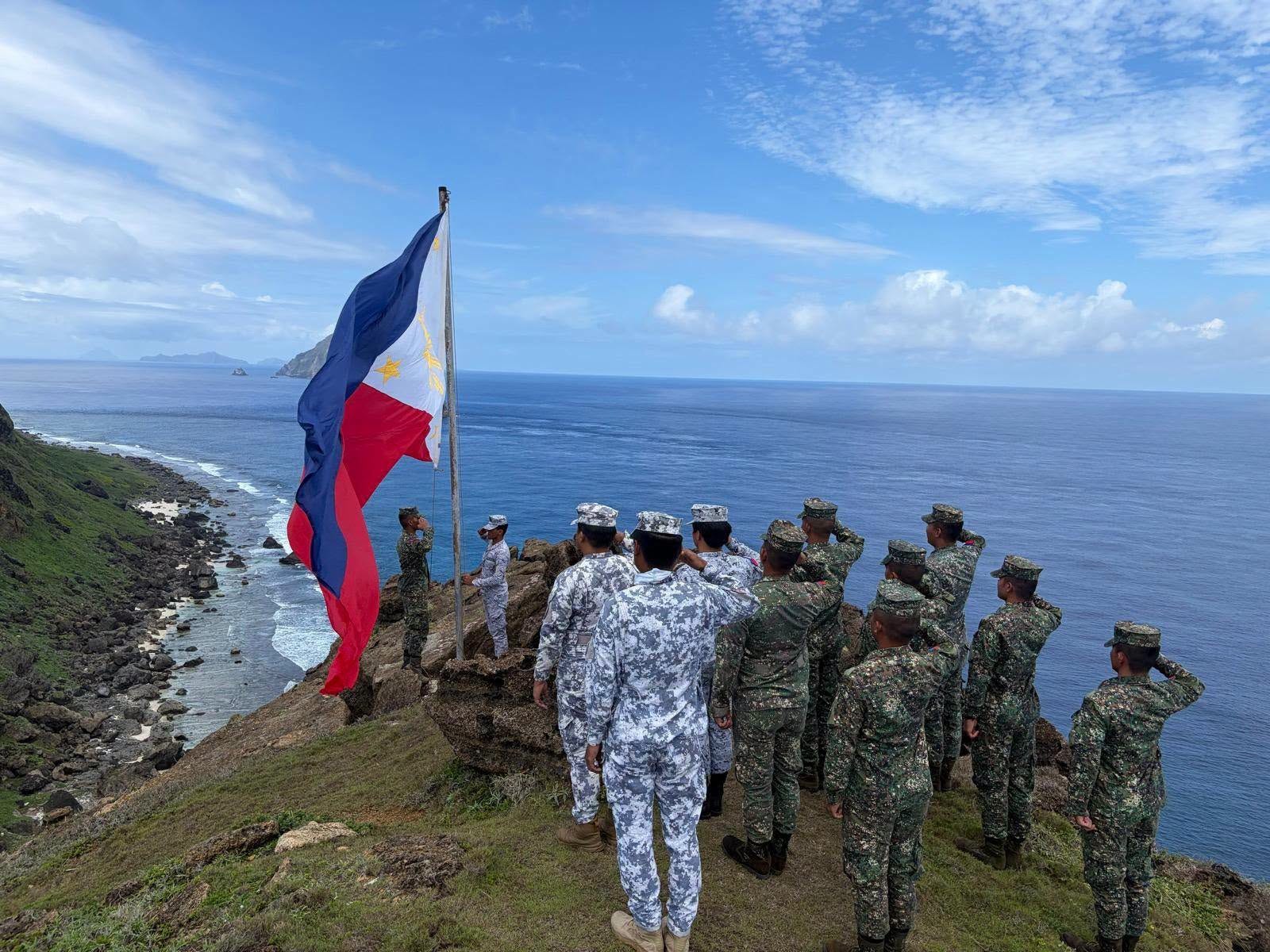
10th Marine Rifle Battalion holding a flag raising ceremony at MD Mavulis, Itbayat, Batanes last July 6, 2026 in commemoration of the 10th Anniversary of the 2016 Arbitral Ruling on the West Philippine Sea. Photo from Philippine Marine Corps.
Manuel Mogato | July 13, 2026
MANILA — On June 30, at a southern Chinese university, a Chinese scholar unveiled research claiming the Philippines’ northernmost islands as part of Beijing’s renegade province, Taiwan; it was not a simple and innocent assertion.
China has been expanding its territory since the Chinese Communist Party took power in 1949, annexing Tibet in the 1950s and recently gaining control over Hong Kong from the British and Macau from the Portuguese.
Inner Mongolia, Manchuria, and Xinjiang were also incorporated into China, and it has land border disputes with Russia and India.
But the biggest expansion was laying claim to almost the entire South China Sea, suggesting it was just a Chinese lake.
There was an even more preposterous claim that Palawan, the Philippines’ most westernmost island-province, was included in its nullified nine-dash-line claim.
Now comes the most absurd claim made by a Chinese scholar that Taiwan and the Batanes islands are geologically linked, and the Philippine islands are just an extension of Taiwan.
If China regarded the tiny island of Taiwan as its renegade province, then the Batanes group of islands are part of China. (Also read: Teodoro calls China’s claims on Batanes a “joke”)
Besides, parts of Batanes, including the strategic Bashi Channel, were not included in the areas ceded by Spain to the United States under the Treaty of Paris.
But it has become part of the Philippine territory.
Taiwan even recognized it as part of the Philippines when it asked, in the early 1990s, to lease the uninhabited Mavulis Island as an impact area for its naval and aerial forces.
In exchange, Taiwan offered an F-5 aircraft to the Philippine Air Force, an existing fighter operated by the Philippines.
At that time, the Philippines turned down the request, adhering to the One-China policy. There was still no tension in the South China Sea, although Beijing has started occupying features in the contested sea.
So, what is China up to?
Beijing has been expanding not only its footprint but also its influence, not only in the Indo-Pacific area but also in other regions of the world.
The Chinese are everywhere, in the African continent, in South Asia, the Middle East, Latin America, and the South Pacific region.
Demonstrating its power and influence, a Chinese submarine had recently test-fired an intercontinental ballistic missile that landed in the waters in the South Pacific.
Lithuania and Poland were quite concerned when China held military exercises with Russia along their borders. Arctic states were also troubled about China’s naval and research vessels in the frozen waters of the Arctic Ocean.
If these European and Arctic states were deeply concerned about China’s presence and activities within their areas, the Philippines should be more worried about China’s statements claiming Palawan and Batanes islands.
Palawan in the west and Batanes in the north are strategic chokepoints that could affect China’s amphibious attack on Taiwan in case it decides to launch an invasion.
American generals had long predicted Beijing would invade Taipei by 2027, when China’s military, the People’s Liberation Army (PLA), would mark its 100th anniversary.
In its effort to increase deterrence, Washington has fortified these two locations with anti-ship and anti-air missile systems, the Navy-Marine Expeditionary ship Interdiction System (NMESIS) and the Marine Air Defense Integrated System (MADIS). (Also read: The Philippines: a new laboratory for US cutting-edge missiles and drones)
The Philippines’ most northernmost island, Mavulis, or Y’Ami, is only 100 kilometers south of Taiwan, where US and Philippine troops could easily detect, monitor, and track the presence and movements of Chinese naval and aerial forces.
China could not easily land its troops on Taiwan without passing through the Bashi Channel, an important sea lane between Mavuis Island in Batanes and Orchid Island in Taiwan.
Claiming sovereignty over Batanes is China’s first step in taking control of the strategic northern islands and justifying its presence and activities in the area.
Chinese Coast Guard vessels have moved to the north of the Philippines from the west, patrolling within 30 nautical miles of both the eastern and western waters of Batanes Island.
China is obviously taking advantage of the Philippines’ lack of naval and coast guard capability to patrol its vast maritime zones. (Also read: Chinese vessels observe Philippine maritime drills with allies)
It has fewer than 20 ocean-going naval platforms and a smaller coast guard fleet to cover the entire maritime zones. The Philippines has a coastline longer than that of the United States.
The waters in northern Luzon, between Batanes and Taiwan, are the roughest and most dangerous from June to December, the monsoon period when smaller watercraft would not dare venture to the sea.
China is testing the Philippines’ responses to its presence and activities, just as it did to Taiwan by sending waves of planes and ships during exercises around the self-ruled island. (Also read: Teodoro calls on a coalition to resist China)
China’s objective is to neutralize any opposing forces stationed on the Batanes islands, removing any hard obstacle to its amphibious forces moving to Taiwan.
Thus, a Chinese scholar’s research claiming Batanes as part of China’s territory is not innocent and innocuous.
It is dangerous, a prelude to something sinister that could be part of China’s invasion plan for Taiwan.